
Reconstructing Social Circles from Motion: A Deep Dive into LBSD Networks
A deep dive into location-based communities in social discovery networks
This paper presents the first large-scale measurement study of Location-Based Social Discovery (LBSD) networks, specifically analyzing the "Momo" application. By examining 176K communities and 1.4 million members, the authors characterize the evolution of location-centric groups and develop a mobility-based classifier that predicts community membership with up to 91% precision.
TL;DR
Researchers have conducted the first massive-scale measurement of Location-Based Social Discovery (LBSD) networks using data from Momo. The study reveals that your physical movement is a digital fingerprint of your social groups: by analyzing sparse mobility traces, they built a system that predicts community membership with a staggering 91% precision, even without access to your friend list or profile.
Background: Discovery vs. Socializing
In the world of social networks, there is a fundamental distinction between LBSNs (like Foursquare or Facebook Check-ins), where you share your location with people you already know, and LBSDs (like Momo, Yik Yak, or WeChat’s "People Nearby"), where the primary goal is to meet strangers based on geographic proximity. This paper fills a critical research gap by examining how these "proximal communities" form and evolve.
The "Rich-Gets-Richer" of Physical Locations
The authors analyzed over 176,000 communities and found a fascinating temporal pattern. Most communities are birthed between 9:00 PM and midnight, suggesting that LBSDs are primarily "after-work" social tools.
More importantly, they observed a spatial reinforcement effect: a location that already hosts many communities is significantly more likely to spawn new ones. If a location has 60+ communities, the probability of it attracting even more is exponentially higher—a "rich-gets-richer" phenomenon for digital hotspots.
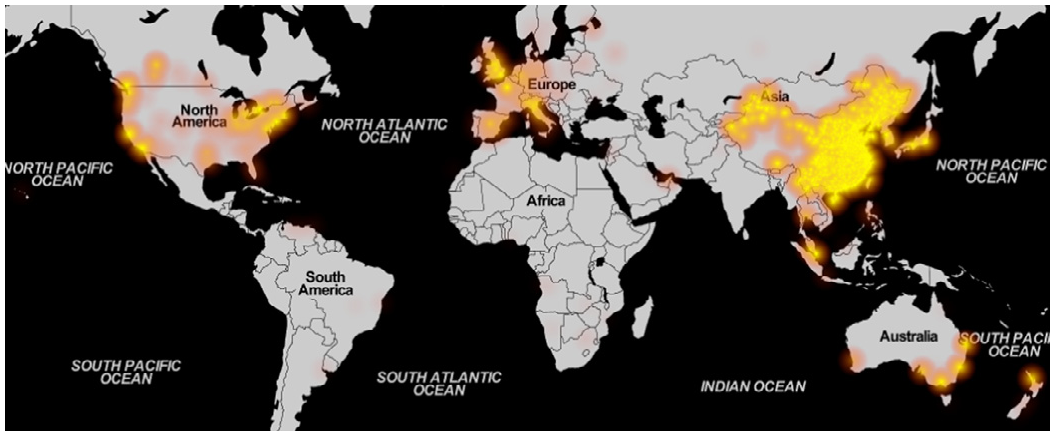 Fig 1: Global distribution of Momo communities shows high density in urban hubs, revealing the geographic dependency of LBSDs.
Methodology: The Tripartite Graph
To understand the hidden structure, the researchers modeled Momo as a Tripartite Graph consisting of three types of nodes: Users, Communities, and Locations.
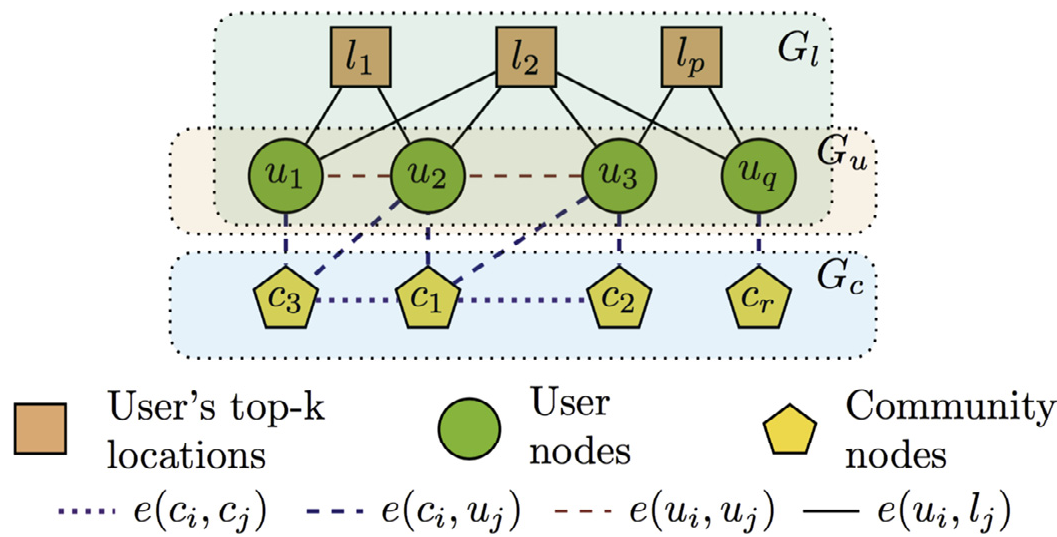 Fig 2: The model links users to the communities they join and the physical locations they visit, creating a multi-dimensional map of social-spatial interaction.
The core insight of the methodology is the use of Spatio-Temporal Co-location (STCoL). It doesn't just ask "did two users visit the same place?" but "did they visit the same place within the same hour window?" This granularity allows the researchers to distinguish between coincidental visits and intentional social gatherings.
Experiments & Results: Mobility as Destiny
The most provocative finding is the Community Membership Prediction. Using a supervised learning approach, the authors tested whether they could predict if two users belong to the same community based only on their past location updates.
| Feature | Precision | Recall | F-measure |
|---|---|---|---|
| Combined Model (Global) | 0.911 | 0.719 | 0.804 |
| Distance | 0.069 | 0.986 | 0.131 |
| Spatial-Cosine (SCos) | 0.982 | 0.042 | 0.080 |
While individual features like "Distance" have high recall (they catch everyone) but terrible precision (too many false positives), the Combined Machine Learning Model reaches a high-fidelity balance.
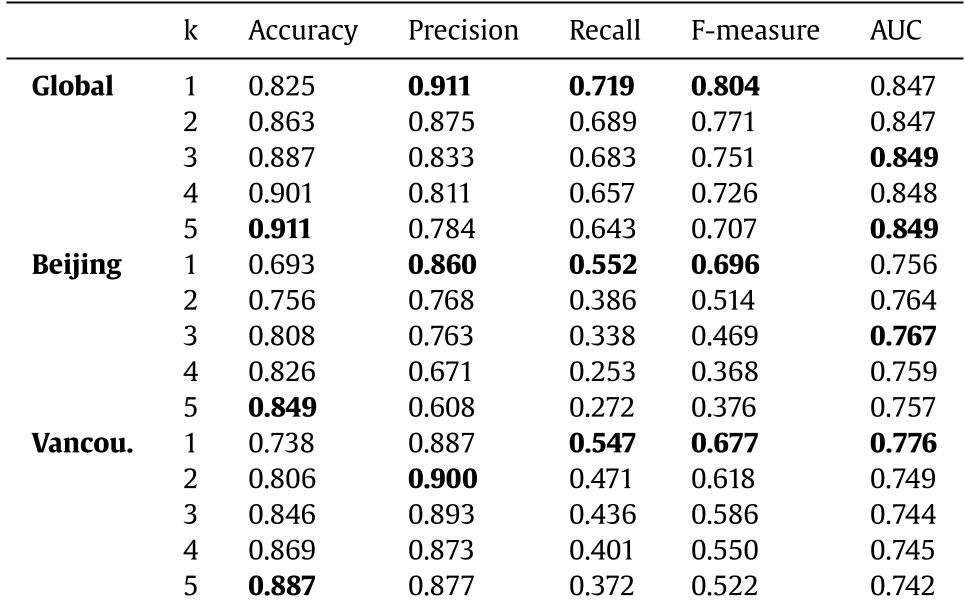 Fig 3: Performance metrics across global and city-specific datasets. The high precision in the global dataset (k=1) underscores the reliability of mobility as a social indicator.
Critical Analysis: Privacy and Caching
This research has a "double-edged sword" implication:
- Opportunistic Delivery: By identifying high-degree "hotspots," mobile ad-hoc networks can cache content 3x more effectively. Selecting just 5% of locations allows a provider to reach 85% of the user base.
- Privacy Risks: The study proves that "Location Privacy" is largely an illusion in the context of social discovery. Even if you don't share your friend list, your routine movements (where you work, where you hang out at 10 PM) effectively leak your social affiliations.
Conclusion
This "Deep Dive" into Momo's LBSD structure demonstrates that the bridge between physical movement and online social connectivity is much stronger than previously thought. As we move toward more location-aware services, the ability to reconstruct social graphs from sparse GPS data will be a cornerstone of both targeted marketing and modern cybersecurity.