
Brushing the Digital onto the Physical: The Rise of Location-Based Crowdsourcing
Location-based crowdsourcing: extending crowdsourcing to the real world
This paper introduces a "Location-based Crowdsourcing" platform that extends digital crowdsourcing into the physical world by utilizing mobile sensors and GPS. It presents a system architecture linking seekers and solvers through location-aware tasks, validated by two field studies showing that proximity and task type are critical for real-world worker engagement.
TL;DR
This seminal 2010 work explores the transition of crowdsourcing from the desktop to the street. By leveraging the sensors in mobile phones (cameras, GPS), the researchers built a platform that allows "seekers" to request real-world actions—like checking a store's stock or photographing a landmark—and "solvers" to fulfill them based on their physical proximity.
Background & Positioning
Published during the early rise of the smartphone era, this paper acts as a bridge between the "Wisdom of the Crowds" (Wikipedia, OpenStreetMap) and the "Internet of Things." It moves beyond simple data sharing to coordinated human action in physical space, positioning itself as an early precursor to modern "gig economy" or "spatial crowdsourcing" frameworks.
The Core Motivation: Why Physical Presence Matters
The authors identified a gap: while we could crowdsource a logo design globally, we couldn't easily crowdsource a photo of a specific mailbox in Munich. The motivation was to exploit the "real-world context" of users who are already on the move. The researchers hypothesized that if tasks were small enough and relevant to a user's current location, the "crowd" could become a distributed set of eyes and ears for any remote seeker.
Methodology: The Prototype Architecture
The system utilizes a classic Three-Tier architecture:
- Web Interface: Where "seekers" define tasks, set rewards, and pinpoint locations using Google Maps.
- Central Server: A PHP/MySQL backend that manages the "matching" logic based on radius and priority.
- Mobile Client: A JME application that allows "solvers" to browse (pull) tasks in their vicinity.
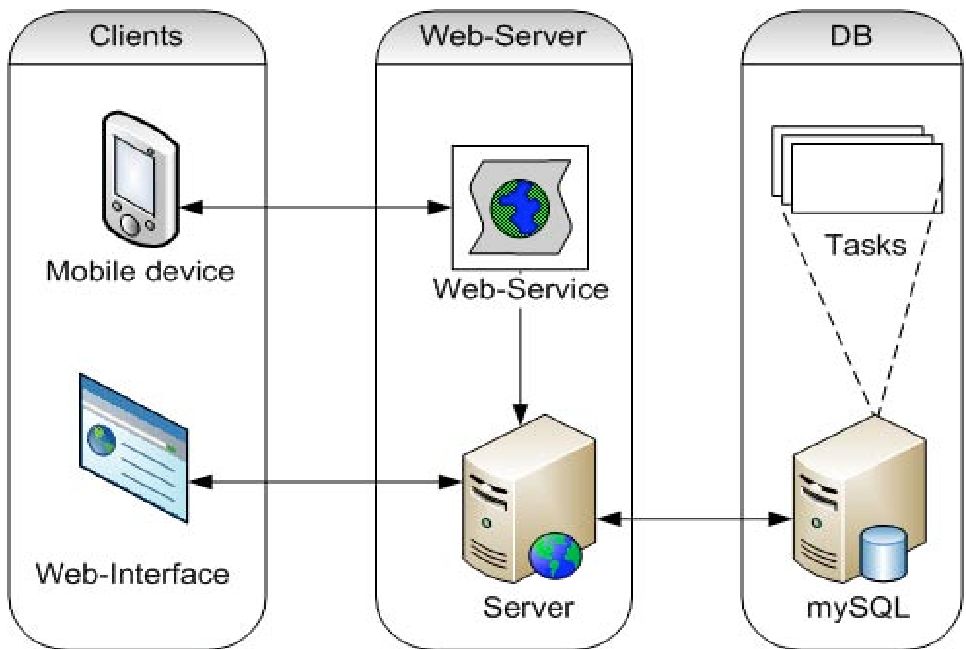 Figure 1: The architecture linking the web-based task creation with mobile-based execution.
Key Task Dimensions
The study categorized real-world work into three types:
- Photo Tasks: High engagement, low effort (e.g., "Take a photo of the coffee machine").
- Informative Tasks: Required text input (e.g., "Check the price of an iPod").
- Action Tasks: Required a physical deed (e.g., "Buy a bottle of coke").
Experimental Insights: What Makes Workers Tick?
Through two field studies, the researchers uncovered several counter-intuitive behaviors that challenge typical "mobile-first" assumptions:
- The Proximity Preference: Workers didn't want to travel for tasks. Approximately 77% of participants preferred tasks within a small radius of their home, treating crowdsourcing as a "neighborhood" activity rather than an "on-the-go" one.
- The Death of "Push" Notifications: Contrary to many modern app designs, users preferred to "pull" tasks when they felt they had a spare moment (e.g., during midday breaks or after work) rather than being interrupted by notifications.
- The Privacy/Utility Paradox: Users largely rejected GPS-based task searching in favor of manual address entry. This was due to technical failures (indoor signal loss) and a desire to maintain control over their location data.
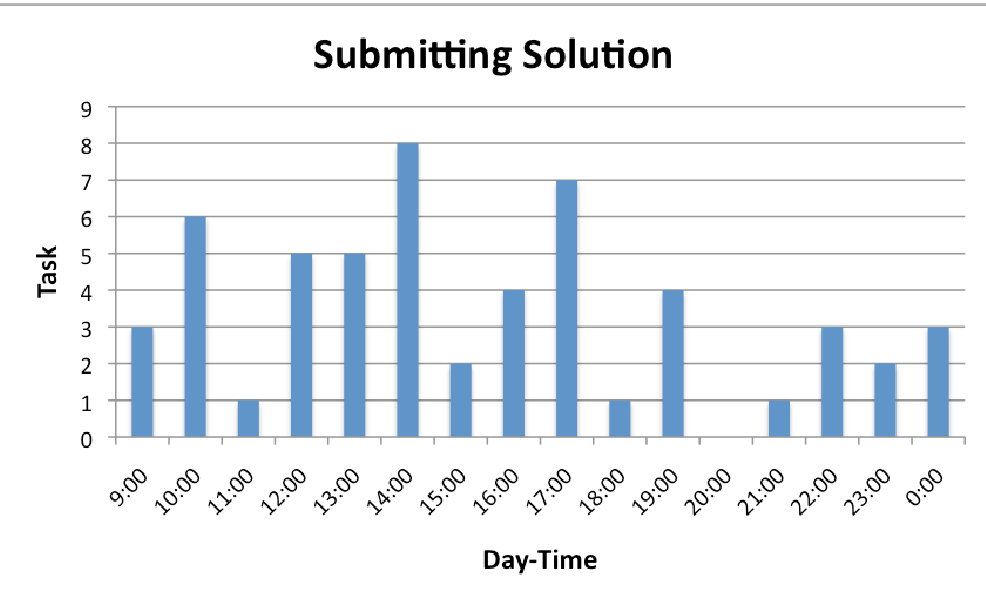 Figure 2: Analysis showing that the majority of solution submissions occur post-working hours, peaking after 5 PM.
Critical Analysis & Future Outlook
Legacy and Impact
This work pre-dates the ubiquity of Uber and DoorDash, yet it correctly identified that financial incentives drive participation (77% of users cited money as the primary driver). It also correctly predicted that a 10-minute cap on task effort is the "sweet spot" for maintaining a healthy worker pool.
Limitations
- Scale: With only 18 participants, the study is qualitative. The "crowd" was not yet large enough to test density-dependent effects.
- Connectivity: In 2010, data costs and speeds were significant barriers, which influenced the preference for text/photo over video/audio.
Conclusion
"Location-based Crowdsourcing" proved that the real world is a viable "marketplace" for micro-tasks. The key takeaway for developers today is that context is king: if you want people to interact with the physical world, work with their existing routines (home/commute) rather than trying to disrupt them.