
Beyond the Grid: Solving the "New City" Problem in Geo-Social Recommendations
3020_Location-based and preference-aware recommendation using sparse geo-social networking data.
The paper introduces a location-based and preference-aware recommender system that utilizes sparse geo-social data from networks like Foursquare. It combines a Weighted Category Hierarchy (WCH) for modeling user interests with an iterative HITS-based model to weight social opinions from local experts, achieving superior performance in "new city" recommendation scenarios.
TL;DR
Recommending a restaurant in a city you've never visited is the ultimate "cold-start" challenge for AI. This paper presents a system that learns your "DNA of interests" (e.g., a love for Italian food over museums) using a Weighted Category Hierarchy (WCH). By matching your profile against local experts—not just random users—it provides high-quality, real-time recommendations even when you are a thousand miles from home.
The Sparsity Trap
Most recommendation engines rely on Collaborative Filtering (CF): "Users who liked Venue A also liked Venue B." In the physical world, this breaks down. Most users visit fewer than 0.1% of a city's venues. When a user from New York lands in Los Angeles, their "user-location matrix" in LA is a sea of zeros. Existing systems struggle because they treat locations as unique IDs rather than functional entities.
The authors observed that while you haven't visited specific spots in LA, your history in NYC reveals a hierarchy of preferences. If you frequently visit "Art Museums" and "Sushi Bars" in Manhattan, you are likely to seek them out in Santa Monica.
Methodology: The Weighted Category Hierarchy (WCH)
Instead of tracking where you go, the system tracks what kind of places you go to, organized by granularity.
1. Offline Expertise Mining
Not all opinions are equal. The system uses an iterative HITS-based model to identify "Local Experts."
- Authority (Venue): A venue is high-quality if visited by many knowledgeable users.
- Hub (User): A user is an expert if they visit many high-authority venues. By partitioning this by city and category, the system knows who the "Sushi Experts" are in LA versus the "Cafe Experts" in NYC.
2. The WCH Preference Model
The system constructs a WCH for every user. It applies TF-IDF logic to categories: if you visit a "Museum" (a rare category) as often as a "Fast Food" joint (a common category), the system assigns a higher weight to your interest in Museums.
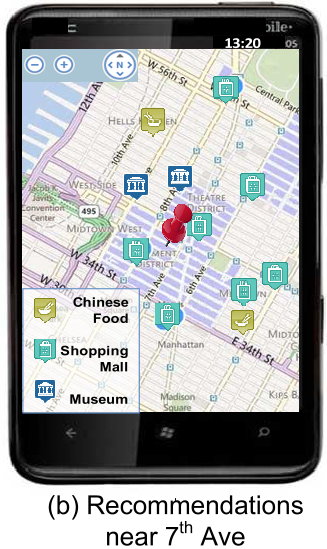 Figure: The dual-phase system architecture separating offline social knowledge from online personalized matching.
Online Recommendation: Preference-Aware Selection
When a user opens the app, the system doesn't just search for nearby venues. It uses a Preference-Aware Candidate Selection Algorithm.
- It identifies the user's top nodes in the WCH.
- It retrieves local experts who dominate those specific categories.
- It calculates a similarity score based on Structural Similarity and Entropy (how diverse the user's tastes are).
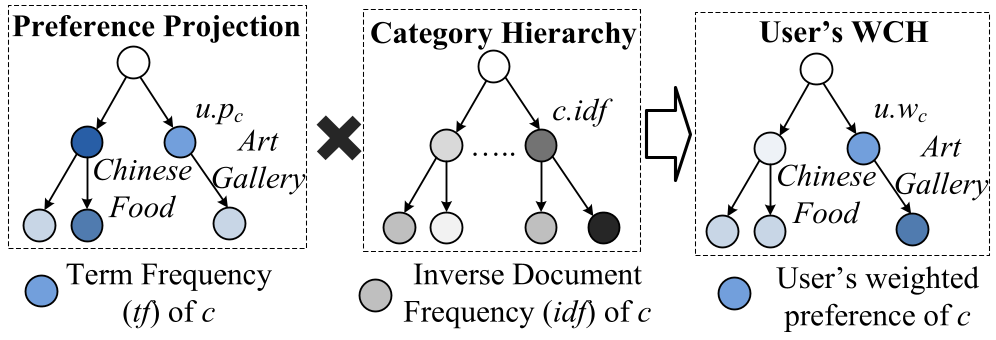 Figure: Projecting raw location history into a Weighted Category Hierarchy to handle data sparseness.
Experimental Battleground: NYC vs. LA
The system was tested on massive Foursquare datasets. A fascinating insight emerged: Recommendations are actually more accurate when a user travels further away.
- In their hometown (NYC/NJ), users are "erratic," visiting random spots like grocery stores or offices.
- In a new city (LA), users follow their core preferences more strictly—visiting famous landmarks and specific types of cuisine—making their behavior more predictable for the WCH model.
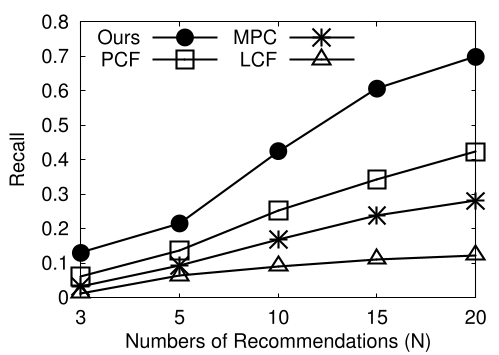 Figure: Precision comparison across different methods. The WCH method (Ours) consistently outperforms category-agnostic CF.
Critical Insight & Future Outlook
The genius of this work lies in the Candidate Selection. By filtering the pool of potential "similar users" to only include local experts in relevant categories, the system slashes computation time. It processes complex geo-social queries in under 60ms, making it viable for mobile production environments.
Limitations: The current model is static. It doesn't yet account for "Friday night" vs. "Monday morning" behavior or how rain might shift a user's preference from a park to a cinema. The authors suggest that adding Temporal and Weather contexts is the next frontier for hyper-personalized LBSNs.
Takeaway
This research proves that in sparse environments, Semantics > Raw Data. By understanding the category of a user's behavior, we can build recommendation engines that travel as well as the users themselves.