
Bridging TV and Social Media: A Robust Over-the-Air Audio Watermarking Approach
Location Based Robust Audio Watermarking Algorithm for Social TV System
The paper introduces a location-based robust audio watermarking algorithm designed for Social TV systems to bridge the gap between traditional TV broadcasting and social media. By embedding interactive URLs into the real-time audio stream via a Double Discrete Cosine Transform (DCT) domain technique, the method achieves seamless mobile terminal interaction with an average accuracy of 97.82% even under air-channel transmission.
TL;DR
This paper presents a robust audio watermarking solution for Social TV that allows mobile devices to automatically "catch" interactive URLs from TV audio. By utilizing Double DCT transformation and Barker code synchronization, the method overcomes the harsh distortions of air-channel transmission (noise, distance, and A/D-D/A conversion), achieving nearly 98% accuracy and enabling seamless cross-media interaction.
The "Air-Channel" Challenge: Why is it Hard?
In a typical Social TV scenario, the audio travels from the TV speakers through the air to a smartphone microphone. This "air-channel" is a hostile environment for digital data. Unlike digital files transferred over the internet:
- Environmental Noise: Ambient sounds interfere with the signal.
- Physical Distance & Volume: Signal-to-noise ratios (SNR) fluctuate wildly as users move.
- Hardware Distortion: The process of converting digital audio to analog (speaker) and back to digital (microphone) destroys subtle data patterns.
- Geometric Attacks: Resampling and format conversions (like MP3 compression) can shift or warp the watermark.
Methodology: The Power of Double DCT and Barker Codes
The authors' core "Insight" is that while the time-domain signal changes drastically, certain relations in the frequency domain remain stable.
1. Watermark Embedding via Double DCT
Instead of a single transformation, the algorithm applies DCT twice. This "Double DCT" domain allows the system to find specific frequency bands where energy modifications are less audible but highly resilient.
- Watermark '0': Modifies coefficients in the first half of the domain.
- Watermark '1': Modifies coefficients in the second half.

2. Synchronization and The Buffer Zone
To ensure the mobile device knows where the data starts, the authors use Barker codes—sequences known for their sharp autocorrelation properties.
- Intermediate Frequency Focus: To avoid low-frequency background noise, the sync signal is tucked into the mid-frequency range.
- Buffer Technology: To prevent "Inter-symbol interference," the team introduced buffer zones between embedded bits, ensuring that recording device sensitivity doesn't lead to "ghost" signals from adjacent bits.
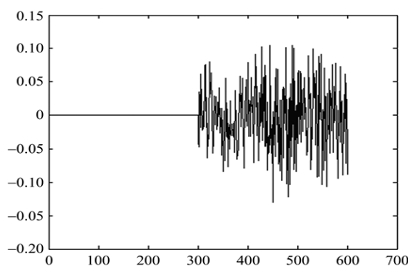
Experimental Performance: Can it survive the real world?
The researchers tested the algorithm against varying distances (up to 1.8 meters) and different orientations (up to 90-degree offsets).
Key Metrics:
- Imperceptibility: Average SNR > 20dB (meeting International Union standards).
- Resilience: Survived Normalize, Re-quantization, and Low-pass filtering (11.025kHz) with nearly 0% error.
- Resampling Attack: Maintained low error rates even when the audio was resampled by 30%.
- Capacity: ~22.0 bps, sufficient for transmitting compressed URLs or session IDs.
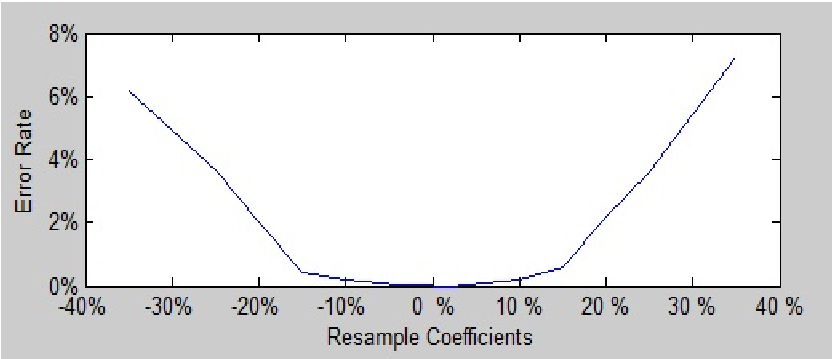
Compared to previous benchmarks (Algorithms [18] and [19] in the paper), this Double DCT approach consistently showed lower bit error rates (BER), particularly in complex "Mix" (symphony) audio samples.
Critical Insight & Conclusion
Most watermarking research stays in the digital domain. This work is significant because it tackles the physicality of sound. By combining BCH error correction with frequency-domain energy manipulation, the authors moved the technology from a lab curiosity to a viable product feature for Social TV.
Limitations: While robust, the 22 bps capacity is quite low for anything beyond URLs. Future work might need to explore "spread spectrum" or "deep learning-based" audio steganography to increase bandwidth without sacrificing the impressive 97.8% robustness achieved here.