Simulating the Pulse of the City: A "Patterns of Life" Approach to Synthetic LBSN Data
Location-Based Social Network Data Generation Based on Patterns of Life
The paper introduces a large-scale Location-Based Social Network (LBSN) simulation framework designed to generate high-fidelity, synthetic spatio-temporal and social data. By leveraging Agent-Based Modeling (ABM) and the "Patterns of Life" (PoL) theory, the framework produces massive benchmark datasets that mimic real-world human mobility and social interaction patterns.
TL;DR
Researchers from George Mason University and Tulane University have developed a sophisticated simulation framework that generates massive, high-fidelity datasets for Location-Based Social Networks (LBSNs). By modeling agents with "human needs" (hunger, financial stability, socialization), the system creates synthetic but socially plausible trajectories and social links. This provides the research community with a "ground-truth" playground that bypasses the sparsity and privacy issues plaguing real-world datasets.
The "Skinny Data" Problem
For over a decade, LBSN research has relied on scraps. Popular datasets like Gowalla or Yelp are notoriously sparse—most users check in fewer than ten times, leaving massive gaps in their actual mobility history. This "0.1% density" makes it nearly impossible to distinguish between a user who never visits a place and a user who simply didn't record a check-in.
Furthermore, the lack of Authoritative Ground-Truth means that when a link prediction algorithm suggests two people are friends, we have no way of verifying if they actually are, or if the data is just noisy.
Methodology: Maslow in the Machine
The core innovation lies in the Patterns of Life (PoL) logic. Instead of moving agents randomly or via simple statistical distributions, the authors endowed agents with psychological drivers based on Maslow’s Hierarchy of Needs:
- Physiological: Agents go to apartments to sleep and restaurants when hungry.
- Safety/Financial: Agents seek jobs, earn income, and pay rent based on education levels and market availability.
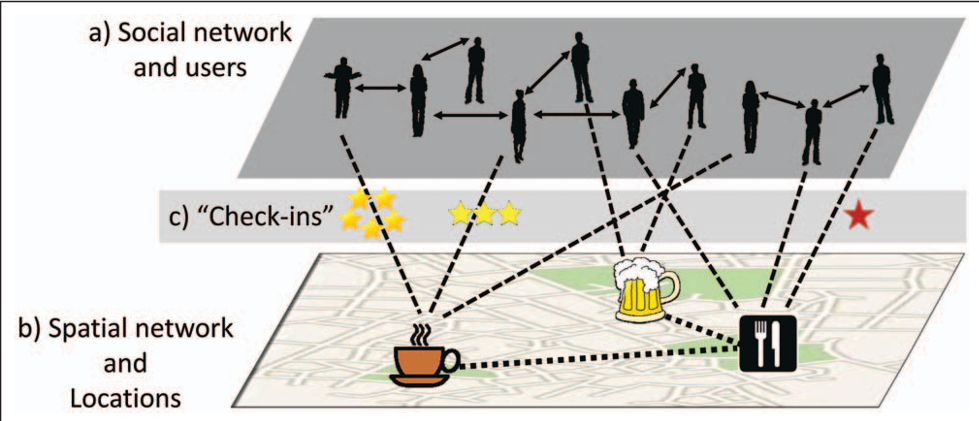
- Belongingness: Once survival is secured, agents visit recreational "hubs" to socialize.
Social Network Evolution
Socializing isn't hard-coded; it's emergent. When two agents co-locate at a bar or park, there is a probability of Focal Closure (becoming friends with a stranger) or Cyclic Closure (meeting a friend-of-a-friend). Crucially, the bond strength decays over time if social interaction isn't maintained, mimicking the fragility of real-world relationships.
Experiments: From GMU to New Orleans
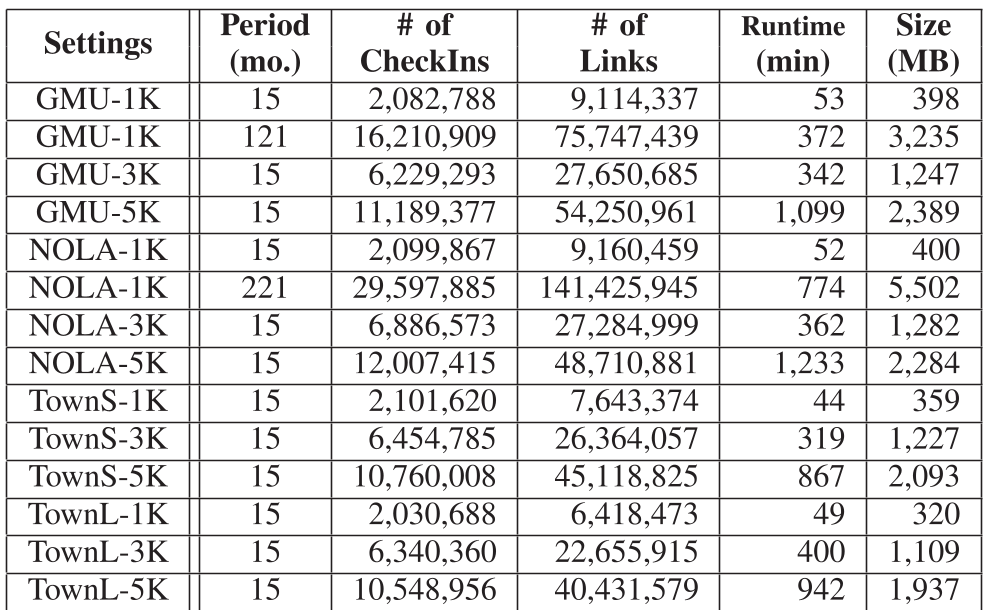
The team tested the framework on both synthetic grid layouts and real-world urban maps from OpenStreetMap (Fairfax, VA and the French Quarter of New Orleans).
- Scale: The simulation scales linearly in check-ins but super-linearly in social links (due to the complexity of co-location encounters).
- Volume: A single run (NOLA-1K over 18 years) generated a 5.5GB dataset with nearly 30 million check-ins—volumes that far exceed typical public datasets.
Realistic Social Dynamics
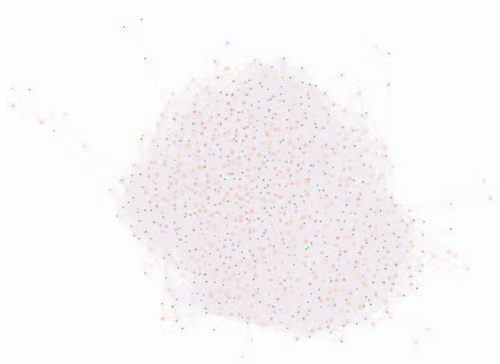
The agents didn't just move; they formed societies. The simulation results showed a "settling time" of about 3 months where social networks stabilized. The resulting degree distribution matched the Dunbar Number, where most agents maintained roughly 15-35 friends, with only a few social "butterflies" exceeding that limit.
Deep Insight: The Value of Omniscience
The true value of this framework is the Omniscient Entity status it grants researchers. Because every social link and movement is recorded with 100% certainty:
- Link Prediction can be tested by intentionally "hiding" known links and seeing if models find them.
- Recommendation Systems can be evaluated for bias by comparing what an agent liked (ground truth) versus what they checked into (observed behavior).
- Privacy Research can experiment with obfuscation and k-anonymity techniques without risk to real humans.
Conclusion & Future Work
The authors have made the simulation code and binaries open-source (via GitHub), encouraging the community to generate "perfect" benchmarks for their specific urban environments. While currently single-threaded, future iterations aimed at distributed computing will likely allow for the simulation of entire metropolitan areas with millions of agents, potentially revolutionizing how we model urban social planning.