
Nitwho: Bridging the Digital-Physical Divide in University Social Networks
Location-based social network services employing student cards for university
This paper introduces "Nitwho," a location-based social networking service (LBSNS) designed for university campuses. It leverages existing student IC card infrastructure, specifically class attendance readers and computer login logs, to track student locations and facilitate real-world social interactions.
TL;DR
Nitwho is an innovative location-based SNS (LBSNS) that turns a student's ID card into a social "beacon." By leveraging class attendance readers and computer lab logins, the system allows students to see where their friends are on campus in real-time, encouraging face-to-face interactions rather than just digital chatting.
Background: The Campus Loneliness Paradox
Despite being physically surrounded by peers, many university students struggle to transition from digital connections to real-world friendships. In 2009, long before the ubiquity of high-precision indoor GPS, the researchers at the Nagoya Institute of Technology identified a major gap: social networks were "location-blind." They hypothesized that knowing a friend is in the "Auditorium" or "Library" right now could be the catalyst for a real-world meeting.
The Problem: Tracking Without the Hardware Headache
Most indoor positioning systems (IPS) are fraught with issues:
- GPS is unreliable inside thick concrete university buildings.
- Specialized Sensors (Ultrasonic/UWB) are too expensive to distribute to thousands of students.
- App-based tracking in 2009 was battery-intensive and lacked the "always-on" reliability needed.
Methodology: Repurposing Institutional Data
The genius of Nitwho lies in its passive data collection. Instead of asking students to "check in," it uses actions they are already performing:
- The Attendance Method: Students swipe their non-contact IC cards at readers when entering/exiting classrooms. This links a
Student IDto aRoom IDand aTimestamp. - The IP Address Method: When a student logs into a campus computer, the system maps the computer's IP to a specific room in the university's database.
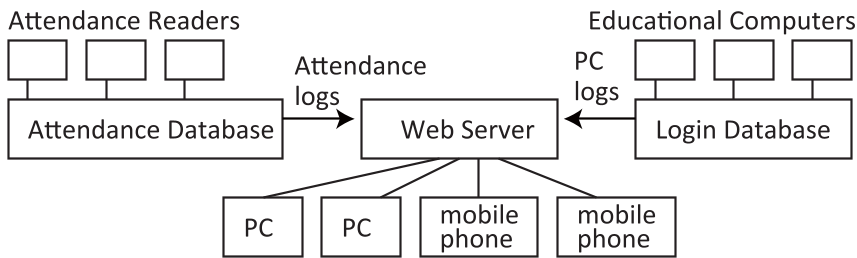 Figure: The Nitwho system architecture, connecting institutional servers to mobile and PC clients.
Experimental Results: Attendance is the "Killer App" for Data
The researchers found a massive disparity in data density. Because teachers grade based on attendance, students are highly motivated to "clock-on."
- Frequency: The attendance system provided 10.8 times more location updates than computer logins.
- Coverage: On a typical day, while only ~30% of students logged into a computer, nearly 90% registered their location via attendance readers.
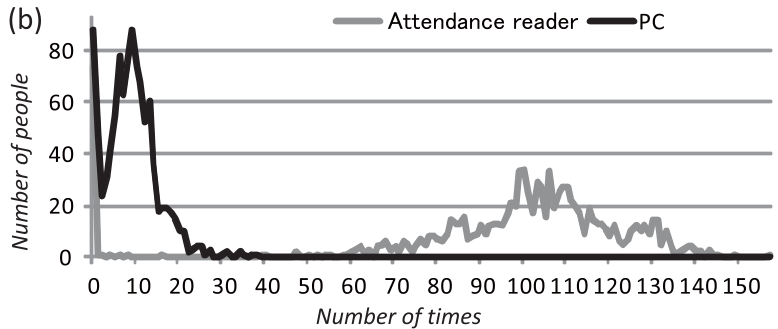 Figure: Comparison between Clock-on (Attendance) and Computer Login data density.
Critical Insight: Privacy vs. Proximity
One might expect students to be wary of "Big Brother" tracking. However, the study found a surprising comfort level. On a Likert scale (1 to 5, where 5 is highly apprehensive), students scored a 2.3.
Why?
- Reciprocity: You only see the locations of people who have also agreed to share theirs with you (mutual friends).
- Utility: The benefit of finding a friend for lunch outweighed the perceived privacy cost. The system even helped friends identify "truant" students and check in on their well-being voluntarily.
Conclusion and Future Outlook
Nitwho proved that you don't need fancy new sensors to build a "Smart Campus." By simply tapping into the data exhaust of existing administrative systems, the researchers created a social layer that favored physical presence over digital isolation.
While modern smartphones now have better location capabilities, the "infrastructure-reuse" philosophy of Nitwho remains a powerful lesson for enterprise and campus IoT developers today: the most reliable data is the data users provide through their necessary daily routines.