
Beyond Ratings: Building the "Heart-Map" for Emotion-Based Social Discovery
Design Guideline on Location Based User Emotion Sharing Map Service
This paper introduces the "Heart-map" system, a novel location-based service that detects user emotions via wearable HRV sensors and visualizes them on a cartographic mobile interface. By integrating physiological data with social networking, the system aims to create an "Emotion Map" for sharing authentic local experiences.
TL;DR
Researchers have developed the Heart-map, a system that bypasses subjective text reviews by using wearable sensors to detect real-time physiological emotions. By mapping heart rate variability (HRV) to geographic locations, the project creates a "living map" of human feelings, allowing users to find "happy places" or "exciting landmarks" based on the collective biological response of previous visitors.
The "Liar's Gap" in Online Reviews
We’ve all visited a five-star restaurant only to find the atmosphere stressful or underwhelming. Traditional reviews suffer from subjective bias—people often write what they think they should feel, or owners post fake testimonials. The core motivation of this research is to bridge this gap using biometric honesty. By capturing internal biological signals, the researchers aim to visualize the "emotional soul" of a city.
Methodology: From Heartbeats to Heatmaps
The researchers didn't just build an app; they established a design guideline through a rigorous user-centric process.
1. The Wearable Architecture
The system uses an HRV (Heart Rate Variability) sensor to track the autonomic nervous system. This data is mapped using the Valence-Arousal model, a standard in psychology that categorizes emotions into quadrants (e.g., High Arousal/High Valence = Joy).
2. Speed-Dating Storyboards
To understand how humans would actually use such a sensitive system, the team employed a "Speed-Dating" study with 10 participants. They tested three scenarios:
- The Foodie: Automating reviews at a restaurant based on measured excitement.
- The Family: Tagging photos with emotional "memos" to preserve memories.
- The Couple: Searching for travel destinations using "ambiance" keywords derived from collective physiological data.
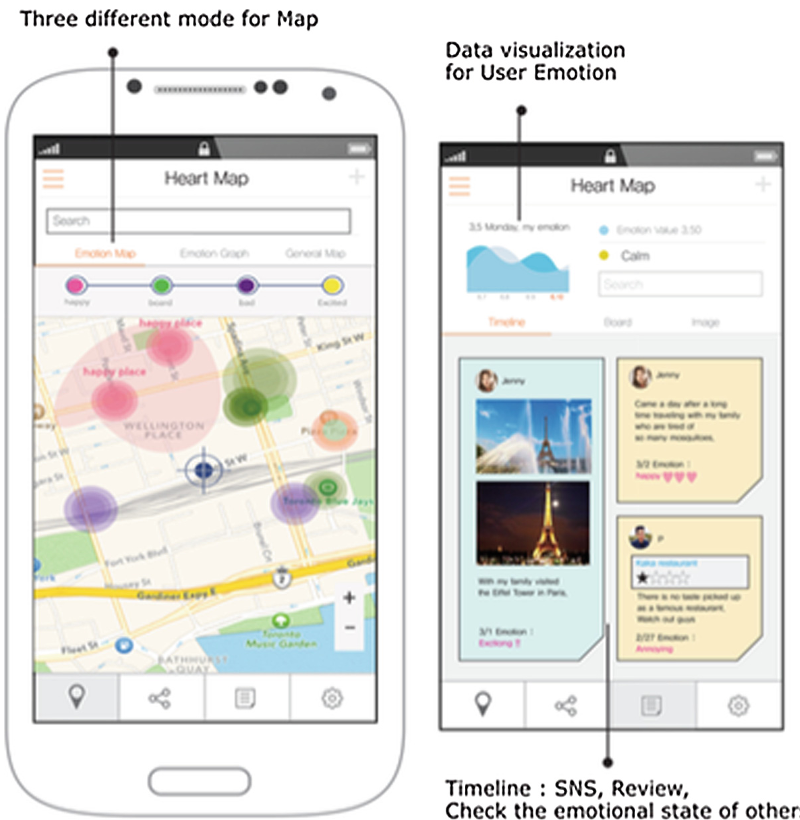 Figure 1: The Heart-Map Prototype showing color-coded emotional zones and the mobile interface.
Key Insights: Visualizing the "Vibe"
The study yielded several critical design principles for the future of Biometric SNS:
- Color Over Words: Users found it much more intuitive to see a "warm red" zone for excitement or a "cool blue" zone for relaxation than reading emotional labels. Color provides an immediate, pre-attentive understanding of the map's "mood."
- Reliability Concerns: While most participants were excited, 20% questioned if a simple wearable could truly capture the complexity of human emotion. This highlights the need for Multimodal Fusion (combining HRV with text or voice) in future iterations.
- Social Impact: Interestingly, users were concerned that "Emotion Mapping" could influence the housing market or local economies—imagine a neighborhood being permanently labeled as "Sad" or "Fearful" on a public map.
Academic & Technical Analysis
From a technical perspective, the paper’s strength lies in its Human-Computer Interaction (HCI) approach to sensing. While many papers focus solely on the accuracy of the ECG/HRV algorithm, this work addresses the UX of Biometrics.
The transition from the "Pulse sensor Amped Visualizer" to a three-mode mobile interface (Emotion Map, Emotion Graph, and General Map) provides a template for how we might eventually move away from the "Star Rating" economy into a "Biometric Feedback" economy.
Conclusion and Future Outlook
The Heart-map represents a shift toward "Affective Computing" in our daily lives. The authors acknowledge that the next step is determining the balance between automatic sensing and manual control—should the app post your stress levels automatically, or should you "check-in" your heart rate?
As wearable technology becomes ubiquitous, the "Emotion Map" could become a standard layer in our navigation apps, helping us not just find the fastest route, but the most joyful one.
Keywords: Emotion map, Location sharing, Socialization, HRV, Affective Computing.