
Sentiment-Aware Travel: Fusing Multimodal Social Media for Venue Emotion Recognition
Location emotion recognition for travel recommendation based on social network
The paper introduces a novel multimedia location emotion recognition framework that predicts the emotional state of venues (e.g., hotels, landmarks) by fusing multimodal data (text, image, video) from social networks like Twitter. It achieves a prediction accuracy of 54%, significantly outperforming single-modal baselines.
TL;DR
This research presents a framework that "feels" the pulse of a city. By analyzing tweets, photos, and videos from social networks, the model identifies the emotional signature of venues (e.g., a "happy" park or a "calm" cafe). It moves beyond simple keyword matching to provide travel recommendations based on real-time human sentiment, achieving a significant performance boost over traditional single-modality methods.
Context & Motivation: Why Venue Emotions Matter
When we choose a destination, we rarely look for just "food" or "history"—we look for an experience. While existing recommendation engines excel at categorizing venues by topic or location, they are often blind to the actual atmosphere.
The authors identify two massive hurdles:
- Heterogeneity: A single venue has thousands of unrelated data points (a grainy video, a short text complaint, a professional photo).
- Noise: Much of social media is "trash" data—non-relevant selfies or spam that dilutes the actual sentiment of a location.
Methodology: The Multimodal Fusion Pipeline
The authors propose a hierarchical fusion strategy. Instead of training one giant model, they leverage the strengths of specialized pre-trained detectors.
1. Data Cleaning & Modal Processing
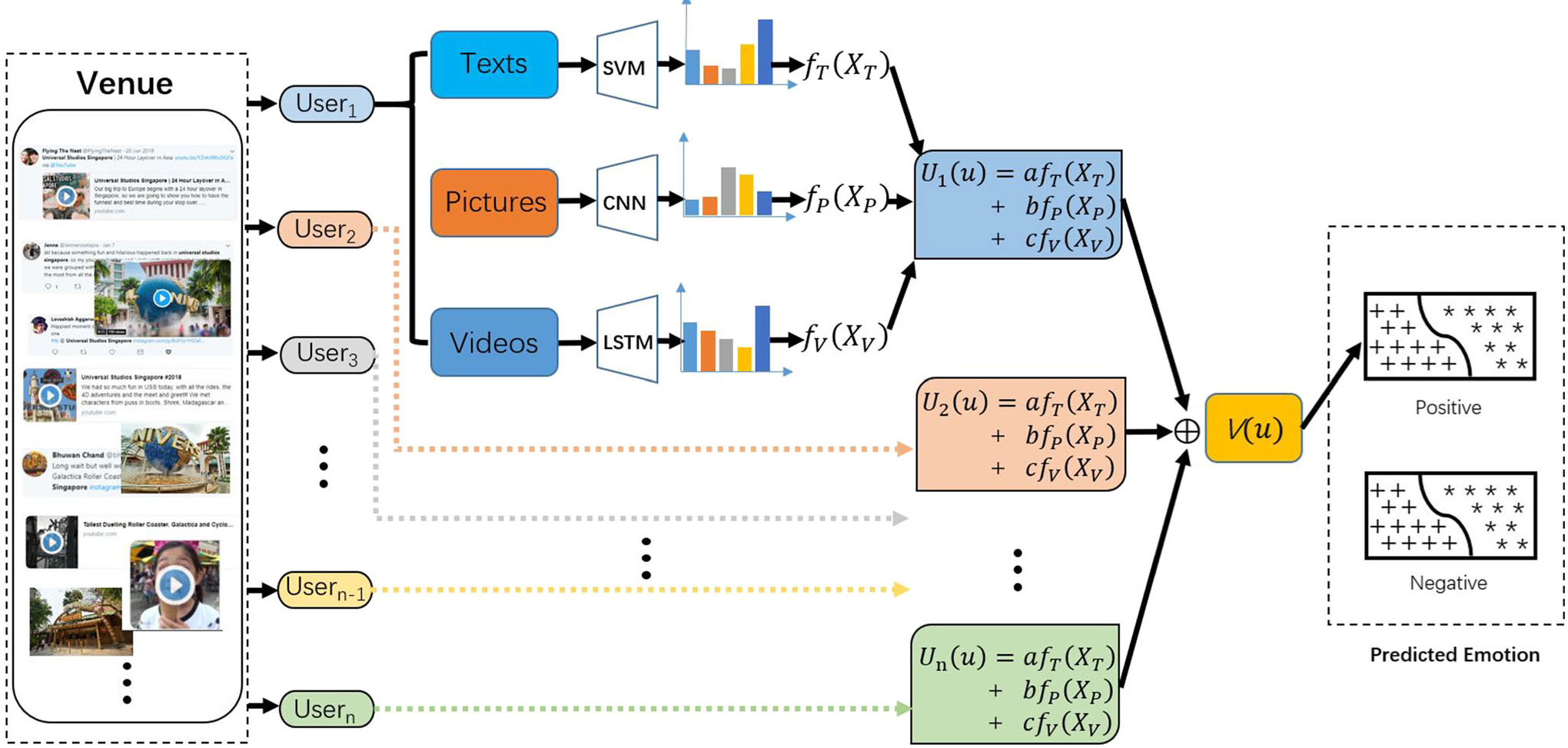
- Text (Twitter): Filtered using word-count thresholds and stop-word removal. A SVM classifier trained on Word2Vec features handles the sentiment.
- Images: An object detector is used as a "relevance filter"—if no significant objects are found, the image is discarded.
- Video: The pipeline uses audio, visual frames, and textual metadata, employing a context-dependent sentiment analysis approach.
2. Weighted Fusion (The "How")
The core innovation lies in the two-step fusion process:
- Inter-modal Fusion: Combining signals from different formats. The authors insightfully assign the highest weight to Video (0.5), recognizing its higher information density compared to Text (0.3) or Images (0.2).
- User-level Aggregation: Not all users are equal. The system calculates a weight () for each user based on their activity levels at a specific venue:
Experimental Validation
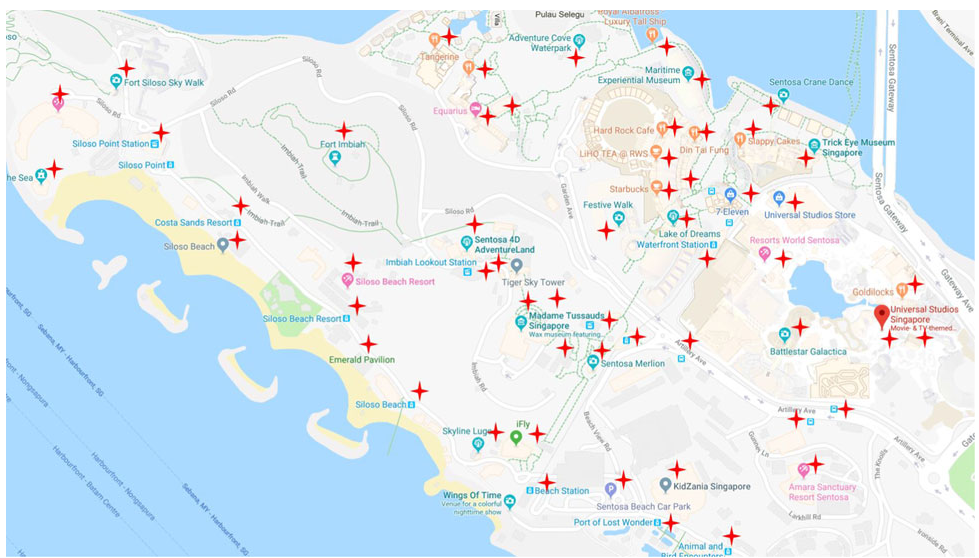
The model was tested on a dataset of 50 popular venues in Singapore (including Universal Studios).
The Power of Multimodality
The experimental results confirm that "more is better" when it comes to data types. While images alone are quite poor at predicting venue emotion (21% accuracy), the combination of all three modalities pushes the accuracy to 54%.
| Modality | Accuracy (%) |
|---|---|
| Text | 37 ± 0.2 |
| Picture | 21 ± 0.35 |
| Video | 43 ± 0.25 |
| Multimodal (Final) | 54 ± 0.30 |
Temporal Insights
The system can track how the "mood" of a place changes hourly. For example, Universal Studios Singapore showed a peak in positive emotion during the morning, a dip during an afternoon rainstorm, and a massive surge during the evening fireworks. This allows for "precision recommendation"—suggesting not just where to go, but when to go for the best experience.
Deep Insights & Limitations
Critical Analysis
The "Video-First" insight is particularly relevant in the era of TikTok and Reels. By giving video 50% of the weight, the model acknowledges that modern users express complex sentiments (tone of voice, facial expressions, background noise) more vividly through moving pictures than static text.
Limitations
- Accuracy Bottleneck: While 54% is better than the baseline, it leaves significant room for improvement, likely due to the inherent subjectivity of "emotion."
- Social Bias: The data relies entirely on users who choose to post. The "silent majority" of visitors are not represented, which might skew the venue's emotional profile toward more "instagrammable" moments.
Conclusion
This paper provides a robust blueprint for the next generation of travel apps. By moving from "What is there?" to "How does it feel?", travel recommendations become far more human-centric. Future work could benefit from integrating Graph Neural Networks (GNNs) to model the spatial relationship between venues, potentially catching emotional "contagion" between nearby tourist spots.