
Russian Social Sensing: Unmatched Precision in Extracting Locations from Noisy Social Data
An Approach to Location Extraction from Russian Online Social Networks: Road Accidents Use Case
This paper introduces a robust location extraction framework for Russian social media, specifically targeting road accident reports on Vkontakte. By employing a Bidirectional Gated Recurrent Unit (Bi-GRU) architecture with Word2Vec embeddings, the method effectively identifies "compound locations" often missed by standard NER tools.
TL;DR
Researchers at ITMO University have developed a specialized location extraction system for Russian social networks, specifically Vkontakte. By moving beyond traditional rule-based NER and utilizing a Bidirectional GRU (Gated Recurrent Unit) network with Word2Vec embeddings, they achieved a staggering 93.7% F1-score, dwarfing the performance of industry-standard tools like Natasha and Pullenti. This system is designed to navigate the "linguistic chaos" of road accident reports to provide real-time, actionable emergency data.
The "Compound Location" Problem
Most NER systems look for a specific noun: a city, a street, or a building. However, in the heat of a road accident, social media users don't write like journalists. They describe locations using relative markers:
- "At the turnout from Steklyanniy..."
- "In the middle between Mayakovskogo and Ligovskiy..."
In the Russian language, this is compounded by flexible word order and morphological richness. A keyword that defines a location might appear several words after the actual name. Standard tools (Pullenti, Natasha) rely heavily on dictionaries and rigid rules, which causes them to crumble when faced with slang, typos, and the fragmented structure of "Social Sensing" data.
Methodology: The Bi-GRU Advantage
The authors argue that to understand a location in a messy sentence, the model must look both forward and backward.
1. Vector Space Representation
The pipeline begins by lemmatizing text and converting it into 300-dimensional vectors using Word2Vec (CBOW). This step is crucial because it allows the model to understand that "intersection," "crossing," and "corner" share a semantic latent space.
2. Neural Architecture
The core of the approach is a Bidirectional GRU.
- Why GRU? It offers similar performance to LSTM but with fewer parameters, making it faster to train and less prone to overfitting on small, manually annotated datasets.
- Why Bidirectional? In Russian, the grammatical clues for a location (like a preposition or a descriptor like "ave") often trail the specific name.
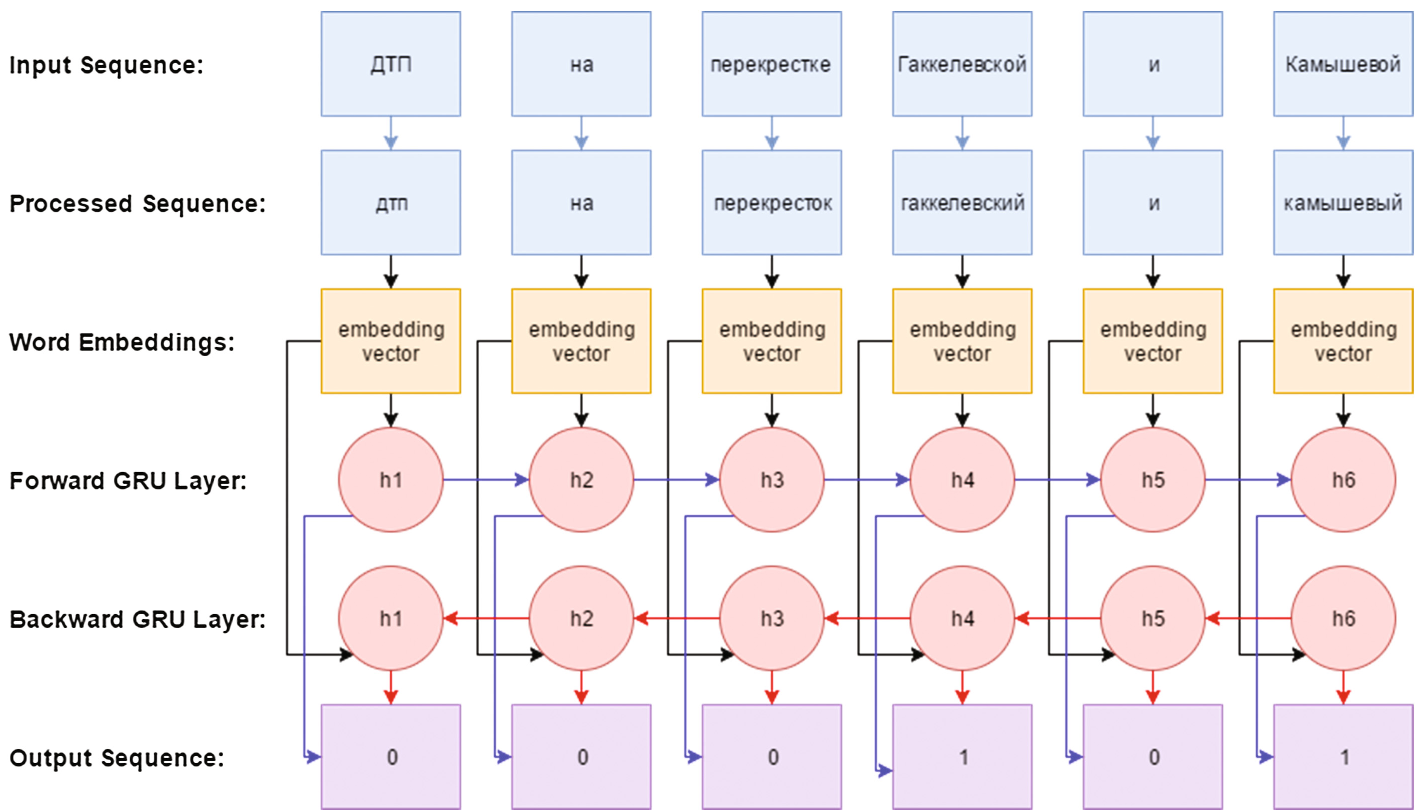 Fig 1: The overall workflow from data collection to geocoding.
Experiments and Results
The model was tested against a dataset of nearly 30,000 sentences from Vkontakte road accident groups.
| Method | Precision | Recall | F1-Score |
|---|---|---|---|
| Pullenti | 24.7% | 28.4% | 26.3% |
| Natasha | 35.4% | 33.8% | 34.5% |
| GRU-based (Proposed) | 92.1% | 96.3% | 93.7% |
The performance gap is massive. The researchers found that while rule-based systems (like Natasha) are great for clean news text, they are virtually blind to the informalities of social media. Even a "Pattern-based" approach specifically designed for this task only achieved a 63.3% F1-score, proving that recurrent neural networks are superior at generalizing linguistic distortions.
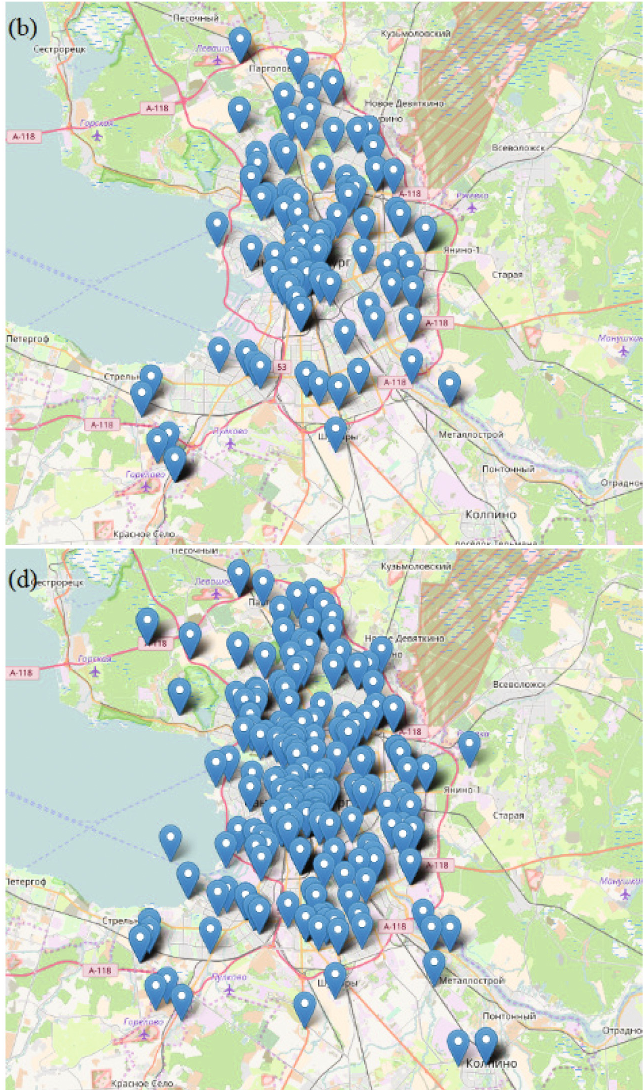 Fig 2: A visual comparison of geocoding accuracy. Map (d) represents the proposed GRU approach, showing a much denser and more accurate cluster of identified incident locations compared to (a) and (b).
Critical Insight: Beyond Binary Labeling
One of the paper's most interesting pivots is their "experiment in multiclass classification." Instead of just asking "Is this a location?", they trained the network to distinguish between:
- Target Locations (e.g., "Sennaya Square")
- Refinement Tokens (e.g., "Shopping Center")
- Directional/Spatial Tokens (e.g., "opposite," "near")
While this slightly dropped the F1-score to 81.6%, it provided much higher semantic value. Knowing that an accident is near a gas station is far more useful for emergency responders than simply identifying the word "gas station."
Future Outlook
The study proves that specialized, domain-trained RNNs are the gold standard for social sensing. However, the authors acknowledge that adding a CRF (Conditional Random Field) layer could further refine the sequence dependencies. As we move closer to 2026, the potential to integrate these models with real-time city management systems could shave minutes off emergency response times—saving lives through smarter social data mining.