
Decoding Urban Expertise: How to Tell Locals from Tourists via Flickr Metadata
Location familiarity based flickr photographer classification for POI mining
This paper introduces a multi-modal framework to classify Flickr photographers based on their location familiarity (Locals vs. Tourists). It proposes three distinct modeling approaches—Social Network Driven, Time Driven, and Location Driven—to enable the discovery of "obscure" Points of Interest (POIs) that are high in quality but low in general popularity.
TL;DR
This research tackles the challenge of identifying "local" photographers on Flickr to uncover hidden gem sightseeing spots. By combining social network analysis, temporal photo-taking patterns, and spatial mobility behaviors into a unified SVM-based framework, the authors achieved an 88% accuracy in classifying user familiarity. This allows recommendation engines to filter for "expert" opinions rather than just following the tourist crowds.
The "Obscure Spot" Problem: Beyond Popularity
Most travel recommendations suffer from a "popularity bias." If you search for things to do in Kyoto, you'll get the same top 10 list everyone else gets. But the truly high-quality, "obscure" spots—those that offer deep cultural experiences without the crowds—are hidden in the information asymmetry between locals and tourists.
The core challenge: How do we identify who the locals are? Most Flickr users don't list their home city. We need to infer "Location Familiarity" from the digital crumbs they leave behind: who they follow, when they take photos, and where they choose to stand.
Methodology: The Three Pillars of Familiarity
The authors argue that familiarity isn't just one thing; it’s a combination of who you know, how often you visit, and how you move.
1. Social Network Driven Model (Who you know)
The intuition here is simple: if your friends are familiar with Kyoto, you likely are too. The authors adapted a Biased PageRank algorithm. Unlike standard PageRank, they injected "seed" users (known residents) to bias the distribution.
2. Time Driven Model (When you are there)
A local doesn't just visit once. This model looks at a 10-year window, calculating frequency and recency. A user who took photos in Beijing in 2010, 2012, and 2015 is weighted much more heavily as a "familiar" user than someone who uploaded 100 photos in a single week and never returned.
3. Location Driven Model (How you move)
This is the most technically sophisticated part. Tourists and locals move differently. Tourists cluster at landmarks; locals move through residential zones and "niche" hubs. The authors used a Probabilistic Generative Process (Algorithm 1) featuring a Gaussian Mixture Model (GMM) to identify latent regions and group behaviors.
 Caption: The Location Driven Model uses spatial distribution to infer whether a photographer belongs to the 'Local' or 'Tourist' latent group.
Experimental Results: Proving the Insight
The researchers tested their models on 14,112 images across Beijing, Kyoto, and San Francisco. They established ground truth by having human experts manually audit 300 target photographers.
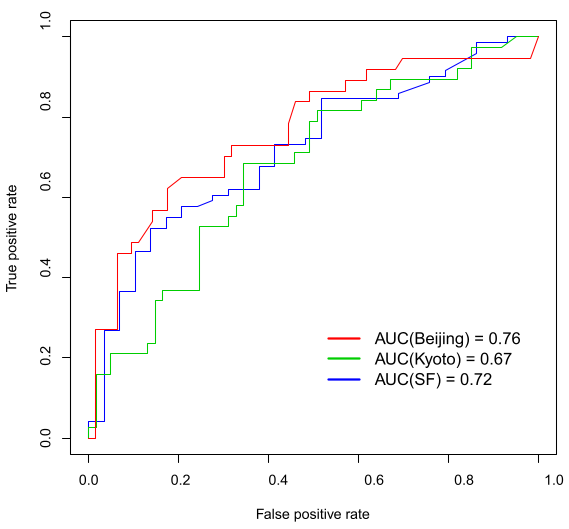
- Social Network Success: The model achieved an AUC of 0.81, significantly better than then-SOTA city-scale predictors. Interestingly, it performed best in San Francisco, suggesting that "open" social cultures create better data for this specific model than more traditional ones like Kyoto.
- The Power of Integration: While the Time-Driven model was highly accurate for active users, it failed for those with few uploads (data sparsity). By integrating all three models into an SVM with an RBF kernel, the system became robust against such sparsity, hitting 88% accuracy.
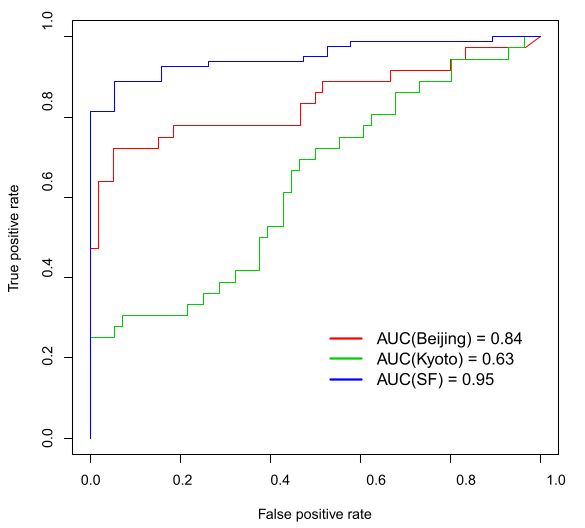 Caption: ROC curves for (a) Social Network, (b) Time, and (c) Location driven models. Note the high performance of the integrated approach.
Critical Insight & Takeaways
The most profound takeaway from this work is that Location Familiarity is a bridge to solving the "obscure spot" problem. By identifying the 20% of users who are actually "locals," we can treat their photo-taking locations as a "gold standard" for high-quality, low-crowd POIs.
Limitations:
- Manual Labeling: The integrated model requires a labeled training set, which is labor-intensive.
- Cultural Variation: As noted in the Kyoto vs. SF comparison, social-driven models are highly sensitive to regional social media usage habits.
Future Impact: This framework isn't just for tourism. Understanding location familiarity is vital for:
- Epidemic Tracking: Locals and tourists spread diseases differently based on their mobility.
- Urban Computing: Planning transit based on where residents actually go versus where visitors congregate.
- Personalized Ads: Delivering hyper-local content to those who actually live in a neighborhood.