
Smart Real Estate: A Multi-Layered Machine Learning Approach to Location Identification
Location identification for real estate investment using data analytics
This paper introduces a multi-layered machine learning framework for optimal real estate location identification, moving beyond simple price prediction. It utilizes a hybrid approach of Decision Trees, Principal Component Analysis (PCA), and K-means clustering to find investment locations in Smart Cities, achieving state-of-the-art accuracy on Florida's TerraFly geospatial dataset.
TL;DR
Predicting house prices is one thing; finding the perfect location for investment in a complex city is another. This paper presents a robust data analytics framework that uses Decision Trees and PCA-driven K-means clustering to help investors locate the best condominium complexes among millions of options. Tested on Miami Beach data, the model achieved over 90% accuracy, significantly outperforming traditional Neural Network approaches in categorizing locations.
Deep Dive into the Motivation
Real estate markets are classic examples of Complex Systems. An investor isn't just buying four walls; they are buying into a network of social, governmental, and environmental factors. Current research is obsessed with how much a house will cost (Price Prediction), but often ignores the spatial optimization problem: Where should I buy if I have specific preferences for garage space, tax amounts, and living area?
The authors identify a massive "search space" problem. In Miami Beach alone, there are millions of condominium units. For a new investor or a busy realtor, manually filtering through 200+ attributes per unit across thousands of landmarks is cognitively impossible.
Methodology: The Hierarchical Approach
The core of the paper lies in its two-layered classification architecture. But before classification begins, the authors perform Statistical Feature Selection.
- Feature Filtering: Using Pearson’s Correlation Coefficient and data availability metrics, they reduced 200+ attributes to the 9 most significant "High Impact" variables (e.g., Number of beds, Tax amount, FLP total value).
- Layer-1 (The Landmark Detector): A Decision Tree (ID3 algorithm) maps a binary vector of user interests to a specific landmark (e.g., Alton Rd or Collins Ave).
- Layer-2 (The Condo Identifier): Once a landmark is chosen, PCA is used to reduce the data dimensions, and K-means clustering groups the condominiums. The system then matches the user's specific attribute values to the closest cluster centroid.
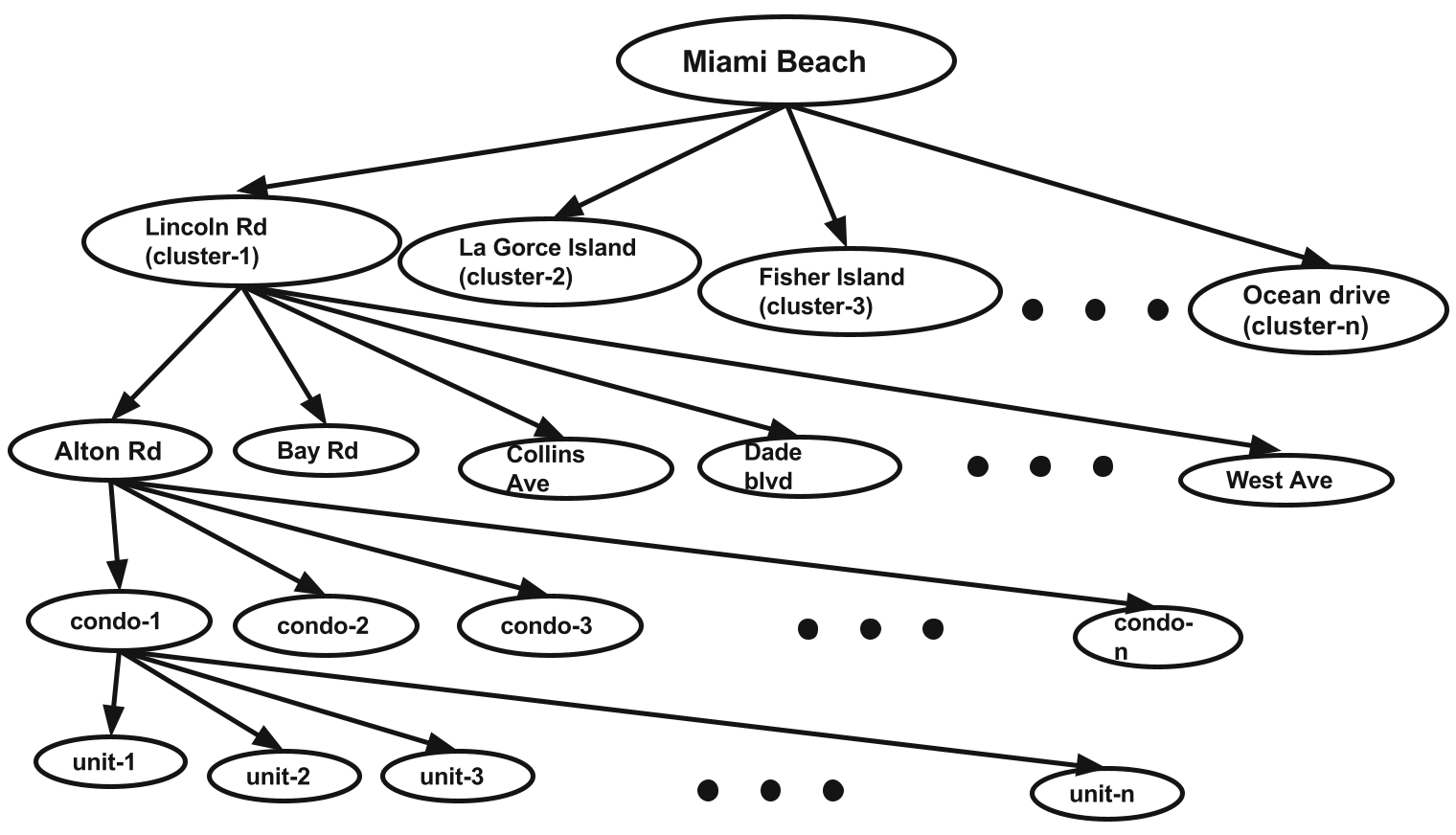 Figure 1: The hierarchical structure from Cluster to Landmark, down to the Condominium Unit.
Experiments & The "Black Box" Battle
One of the most interesting parts of this study is the head-to-head comparison in Layer-2. The authors compared their PCA-based method against an Artificial Neural Network (ANN).
Results Breakdown:
- Layer-1 (Decision Trees): Achieved a flawless 100% accuracy. The logic here is that for top-level landmark identification, the information gain approach is extremely stable.
- Layer-2 (PCA vs. ANN):
- PCA + K-means: 90.25% accuracy.
- ANN + K-means: 55.43% accuracy.
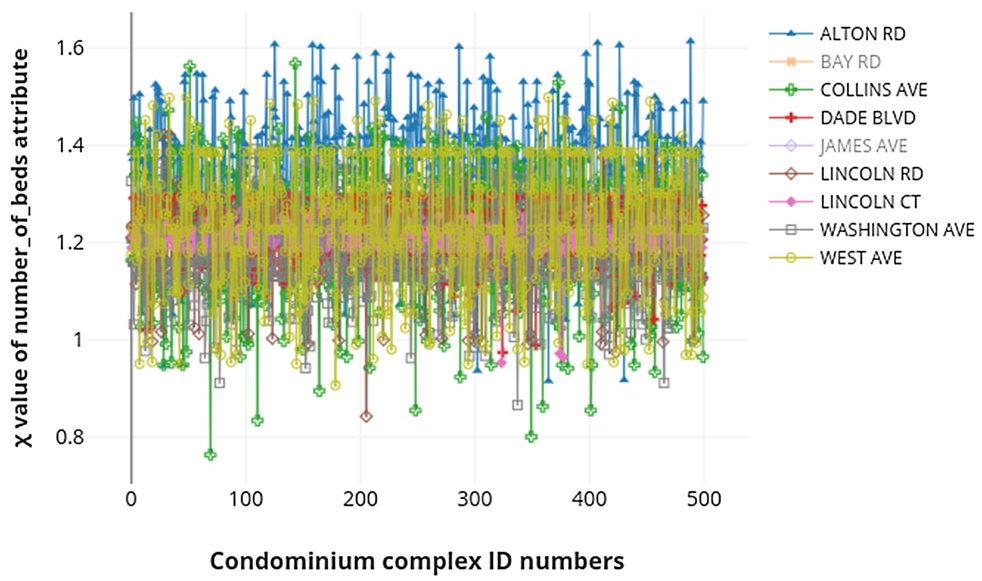 Figure 8: Visualization of the Chi (χ) values showing how certain attributes like 'Number of Beds' dominate in specific landmarks like Alton Rd.
Why did ANN fail?
The authors suggest that while ANNs are great for curve fitting, PCA is superior at capturing the underlying variance and providing a "ranking" that works better for unsupervised clustering of real estate data. The ANN approach suffered from high error rates in centroid matching, making it less reliable for specific location suggestions.
Critical Insight: The Value of Simplicity
In a world where researchers often rush to use the most complex Deep Learning models, this paper provides a refreshing reminder: sometimes statistical modeling and classic ML (like PCA and Trees) are superior. Their framework handles the "Big Data" of the TerraFly platform efficiently without the computational overhead or over-fitting risks of a massive neural network.
Future Outlook
While this study focused on "direct" factors (bedrooms, square footage), the framework is built to be scalable. The next step is the inclusion of "indirect" factors—incorporating climate change risks (crucial for Miami!), crime statistics, and proximity to transit.
Conclusion: This is a foundational step toward "Smart Real Estate" within the broader Smart City movement, shifting the focus from price-watching to intelligent, preference-driven location searching.