
L-WMF: Rethinking Geographical Influence in POI Recommendation from a Location Perspective
Location perspective-based neighborhood-aware POI recommendation in location-based social networks
The paper proposes L-WMF (Location Neighborhood-aware Weighted Probabilistic Matrix Factorization), a POI recommendation method that models geographical influence from a location perspective rather than the traditional user perspective. It integrates geographical distances into a weighted matrix factorization framework to handle implicit check-in data.
TL;DR
L-WMF is a novel recommendation framework that shifts the focus of geographical modeling from the "user's travel patterns" to the "spatial proximity of locations." By integrating geographical distance as a regularization term within a Weighted Matrix Factorization (WMF) architecture, it effectively addresses the sparsity and implicit feedback challenges inherent in Location-Based Social Networks (LBSNs), outperforming traditional methods like BPRMF on real-world datasets.
Problem & Motivation: The "User" vs. "Location" Perspective
Traditional Point-of-Interest (POI) recommendation systems often focus on the User Perspective: modeling how far a user is willing to travel or identifying their "activity centers." However, the authors argue for a Location Perspective: the physical reality that neighboring POIs inherently share similar characteristics and attract similar types of visitors regardless of the specific user.
Furthermore, POI data is notoriously noisy due to Implicit Feedback. In a typical LBSN (like Yelp or Foursquare), we know where a user has been, but we don't know if they dislike the places they haven't visited or if they simply haven't discovered them yet. This is known as the One-Class Collaborative Filtering (OCCF) problem.
Methodology: Bridging Geography and Implicit Matrix Factorization
The core of the L-WMF approach lies in two components:
1. Handling Implicit Feedback (WMF)
Instead of treating unvisited POIs as zeros (negative samples), the model uses a weighting matrix . Visited POIs receive a weight proportional to their check-in frequency (), while unvisited POIs receive a baseline weight of 1, acknowledging the uncertainty of the signal.
2. Location Neighborhood-aware Regularization
The authors assume that the latent feature of a POI () should be close to the weighted average of its neighbors (). This is captured through a similarity matrix based on geographical coordinates:
This geographic similarity is injected into the objective function as a regularization term, forcing the model to learn spatially-aware embeddings.
 Fig 1: Illustrating the user check-in frequency and the geographical distance between POIs.
Experiments & Results
The authors evaluated L-WMF on the Gowalla and Foursquare datasets, comparing it against seven baselines including popularity-based, time-aware (LRT), and ranking-based (BPRMF) models.
Key Findings:
- Superiority of Implicit Modeling: Methods designed for implicit feedback (BPRMF, WMF, L-WMF) significantly outperformed explicit rating-based methods (MGMPFM).
- The Power of Geography: The parameter (which controls geographical influence) showed a clear "bell curve" effect—performance peaks when user check-in data and geographical proximity are balanced.
- Efficiency: Despite the added complexity of neighborhood regularization, L-WMF converges as fast as standard WMF (often within 3-5 iterations).
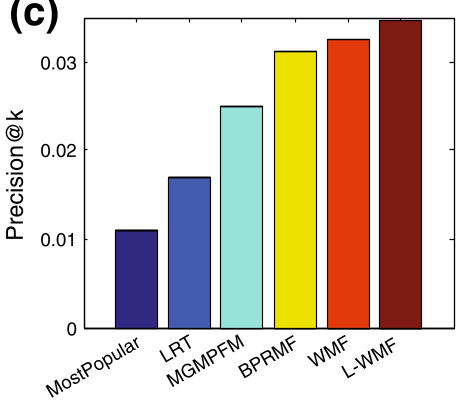 Fig 2: Precision@k and Recall@k comparison on Gowalla and Foursquare datasets.
Critical Analysis & Conclusion
Takeaway
The shift to a location perspective is the paper’s strongest contribution. It treats geography as a fundamental property of the items (POIs) themselves, which helps smooth out the sparse check-in matrix by allowing information to "flow" between nearby locations.
Limitations & Future Work
The model relies on a simple Gaussian kernel for distance similarity, which might not account for urban barriers (e.g., a river between two close coordinates). The authors acknowledge that integrating multi-dimensional side information (like user comments and temporal slots) via Deep Learning and Network Embeddings is the next logical step to capture more complex non-linear relationships in social networks.
In conclusion, L-WMF provides a mathematically elegant and computationally efficient way to ground collaborative filtering in physical space.