
LATE: Securing the "Where" in Spatial Crowdsourcing via Lagrange Interpolation
Location privacy-aware task recommendation for spatial crowdsourcing
The paper introduces LATE, a novel location privacy-aware task recommendation framework for spatial crowdsourcing. By utilizing Lagrange Interpolating Polynomials and bilinear pairings, LATE enables a central server to match workers to tasks within specific "geocast" regions without revealing the workers' exact locations or the tasks' target areas.
TL;DR
Spatial crowdsourcing turns citizens into mobile sensors, but it often requires them to sacrifice their location privacy for task efficiency. LATE (Location privacy-Aware Task rEcommendation) is a framework that allows a server to recommend tasks only to workers in specific geographical regions—without the server ever knowing where the workers are or what the target region is. It achieves this through a clever application of Lagrange Interpolating Polynomials and Bilinear Pairings.
Problem & Motivation: The Location Privacy Paradox
Spatial crowdsourcing (e.g., reporting traffic, environmental sensing) relies on recruiting the right people at the right place. If a server doesn't know where you are, it might send you a task 50 miles away—wasting your time. However, if you tell the server your location, you risk being tracked, profiled, or physically targeted.
Prior attempts to solve this fell into three categories, all with flaws:
- Anonymity (Pseudonyms): Requires complex management and doesn't prevent trajectory tracking.
- Differential Privacy: Adds "noise" to locations, which leads to task assignment errors (low accuracy).
- Mix Networks: Computationally heavy and requires at least one honest node in the chain.
The authors' insight: Can we treat the geocast region as a mathematical set and the worker's location as a query, performing a "set membership test" entirely in the encrypted domain?
Methodology: Polynomials as Privacy Shields
The core of LATE is a privacy-preserving location matching mechanism.
1. Representing Space as Roots
The customer defines a geocast region as a set of points . Instead of listing them, they treat these points as the roots of a polynomial using Lagrange Interpolating Polynomials.
- If a location is in the set, evaluates to a specific predictable value.
- If it isn't, the result is essentially random noise.
2. Matching via Bilinear Pairings
The server receives an encrypted version of this polynomial and a "location trapdoor" from the worker. By computing a series of operations in a bilinear group, the server can check a specific equation:
u, \lambda)})$$ If the equation holds, the worker is in the region. The server learns **nothing else**—not the worker's coordinates, nor the bounds of the task region. 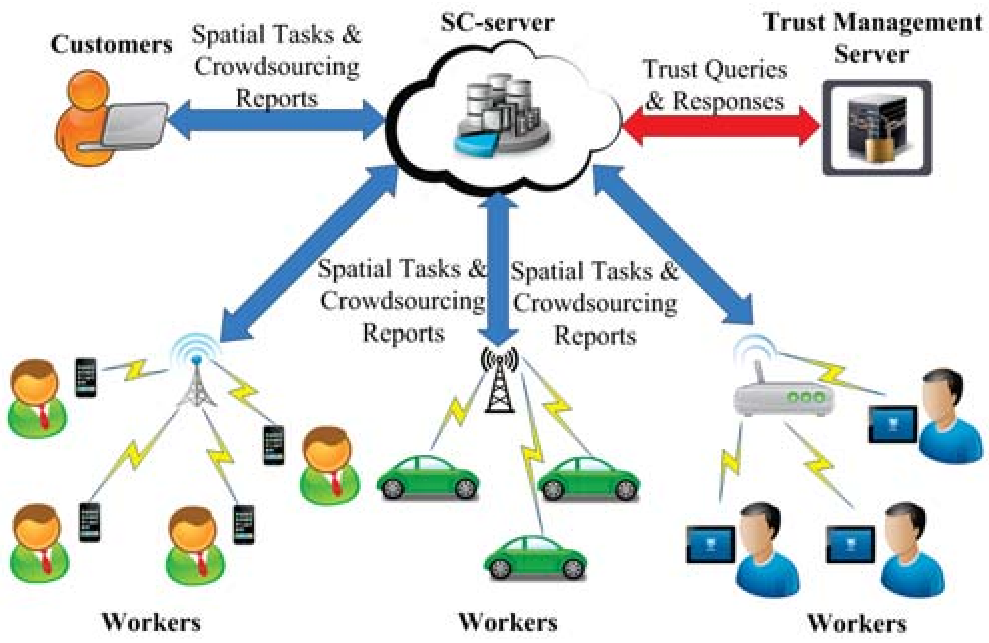 *Figure 1: The LATE system model involving the SC-Server, Task Management Server (TMS), Customers, and Workers.* ## Experiments & Results: Efficiency meeting Security The authors implemented LATE using the MIRACL library and tested it on standard laptop hardware to simulate realistic server performance. * **Accuracy**: Unlike Differential Privacy, LATE provides **100% matching accuracy**. If you are in the region, the math guarantees a match. * **Computation**: The "Recommendation" phase (the most frequent operation) takes roughly **200ms**. While bilinear pairings are expensive, the overhead is manageable for real-time tasking. * **Communication**: The encrypted task size grows linearly with the number of locations ($n$). For a typical task with several specific points of interest, the data size remains well within the limits of mobile networks. 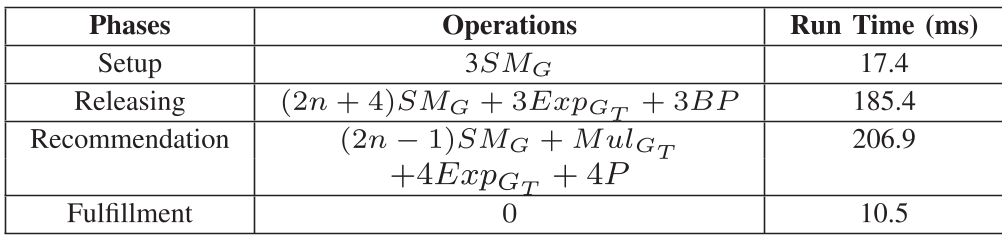 *Table 1: Computational overhead of different phases. The matching (Recommendation) is efficient enough for practical deployment.* ## Critical Analysis & Conclusion LATE is a sophisticated piece of "Crypto-Engineering." It successfully uses the **Co-Decisional Bilinear Diffie-Hellman (Co-DBDH)** assumption to protect user data. **Key Takeaways:** * **Zero-Knowledge Tasking**: It proves that we don't need to choose between efficiency and privacy. * **Proxy Re-Encryption**: By using the Trust Management Server (TMS) as an intermediary to re-encrypt data, the system ensures that only "matched" workers can actually read the task details, preventing data leakage to outsiders. **Limitations**: The current version treats locations as discrete points of interest. In a future where regions are defined by complex polygons or continuous coordinates, the polynomial degree $n$ might increase significantly, potentially slowing down the server. **Future Work**: Expanding this to **Multi-Task Recommendation** (where one worker might be eligible for 5 tasks at once) while maintaining the same privacy guarantees is the next logical frontier.