
L3P: Revolutionizing Location Privacy in Spatial Crowdsourcing via Exact Ciphertext Computation
Location Privacy-Preserving Distance Computation for Spatial Crowdsourcing
2020-04-03
Summary
Problem
Method
Results
Takeaways
Abstract
This paper proposes L3P, a comprehensive location privacy-preserving framework for Spatial Crowdsourcing (SC). It introduces four specialized protocols—Euclidean-L3P, Minkowski-L3P, Manhattan-L3P, and Chebyshev-L3P—leveraging homomorphic encryption and multilinear mapping to enable distance computation over ciphertexts, achieving SOTA security without sacrificing task assignment accuracy.
## TL;DR
Location privacy in smart cities has long faced a "Utility vs. Privacy" trade-off. Traditionally, we add noise (Differential Privacy) to hide locations, which unfortunately breaks the accuracy of matching workers to tasks. This paper introduces **L3P**, a framework that uses **Homomorphic Encryption (HE)** and **Multilinear Mapping** to compute the *exact* distance between workers and requesters without either party ever revealing their coordinates to the untrusted server.
## Background: The Price of Noise
In Spatial Crowdsourcing (SC) platforms like Uber or food delivery apps, the server needs to know your location to assign the nearest worker. Previous SOTA methods used **Differential Privacy (DP)**, which effectively "blurs" your location.
* **The Problem**: If the location is blurred, the server might assign a worker who is actually 10 miles away instead of 1 mile away, leading to high failure rates.
* **The Gap**: How do we give the server the "Distance" without giving it the "Location"?
## Methodology: The Cryptographic Bridge
The core insight of L3P is that distance metrics (Euclidean, Manhattan, Chebyshev) can be decomposed into mathematical operations that are compatible with homomorphic encryption.
### 1. Euclidean-L3P (The Geometric Approach)
For cities with sparse buildings, Euclidean distance is king. The authors use **BGN-type Homomorphic Encryption** and **Composite-Order Multilinear Mappings**.
* The coordinates $x, y$ are encrypted.
* The server performs subtraction and squaring in the encrypted domain.
* Through a joint decryption process involving multiple computing servers ($S_1 ... S_{2l+1}$), the final distance is revealed without revealing the coordinates.
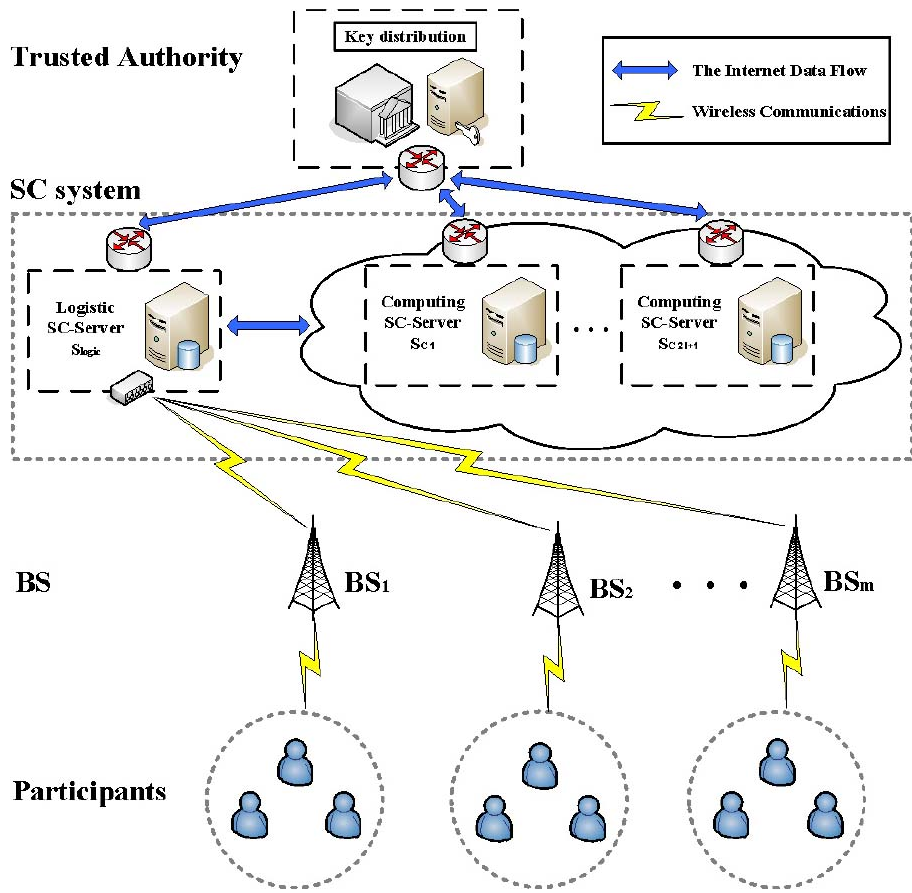
*Fig 1. The L3P System Model: Untrusted Logistic Servers working with specialized Computing Servers.*
### 2. Manhattan and Chebyshev-L3P (The Grid Approach)
In dense urban "grids," Manhattan distance is more practical. Here, L3P employs **Prefix Membership Verification**. It transforms the location into a "Prefix Family" (binary strings representing ranges). Distance is then calculated by checking overlaps in these prefix sets within the encrypted space.
## Experimental Breakdown
The authors rigorously tested the framework using the **jPBC library**.
### Computational Efficiency
* **Participant Side**: Computation is lightweight (mostly modular exponentiations), making it feasible for IoT devices and smartphones.
* **Server Side**: There is a clear "crossover" point. While Manhattan-L3P has a higher overhead for individual participants, it becomes more efficient for the server group as the number of participants ($n$) exceeds 105.
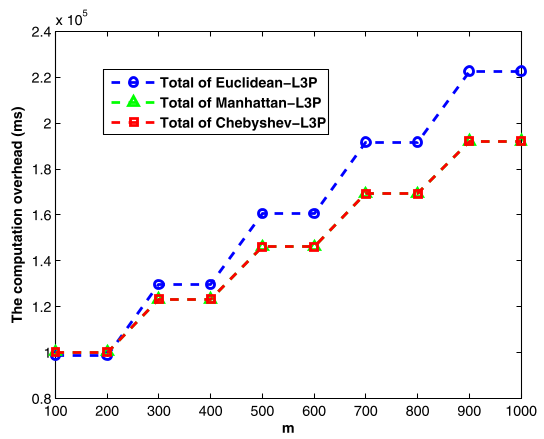
*Fig 2. The trade-off between Euclidean and Manhattan computation costs as group size scales.*
### Communication Overhead
Euclidean-L3P is the clear winner in bandwidth. It requires only $6\sigma$ bits for a report, whereas Manhattan and Chebyshev require significantly more due to the complexity of the prefix membership strings ($4w + 6\sigma$).
## Critical Insight: Why This Matters
The L3P framework moves the field away from "Heuristic Privacy" (adding noise) toward "Provable Privacy" (cryptography).
1. **Zero Accuracy Loss**: Unlike DP, the distances calculated are exact.
2. **Untrusted Server Resilience**: By splitting the decryption key among $2l+1$ servers via Lagrange interpolation, the system remains secure even if nearly half of the computing infrastructure is compromised.
3. **Versatility**: By supporting the **Minkowski distance**, L3P provides a generalized mathematical tool that can be tuned to any urban topography.
## Conclusion & Future Work
L3P demonstrates that heavy-duty cryptography (HE, Multilinear Mapping) is becoming efficient enough for real-time spatial tasks. The next frontier, as the authors suggest, will be incorporating non-spatial factors—like worker reputation and rewards—into these encrypted computation pipelines to create a truly "Privacy-First" gig economy.
**Takeaway for Practitioners**: If your application demands high matching accuracy but handles sensitive location data, skip the noise; use cryptographic distance protocols.