
RPAR: Optimization of Location Privacy in MSNs through Sub-Region Repartitioning
A Location Privacy Preserving Scheme Based on Repartitioning Anonymous Region in Mobile Social Network
The paper introduces RPAR (Repartitioning Anonymous Region), a location privacy-preserving scheme designed for Mobile Social Networks (MSN). It utilizes sub-region repartitioning to replace a user's exact coordinates with calculated central locations of anonymous sub-regions, effectively interfacing between users and LBS servers via a central anonymous server.
TL;DR
With the rise of Mobile Social Networks (MSN), sharing location to find nearby friends has become a vulnerability. The RPAR (Repartitioning Anonymous Region) scheme solves this by breaking down a large group of anonymous users into optimized sub-groups. By sending only the "central location" of these sub-groups to LBS servers, it cuts down communication costs and significantly improves query accuracy compared to traditional "large-box" cloaking methods.
Problem & Motivation: The Precision-Privacy Paradox
Most current Location-Based Services (LBS) use simple K-anonymity. To hide one user, the system finds other users and creates a giant "cloaking box" containing all of them.
The industry faces two major pain points with this:
- Inaccuracy: If the cloaking box is too large, the LBS results (like "nearest restaurants") are based on the box center, which might be miles away from the actual user.
- Overhead: Communication between the anonymous server and the LBS server becomes bloated when dealing with complex geometric shapes or large sets of coordinates.
The authors' insight is simple yet powerful: Why use one giant, inaccurate region when you can use several optimized, smaller sub-regions?
Methodology: The RPAR Mechanism
The RPAR scheme functions through a four-step pipeline involving the user, a central anonymous server, and the LBS provider.
1. The Core Algorithm
Instead of treating users as a single mass, RPAR divides them into sub-regions.
- Initial Grouping: Finds neighbors for the query user.
- Sub-Regioning: Uses a nearest-neighbor approach to group these users into smaller clusters of size .
- Center Calculation: For each sub-cluster, the algorithm calculates a Central Location . This coordinate serves as the "proxy" for all users in that cluster.
2. Architecture Overview
The system architecture ensures that the LBS server never sees the raw GPS data of the individual, only the calculated centers of the repartitioned groups.
 Figure 1: The interaction flow between users, Central Anonymous Servers, and LBS Servers.
3. Handling the "Tail" Problem
A unique feature of RPAR (Algorithm 1) is how it handles "leftover" users. If is not perfectly divisible by , the remaining "tail" users are repartitioned into existing regions based on proximity, ensuring no user is left without protection.
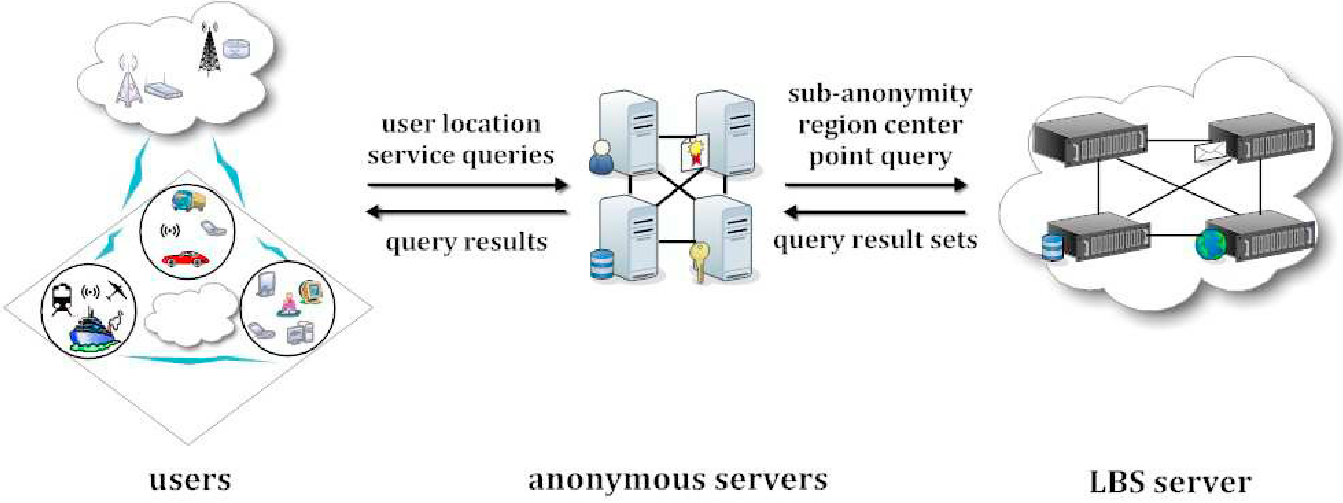 Figure 2: (a) Initial user distribution vs (b) Resulting sub-anonymity regions with calculated centers.
Experiments & Results
The study focuses on minimizing the total area of the cloaking regions. By keeping the total area below a threshold , the scheme ensures that the LBS server receives a query point that is geographically "tight" to the users' actual positions.
Key Findings:
- Reduced Communication Overhead: By transmitting discrete central points instead of area boundaries or large user lists, the packet size is minimized.
- Higher Accuracy: Because sub-regions are localized, the "center" used for the LBS query is much closer to the actual users than the center of a traditional large k-anonymity box.
Critical Analysis & Conclusion
RPAR is a pragmatic step forward for MSN privacy. It acknowledges that in the real world, users care as much about getting the right restaurant recommendation as they do about their privacy.
Takeaway: The move from "Area-based Anonymity" to "Point-based Sub-region Anonymity" is a superior architectural choice for modern IoT and MSN applications.
Limitations & Future Work: The current model assumes a relatively uniform distribution of users. In extremely dense urban environments, the proximity of users might allow for side-channel attacks if the repartitioning logic is known. The authors have noted that their next phase of research will focus specifically on these "dense region" scenarios to prevent location leakage through high-frequency query patterns.