
The GSN Paradox: Balancing Personal Privacy with the $40 Billion Location Industry
Location Privacy and Utility in Geo-social Networks: Survey and Research Challenges
This paper provides a comprehensive survey and taxonomy of Location Privacy-Preserving Mechanisms (LPPMs) specifically within the context of Geo-Social Networks (GSNs). It evaluates existing methodologies based on their ability to balance user privacy needs with the data utility requirements of platform providers, ultimately identifying critical research gaps in handling semantic location history.
TL;DR
Geo-Social Networks (GSNs) like Facebook and Foursquare are built on a fragile compromise: users trade their location data for "free" services, while providers monetize this data via targeted ads. This paper surveys the landscape of Location Privacy-Preserving Mechanisms (LPPMs), revealing that most current solutions are either too weak to stop "stalking" via history analysis or too aggressive, destroying the commercial utility that keeps these platforms alive.
The Core Conflict: Privacy vs. Profits
The "Location-Based Service" (LBS) market is massive, yet it faces a quality crisis. Marketers report that nearly 86% of targeted ads are based on inaccurate location data, leading to wasted spend. Conversely, users are increasingly wary; studies suggest people value location data as much as health data.
The author's highlight a fundamental non-cooperation:
- Providers avoid privacy features that coarsen data.
- Users react by falsifying locations or disabling GPS entirely.
Methodology: The Taxonomy of Protection
The paper categorizes privacy solutions into three architectural pillars:
1. Device-Centric (Trust the Phone)
The privacy logic lives on the user's device.
- Sharing-Decision: AI learns when you usually want to share (e.g., at a park) vs. when you don't (e.g., at a hospital).
- Obfuscation: Techniques like Spatial Cloaking (showing a region instead of a point) or Perturbation (adding "noise").
 Fig A: Comparison of Cloaking, Perturbation, and Dummies.
2. Infrastructure-Centric (Trust the Provider)
Users set complex "Sharing Rules" (e.g., "Only show my location to coworkers between 9-5"). The platform is trusted to enforce these, but not to misuse the data internally (a massive leap of faith).
3. Hybrid Mechanisms (Trust No One)
The most promising but complex category.
- Position Sharing: Splits a precise location into several "imprecise shares" and stores them on different, non-colluding servers. No single server knows exactly where you are, but authorized friends can "fuse" shares to find you.
Experimental Analysis: Why We Are Still Vulnerable
The authors evaluated these classes against a rigorous matrix. A critical insight is the Location-History Attack. Even if you obfuscate a single check-in, an attacker who knows you go to a specific gym every Tuesday can "reverse engineer" your true location using temporal correlations.
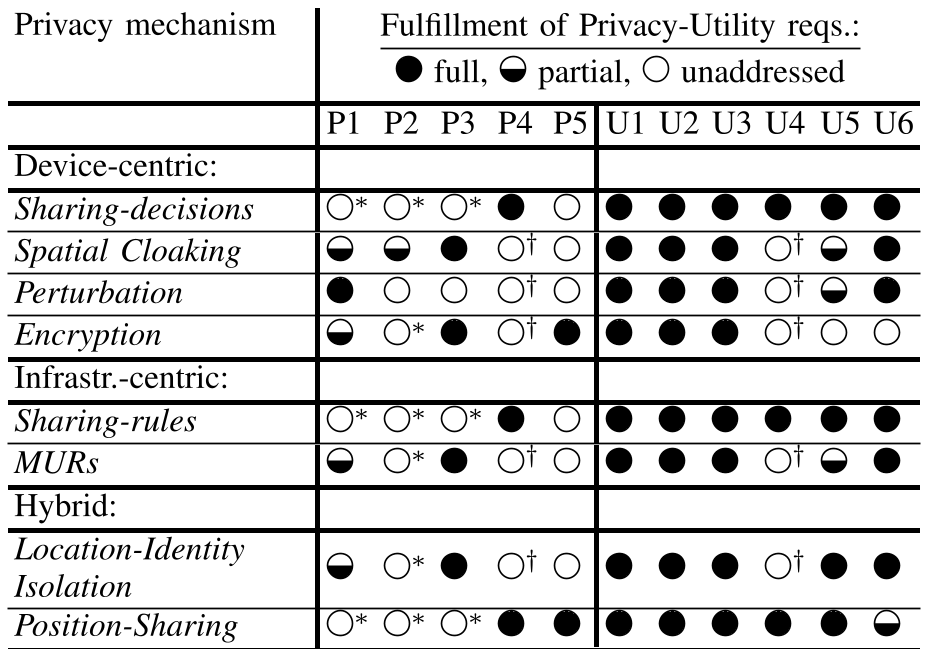 Table 1: The gap in current mechanisms—note how few address P5 (limiting history aggregation) and U5 (data precision).
Critical Insight: The "Attacker Strength" Dilemma
One of the paper's most profound points is the Multi-Attacker Scenario. If a privacy algorithm assumes a "Strong Attacker" (one who knows your habits), it might generate a region that inadvertently reveals your preferences to a "Weak Attacker" (a stranger).
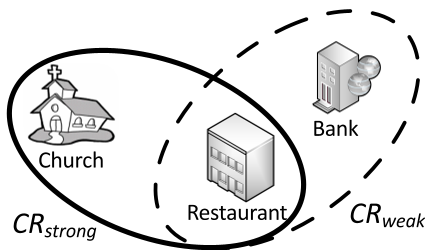 Fig B: How different assumptions about an attacker's knowledge lead to different (and potentially leaky) cloaking regions.
Conclusion & Future Work
The paper concludes that we lack "Intelligent History Partitioning." We need systems that allow providers to perform Audience Profiling (e.g., "This user likes shopping") without allowing Stalking (e.g., "This user is currently at 123 Main St").
Key Takeaways for Researchers:
- Efficiency Matters: Complex differential privacy models must be verified on actual mobile hardware.
- Hybrid Architecture: We need more research into non-colluding distributed systems that can handle the massive scale of GSNs.
- Semantic Awareness: Privacy isn't just about coordinates; it's about the meaning (semantics) of the places we visit.