
Fusion of Social and Spatial: Revolutionizing Location Recommendation in LBSNs
139_Location recommendation in location-based social networks using user check-in data.
This paper introduces FBCA and LFBCA, two advanced location recommendation algorithms for Location-Based Social Networks (LBSNs). By integrating social friendship links, user similarity, and geographical constraints into a Personalized PageRank (PPR) framework, it achieves superior performance on real-world datasets like Gowalla and Brightkite.
TL;DR
This paper addresses the unique challenge of venue recommendation in Location-Based Social Networks (LBSNs) like Foursquare or Gowalla. By introducing FBCA and LFBCA, the authors move beyond simple "who likes what" collaborative filtering, instead modeling the "flow" of interests through social ties and geographical boundaries using an efficient Personalized PageRank (PPR) variant.
Context: Published at SIGSPATIAL, this work represents a pivotal shift from pure collaborative filtering to multi-facet graph mining in the geospatial domain.
Deep Dive into the Pain Points
Traditional recommender systems (e.g., Netflix, Amazon) treat items as abstract entities. However, in LBSNs, locations have a "physical gravity." The authors observe two critical data-driven insights from Gowalla and Brightkite:
- The 10km Rule: Over 81% of new visits occur within 10km of a user's previous "footprint."
- The Social Ripple: Roughly 30% of new visits are to places already visited by a friend or a friend-of-a-friend.
Existing SOTA methods like Random Walk with Restart (RWR) attempted to bridge this gap, but often did so with uniform transition probabilities that failed to distinguish between a "close friend" and a "casual acquaintance" or a "nearby park" vs. a "distant city."
Methodology: The LFBCA Engine
The core contribution is the Location-Friendship Bookmark-Coloring Algorithm (LFBCA). It operates on a sophisticated graph augmentation strategy:
1. Graph Augmentation
Instead of just using the friendship graph , the authors build a similarity graph . If two users visit the same venue, a "similarity edge" is added, even if they aren't friends.
2. Transition Logic
Transitions between nodes are not uniform. They are controlled by a parameter :
- Friendship Path (): Flows through explicit social links.
- Similarity Path (): Flows through users with similar "tastes" (shared venues).
3. The Bookmark-Coloring Algorithm (BCA)
To make this scalable, the authors use BCA. Think of it as pouring a fixed amount of "paint" on a source user node. The paint spreads across the graph, losing some volume at each hop (the teleportation factor ). The resulting "color" density on venue nodes becomes their recommendation score.
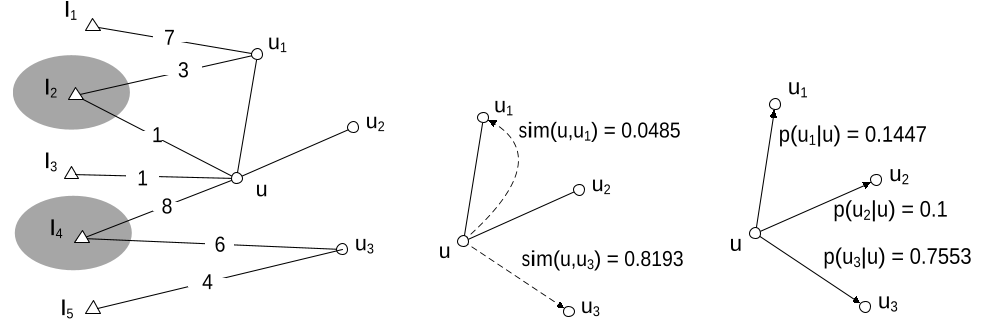 Figure: The process of augmenting a social graph with similarity links and transition probabilities.
Experiments & Quantifiable Results
The authors compared LFBCA against UserCF, LocCF, and the competitive RWR model.
- Superior Coverage: Unlike CF methods which can only recommend to users with enough history, graph-based FBCA/LFBCA achieve 100% coverage.
- Precision and Utility: LFBCA consistently dominates the Precision@N and Utility@N metrics. Interestingly, as time progresses and networks mature (like Gowalla), the performance of LFBCA improves, whereas it declines on "dying" networks (like Brightkite).
- Impact of Geo-Filtering: The introduction of a distance threshold acts as a massive noise filter. By cutting out recommendations outside a user's active radius, the precision spikes significantly.
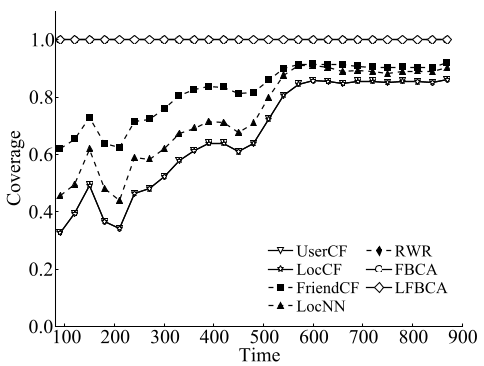 Figure: Comparison of Precision, Recall, and Utility across different LBSN snapshots.
Critical Analysis & Conclusion
Takeaway
The paper proves that in LBSNs, identity (who you are), community (who you know), and environment (where you are) are inseparable. LFBCA is an elegant mathematical framework to join these dimensions.
Limitations
- Temporal Dynamics: The model treats check-ins statically within a window. It doesn't account for the "time of day" (e.g., suggesting a bar at 10 PM vs. a coffee shop at 8 AM).
- Categorical Context: While social and spatial factors are captured, the type of venue (venue metadata) is largely unused.
Future Outlook
Future iterations of this logic likely evolved into the Graph Convolutional Networks (GCNs) we see today, which automate the feature engineering that this paper manually crafted via graph augmentation.