
UPS-CF: Navigating the Challenges of Out-of-Town Recommendations in LBSNs
Location recommendation for out-of-town users in location-based social networks
This paper introduces UPS-CF (User Preference, Proximity and Social-Based Collaborative Filtering), a framework designed for Location-Based Social Networks (LBSNs). It specifically addresses the drop in recommendation quality when users travel away from their home regions by integrating geographical proximity constraints with a hybrid of user similarity and social friendship weights.
TL;DR
Standard recommendation engines often fail when you leave your home city, suggesting your favorite hometown coffee shop while you are miles away on vacation. This paper introduces UPS-CF, a Collaborative Filtering framework that combines User preference, geographical Proximity, and Social influence to provide context-aware recommendations that work whether you are in your neighborhood or a new continent.
The "Hometown Bias" Problem
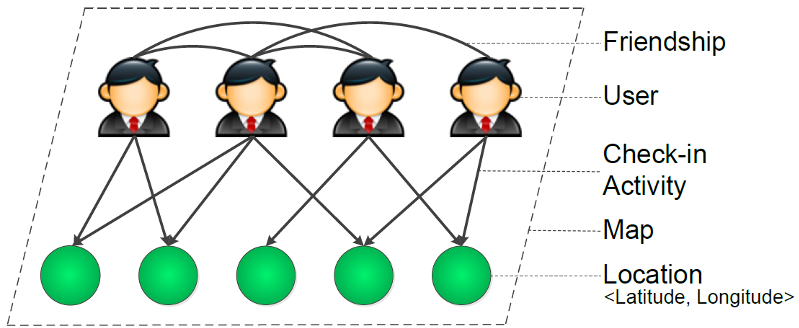
Most Location-Based Social Networks (LBSNs) like Foursquare and Gowalla rely on User-Based Collaborative Filtering (User-CF). This method assumes that if User A and User B both liked the same five bars in New York, they will share interests elsewhere.
However, there is a catch: human mobility is geographically local. Most "similar users" to you live in your city. When you travel from New York to San Francisco, a classic CF algorithm will still suggest NYC spots because your "neighbors" in the latent space haven't visited San Francisco. This leads to a massive drop in precision (as shown in the author's analysis of Foursquare/Gowalla data).
Methodology: The UPS-CF Framework
The researchers propose a hybrid weight formula to calculate the score for a user and location :
Where:
- (Experience): Similarity based on check-in history.
- (Friendship): Social ties in the network.
- (Balance Factor): A tuning parameter that shifts the model's "loyalty" between similar strangers and actual friends.
1. The Proximity Constraint
The model introduces a hard boundary (e.g., 100km). Any location beyond this radius from the user's current query point is pruned. This reflects the physical reality that a user looking for a restaurant won't drive to another state.
2. The Dynamic Role of Friends
The paper’s most profound insight is the discovery of the "Social Shift." Through parameter tuning, they found that:
- In-Town: (Trust similar users/common interests).
- Out-of-Town: (Trust social friends).
When you are in unfamiliar territory, your direct social circle (who might have traveled there or have reliable tastes) becomes a far more accurate predictor of your behavior than regional strangers.
Experimental Results
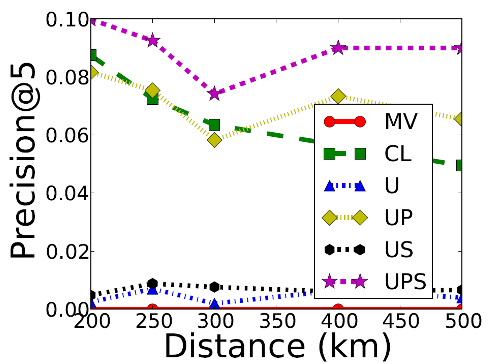
The authors validated UPS-CF against several baselines (Most Visited, Closest Location, and standard User-CF).
Precision Benchmarks
UPS-CF consistently provided the highest Precision@5 and @10. While standard CF performance tanked as distance from home increased, UPS-CF remained robust specifically because it switched its focus to social connections and local candidates.
Solving the Cold Start
The "Cold Start" problem (recommending for new users with no history) was also mitigated. By using social ties (), the system can make educated guesses about a new user's preferences based on their friends' check-ins, even if the user hasn't checked into a single location themselves.
Critical Insight & Conclusion
The core contribution of this work isn't just a better algorithm, but a behavioral observation: human decision-making processes change based on spatial context.
Takeaways:
- Filter First: Hard geographical constraints are more effective than soft penalties for mobile recommendations.
- Friends over Strangers: When traveling, social influence is the dominant factor in location discovery.
- Future Directions: The authors suggest adding semantic tags (e.g., distinguishing a "museum" from a "bar") to further refine these multi-dimensional weights.
While the paper dates back to the peak of the LBSN era (2013), its foundational logic regarding the interplay between social graphs and physical space remains a cornerstone for modern apps like Yelp, TripAdvisor, and Google Maps.