
Decoding Your Location from Your Clicks: The Power of Social Media Clickstream Motifs
5392_Location Semantics Identification via Users' Clickstreams in Mobile Social Networking.
This paper introduces a novel framework for identifying location semantics (Home, Work, Passby, Shortstay) by analyzing mobile social network clickstreams (Weibo). The study proposes the concept of "click motifs"—recurrent patterns of user interactions—and utilizes an embedding and clustering methodology to classify semantics without relying on high-precision GPS data.
TL;DR
Researchers have discovered a way to identify whether you are at home, work, or just passing through, simply by analyzing how you interact with social media apps like Weibo. By identifying "click motifs"—specific patterns of browsing, liking, and chatting—the proposed system achieves a classification precision of 61%, proving that clickstreams can disclose location semantics without ever needing your GPS coordinates.
Background & Motivation: The Privacy vs. Utility Tug-of-War
In the era of heightened privacy awareness, accessing high-resolution GPS data is becoming a bottleneck for service providers. Users frequently deny location permissions, and mobile OS updates (like iOS) restrict access to WiFi identifiers. However, every time you tap a link, "like" a post, or check a notification, you leave a clickstream.
The authors of this paper ask a provocative question: Does the way we use social media change depending on where we are? If so, clickstreams can serve as a semantic "fingerprint" of our location, enabling personalization while bypassing the need for explicit coordinates.
Methodology: From Raw Clicks to Graph Motifs
The research moves through a rigorous pipeline to translate messy internet logs into behavioral insights.
1. Establishing the Ground Truth
Before classifying clickstreams, the authors needed a baseline. They used ISP-level "Internet_access" data from Shanghai to reconstruct trajectories. Using a scalable ε-neighborhood DBSCAN, they clustered imprecise base station data into "Important Areas." By analyzing stay duration and time-of-day (night for Home, day for Work), they labeled the semantic meaning of these locations.
2. The Architecture of a Clickstream
The core innovation lies in the Representations Extractor. Instead of viewing clicks as a simple list, they are modeled as directed graphs.
- Nodes: 9 categories of actions (Browse, Login, Release, Chat, Notification, Friend, Comment, Repost, Likes).
- Edges: Transition frequencies between these actions.
**
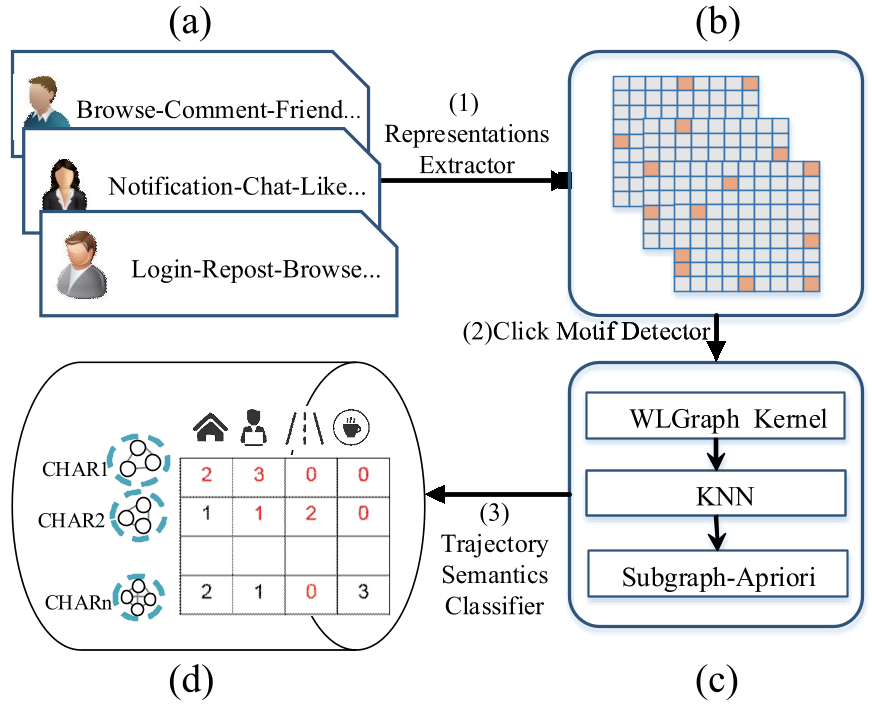
3. Click Motif Detection
To find patterns across millions of users, the team employed the Weisfeiler-Lehman (WL) subtree kernel. This allows for the efficient comparison of graph structures. They defined Click Motifs—recurring subgraphs that represent specific behavioral habits (e.g., the sequence of checking a notification, then reading a comment, then liking the post).
Experimental Insights: How We Behave Differently
The study reveals fascinating statistical differences in user behavior:
- Home: Users have longer, more complex click motifs. There is a massive peak in activity at 23:00 (pre-bedtime browsing).
- Work: Activity peaks during lunch (12:00) and break times (16:00). Users are more likely to perform quick interactions like "Likes" or "Comments" before starting their shift (08:00).
- Passby: Clicks are simple and infrequent. Interestingly, people are more active on Weibo when leaving work than when arriving.
Performance Metrics
Using a Random Forest classifier, the model achieved impressive results:
**
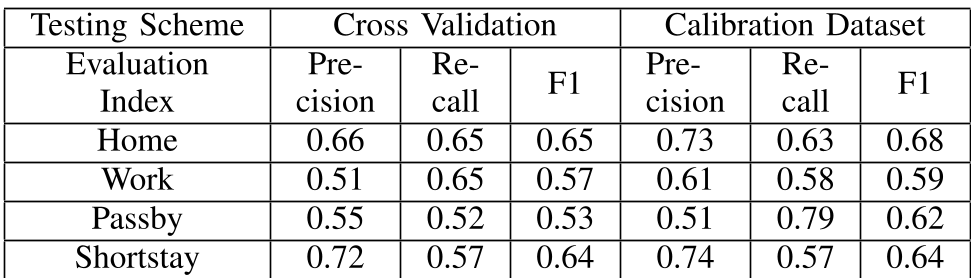
The precision for Home (0.66) and Shortstay (0.72) was highest, likely because these locations allow for the sustained, characteristic browsing patterns that the WL-Kernel is best at capturing.
Critical Analysis & Conclusion
This work is a double-edged sword:
- For Service Providers: It offers a path toward deep personalization (e.g., suggesting long-form videos when a user is "Home" and short-form content when they are "Passby") without the "creep factor" of requesting GPS.
- For Privacy: It exposes a massive, hidden side-channel. Even if you mask your IP and disable GPS, the cadence and logic of your interactions can reveal your life’s structure.
The Takeaway: Location is not just a coordinate; it is a context. As this paper demonstrates, our digital habits provide a high-resolution map of our physical presence. Future privacy research must look beyond "where" we are and start considering "how" we click.
Limitations & Future Work
While the 61% accuracy is a breakthrough for this data type, "Work" and "Passby" semantics remain harder to distinguish. The authors suggest that future iterations will integrate content analysis (what users are actually reading) to further refine the motifs.