
LCWC: Decoding the Geography of Interest in the Twitter Stream
Location-specific tweet detection and topic summarization in Twier
This paper introduces a novel framework for identifying and summarizing location-specific tweets by combining textual content with social network characteristics. The authors propose the Location Centric Word Co-occurrence (LCWC) weighting scheme and utilize a news-augmented Latent Dirichlet Allocation (LDA) model to categorize local topics, achieving significantly higher precision in geo-relevant tweet retrieval compared to traditional frequency-based methods.
TL;DR
Physical location does not equal topical relevance. Just because you are in London doesn't mean your tweet about the latest Hollywood blockbuster is "local" content. This paper introduces LCWC (Location Centric Word Co-occurrence), a framework that filters the Twitter noise to find tweets actually about a location by combining linguistic patterns with the user's social circle.
Background: The "User Location" Fallacy
In the world of social media analytics, researchers have long focused on where a user is. However, the authors of this study identify a critical gap: Predicting a user's location is fundamentally different from predicting if a tweet is location-specific.
A user in Detroit might tweet about a local "Holiday Nights" event (Location-Specific) or about a global political movement (General). Most SOTA methods at the time failed to distinguish between these two, leading to "local" feeds cluttered with irrelevant global noise.
Methodology: Beyond the Hash-tag
The authors propose the LCWC Weighting Scheme, which moves away from simple term frequency toward a multi-dimensional scoring system.
1. The Linguistic Engine: Bi-grams and PMI
Twitter users often use word pairs (bi-grams) to define events (e.g., "Brooklyn Bridge", "Ground Zero"). The model uses Point-wise Mutual Information (PMI) to measure the strength of association between these words. This is more effective than uni-gram models which struggle with the ambiguity of short texts.
2. The Social Signal: Network Score
Perhaps the most insightful part of this research is the use of the Social Graph. The authors discovered that approximately 37% of a user's friends reside in the same location. By calculating a Network Score (the ratio of local friends to total friends), the algorithm can "up-vote" tweets from users who are deeply embedded in the local community, as they are statistically more likely to post local news.
 Figure 1: The conceptual framework merging streaming data, network analysis, and topic modeling.
3. Summarization through Knowledge Transfer
LDA (Latent Dirichlet Allocation) famously fails on tweets because they are too short to provide enough co-occurrence context. To solve this, the authors used a clever technical "hack": they trained their LDA model on Local News RSS feeds and external articles found in tweet URLs. They then used this "pre-trained" topical knowledge to categorize the sparse tweets.
Experimental Insights
The team annotated 10,000 tweets to create a ground-truth dataset. Their findings were revealing:
- Trending != Local: Top trending hashtags are actually poor indicators of location-specific content; they usually represent global memes or viral news.
- Bi-grams win: Bi-gram models significantly outperformed tri-grams, likely because the 140-character limit of Twitter (at the time) forced users to be extremely concise.
- Network Importance: As shown in the performance graph below, removing the "Network Score" leads to a noticeable drop in precision.
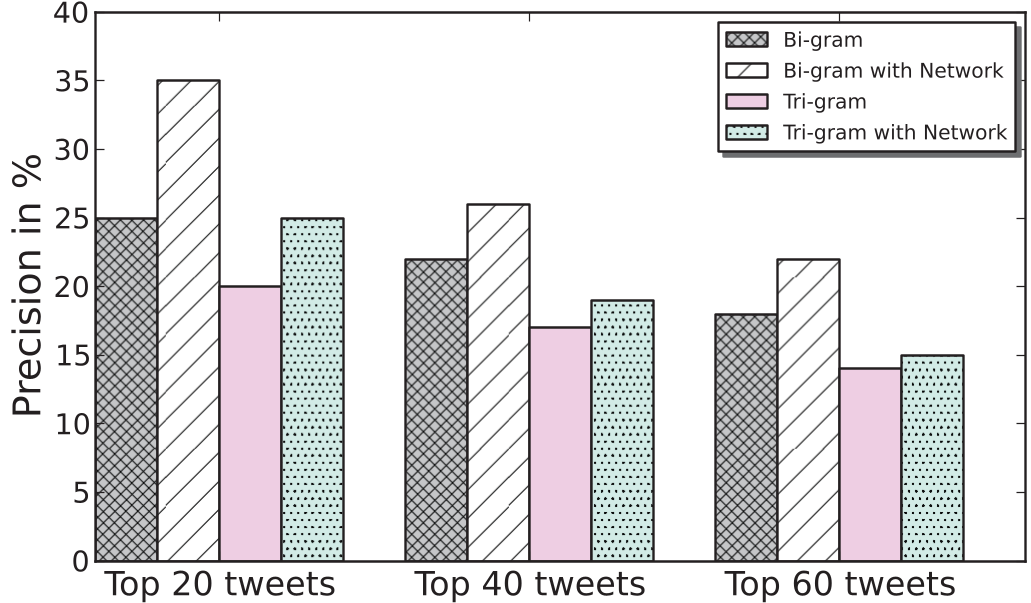 Figure 2: Precision comparison showing LCWC outperforming frequency and pure geo-location baselines.
Critical Analysis & Conclusion
This paper represents a shift from "Where is the user?" to "What is the focus?". By leveraging the hidden signal in a user's friend list, the researchers managed to turn a noisy stream into a structured, localized news feed.
Limitations: The model relies on the availability of a user's friend list, which is increasingly restricted by API privacy policies (like those currently seen on X/Twitter). Furthermore, the 2013-era LDA approach has since been superseded by Embedding-based topic models (like BERTopic), which might handle the "short text" problem even more elegantly.
The Takeaway: If you want to know what's happening on the ground in a specific city, don't just look at the GPS tags—look at the community. The "who you know" is just as important as the "where you are."