
Your Camera is Buffering the Truth: Detecting Location Spoofing via Sensor Fingerprints
Location Spoofing Detection for Social Network Service using Camera Fingerprint
This paper introduces a blind forensic method for detecting location spoofing in Location-Based Social Networks (LBSNs) using Photo Response Non-Uniformity (PRNU) as a camera sensor fingerprint. By verifying if the device used to capture check-in images matches the user's historical device signature, the system achieves SOTA-level anomaly detection without requiring massive geotagged datasets.
TL;DR
Researchers have developed a method to catch location "fakers" on social networks not by looking at where they claim to be, but by looking at the physical hardware that took the photo. By extracting a unique "sensor fingerprint" (PRNU) from uploaded images, the system can detect if a user is stealing someone else's vacation photos to fake a check-in, achieving over 99% accuracy in common spoofing scenarios.
Context: The Vulnerability of the Digital "Check-in"
In the era of Facebook, Instagram, and Twitter, a "check-in" is more than just a social flex—it's digital evidence used for alibis, insurance claims, and social validation. However, GPS coordinates are trivial to spoof using software. Previous attempts to solve this required analyzing thousands of a user's past tweets to find "behavioral inconsistencies," a method that is both privacy-invasive and useless for new or infrequent users.
The Insight: Hardware Leaves a Signature
The authors propose a "blind forensic" approach. Every digital camera sensor has microscopic physical imperfections created during manufacturing. These defects result in Photo Response Non-Uniformity (PRNU)—a unique noise pattern that acts as a hardware "DNA." No two sensors, even from the same production line, have the same PRNU.
If User A claims to be at "Location X" but uploads a photo that carries the sensor fingerprint of User B’s phone, the system can instantly flag it as a location spoof.
Methodology: From Pixels to Fingerprints
The workflow transforms a computer vision problem into a statistical verification task:
- Noise Extraction: Using a wavelet-based denoising filter, the system isolates the signal (the photo) from the noise (the sensor fingerprint).
- Reference Pattern (Fingerprint Construction): By averaging the noise from several known images from a user, the system creates a "clean" reference fingerprint for that specific device.
- Cross-Correlation: When a new check-in occurs, the noise from that image is compared to the reference pattern using Peak-to-Correlation Energy (PCE).
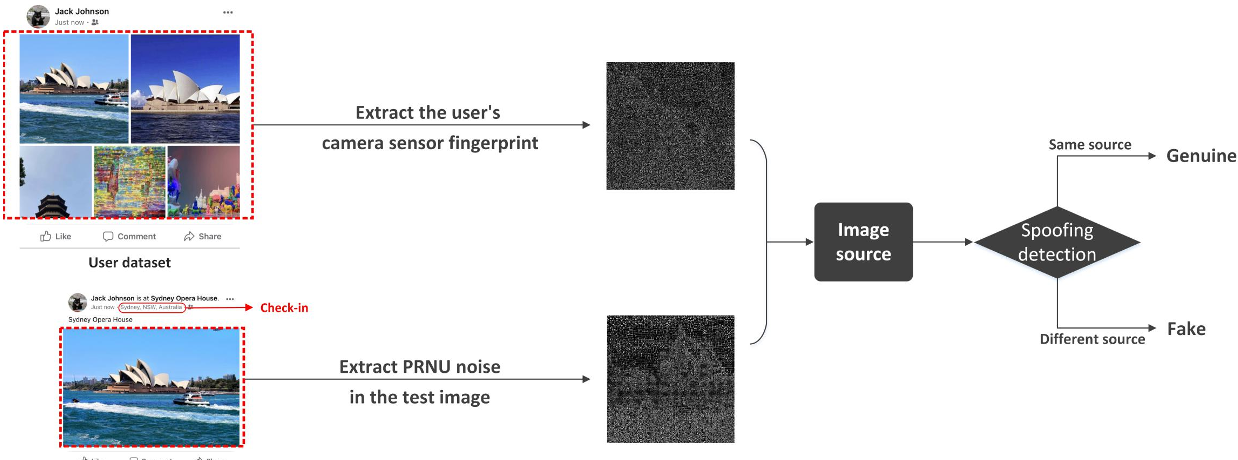 Figure 1: The proposed framework—extracting PRNU noise to verify the consistency of image sources.
Real-World Scenarios and Performance
The researchers tested their method against four practical scenarios:
- Single Device (Digital Identity Theft): User B steals User A’s photo. Result: Detected with high accuracy.
- Multiple Devices: A user owns an iPhone and a Huawei. Result: Effective through noise clustering.
- Device Sharing/Overdue Images: Scenarios where a user uses their own phone to fake a location or uses an old photo. Result: The method faces limitations here because the "fingerprint" remains legitimate.
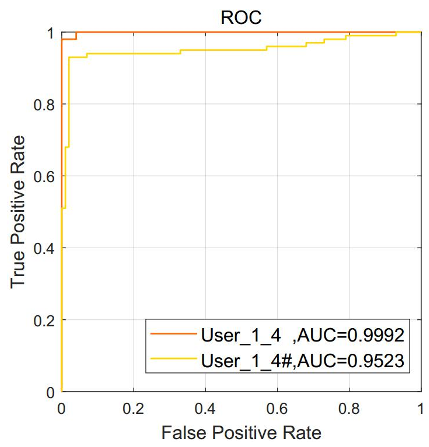 Figure 2: Performance comparison. Note how the correlation peaks (PCE) clearly distinguish a matching device (red) from non-matching ones (blue).
One of the biggest challenges in this field is compression. Social media platforms like Facebook aggressively compress images, which can "smear" the delicate sensor noise. The study found that even with "Twice Compression" (downloading from one platform and re-uploading to another), the AUC remained at a robust 95.23%.
Critical Insight & Future Outlook
This work demonstrates that the physical layer of hardware provides a more reliable security anchor than the software layer (GPS/Metadata), which is easily manipulated.
Limitations: The method is currently "hardware-centric." It cannot detect if a user takes a photo of a postcard or a screen using their own phone (a "re-capture" attack), nor can it stop someone from using their own old photos (overdue problem).
Future Directions: The next logical step is fusing this hardware fingerprinting with Spatio-Temporal Analysis. By combining the physical sensor ID with the user's predicted movement trajectory, LBSNs could create an unforgeable "Proof of Presence."
Conclusion
This research bridges the gap between digital forensics and social media security. It reminds us that in a world of deepfakes and spoofed locations, the subtle, unintended imperfections of our hardware might be the last bastion of digital truth.