
LTSCR: Bridging Retrieval and Recommendation for Next-POI Prediction
Location and Time Aware Social Collaborative Retrieval for New Successive Point-of-Interest Recommendation
The paper introduces LTSCR (Location and Time aware Social Collaborative Retrieval), a unified latent factor model for successive POI recommendation. By treating the current location as a query, it achieves SOTA performance on Brightkite and Gowalla datasets using a WARP loss-based collaborative retrieval framework.
Executive Summary
TL;DR: The paper presents LTSCR, a robust model designed to predict where a user will go next (Successive POI Recommendation). By treating a user's current location and time as a "retrieval query" and combining this with social influence and long-term preferences, the authors achieved a nearly 50% improvement in recommendation accuracy over existing state-of-the-art methods.
Positioning: This work represents a significant evolutionary step in Location-Based Social Networks (LBSNs), moving from simple Matrix Factorization to a hybrid structure that fuses Information Retrieval (IR) techniques with Collaborative Filtering (CF).
Problem & Motivation: The "Where Next?" Challenge
Most recommendation engines focus on what you like in general. However, in LBSNs, the most critical factor is where you are right now. If you just finished a meal at a restaurant, you are unlikely to visit a park 50 miles away; a nearby cafe or cinema is more probable.
The authors identified three gaps in existing research:
- Social Neglect: Friends influence our choices, but current models rarely use social graphs for successive moves.
- Temporal Blindness: A restaurant's popularity spikes at 7 PM, while a park's spikes at 10 AM. Most models treat time as static.
- Ranking Inefficiency: Standard models optimize for overall error (RMSE) rather than the "Top-K" results that users actually see.
Methodology: The LTSCR Framework
LTSCR models the recommendation score through three distinct latent components:
- Transition Patterns (): Captures the physical likelihood of moving from POI i to POI c.
- User Preference (): Captures the personalized affinity of user u for POI c at time t.
- Temporal Popularity (): A bias term reflecting how "hot" a location is during a specific time window.
Architecture and Loss Function
The model uses the WARP (Weighted Approximately Ranked Pairwise) loss. Unlike standard BPR (Bayesian Personalized Ranking) which samples one random negative example, WARP keeps sampling until it finds a "violating" example (one that is ranked higher than the positive one). This forces the model to work harder on difficult cases, leading to much better top-tier accuracy.
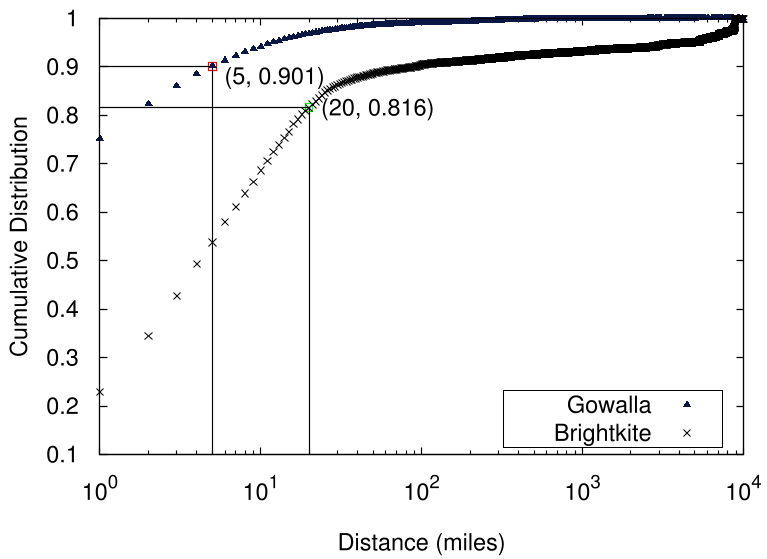
Figure 1: The synergy between Temporal, Social, and Geographical data in LBSNs.
Experiments & Results
The authors tested LTSCR on two massive datasets: Brightkite and Gowalla.
Key Findings:
- Massive Precision Lift: LTSCR outperformed FPMC+LR by 38.3% to 54.9% in Precision@5.
- Social & Time Matter: The ablation study (incremental testing) showed that adding social regularization and temporal factors consistently pushed the performance curve upward.
- Localized Constraint: Restricting candidates to the current "grid" significantly reduced noise and improved retrieval speed.
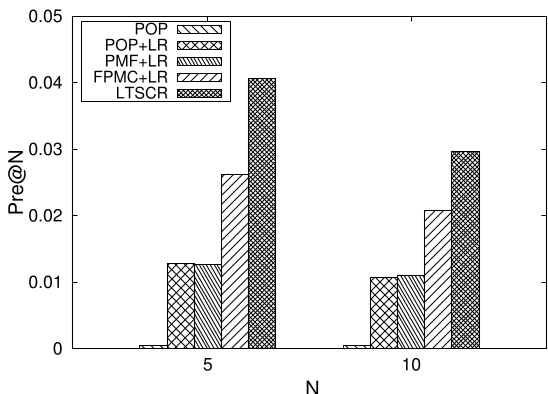
Figure 2: Precision and Recall comparison across different models. LTSCR (Red) shows dominant performance.
Critical Analysis & Conclusion
Takeaway
The genius of LTSCR lies in its hybrid nature. It recognizes that "Next POI" is as much a search problem (query = current location) as it is a recommendation problem (profile = historical visits).
Limitations & Future Work
- Data Sparsity: The model relies on social links; for users with no friends in the system, the social regularization term becomes useless.
- Grid Rigidity: Fixed-size grids (0.05x0.05) might be too large for dense cities and too small for rural areas.
- Deep Learning: As a 2015 paper, it uses latent factor models. Future iterations could replace these linear inner products with Deep Neural Networks to capture non-linear transition complexities.
Final Thought: LTSCR remains a foundational blueprint for how to build context-aware systems that respect the physical constraints of the real world.