
DGD: Dynamic Group Division for Robust Location and Trajectory Privacy in 5G-VSN
Towards Location and Trajectory Privacy Preservation in 5G Vehicular Social Network
This paper introduces the Dynamic Group Division (DGD) algorithm for 5G-based Vehicular Social Networks (VSN). By integrating Mobile Femtocell (MFemtocell) technology and a novel pseudonym exchange protocol, the method achieves superior location and trajectory privacy preservation while meeting the real-time requirements of 5G environments.
TL;DR
With the advent of 5G Intelligent Transport Systems, vehicular privacy has become a critical focal point. This paper proposes the Dynamic Group Division (DGD) algorithm, which utilizes Mobile Femtocells (MFemtocells) and social behavior analysis to protect vehicle trajectories. By dynamically clustering vehicles around "hot pots" and optimizing pseudonym exchange via entropy, DGD outperforms existing SOTA methods like MixGroup in both speed of anonymity formation and overall tracking resistance.
Problem & Motivation: The Static Limitation
In a Vehicular Social Network (VSN), vehicles must broadcast safety messages (location, speed, direction) periodically. This is a goldmine for attackers. Previous efforts, such as MixGroup, introduced "Mix-zones" where vehicles swap pseudonyms. However, these methods face three critical failures:
- Latency: They cannot meet the microsecond real-time demands of 5G.
- Static Topology: They assume fixed regions, ignoring the dynamic, center-less nature of 5G MFemtocells.
- Trajectory Leakage: They don't account for "individual hot pots"—the predictable routes people take daily (e.g., home to work), which allows attackers to de-anonymize even intermittent data.
Methodology: High-Speed Dynamics & Social Awareness
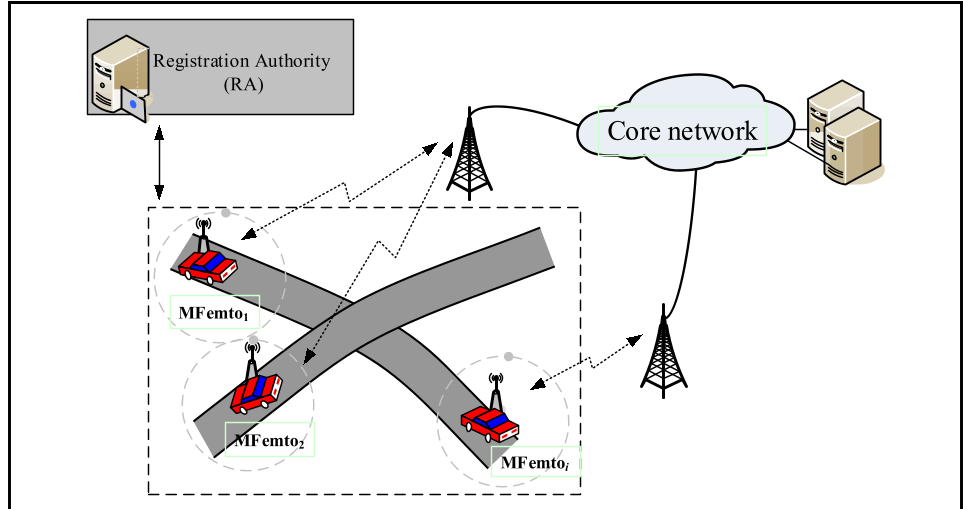
The authors propose a 5G-integrated architecture where each vehicle acts as an MFemtocell, allowing for adaptive communication and lower signaling overhead.
1. The Architecture
The system relies on three pillars: Vehicles (mobile sensing nodes), Registration Authority (RA) (trusted certificate issuer), and Base Stations (gateways to the core network).
2. Group Generating Protocol (GGP)
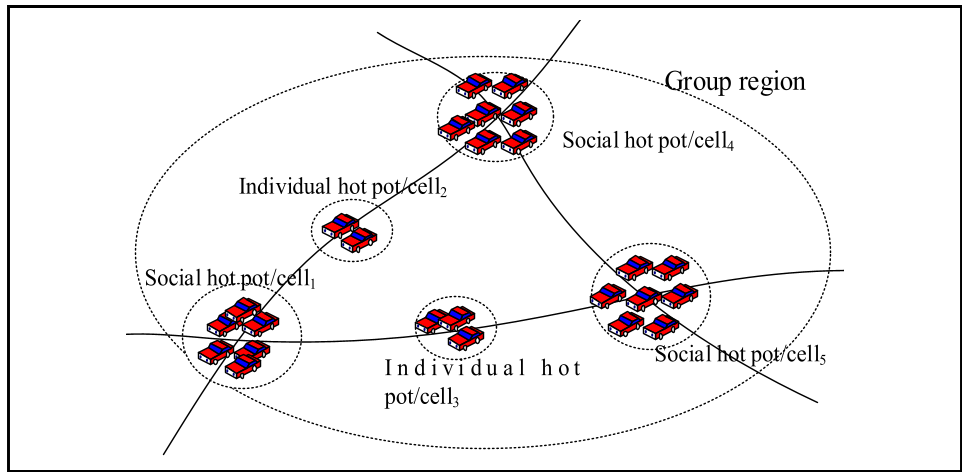
Unlike static zones, DGD forms groups dynamically when vehicles enter a "hot pot" (an area of high social density or frequent individual visits). The group expands or contracts based on two thresholds:
- : Maximum anonymity set size.
- : Maximum spatial distance deviation.
This ensures that the "mixing" area is large enough to obscure the path but efficient enough to maintain performance.
3. Entropy-Based Pseudonym Exchange
Instead of swapping pseudonyms randomly, DGD uses Pseudonym Entropy (). An exchange only occurs if it increases the collective uncertainty of the system: This filtered approach ensures that exchanges actually contribute to privacy rather than just consuming computational resources.
Experiments & Results
The authors validated DGD against MixGroup using a 3000m x 3000m simulation.
Rapid Anonymization
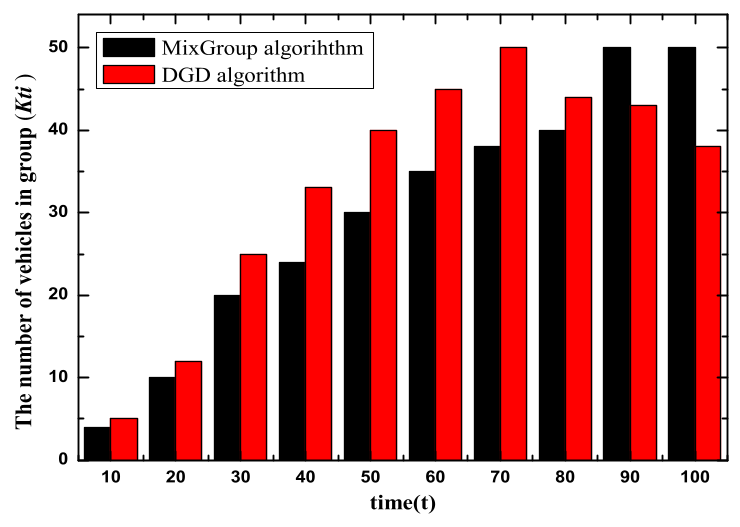
DGD reaches the target anonymity set size () significantly faster than the baseline. In the time it takes MixGroup to reach stability (90s), DGD has already been stable for 20 seconds, proving its suitability for high-speed 5G traffic.
Superior Trajectory Obfuscation
Over a continuous trajectory (600s), DGD maintained an average distance deviation of 727.67m, compared to MixGroup’s 621.33m. This higher deviation means that even if an attacker attempts to "guess" the vehicle's path, the mathematical error margin is vastly increased, effectively protecting the vehicle's long-term trajectory.
Critical Analysis & Conclusion
Takeaway
The DGD algorithm successfully turns the high mobility of 5G into an advantage for privacy. By using Mobile Femtocells, the system removes the bottleneck of fixed infrastructure, allowing groups to form wherever social activity occurs.
Limitations & Future Work
While DGD handles trajectory privacy well, the reliance on a single Registration Authority (RA) remains a potential single point of failure. Future research could explore Decentralized Identifiers (DIDs) or Blockchain-based RA to ensure the system remains robust even if the central authority is compromised.