
LOCI: Bridging the Gap in Local Knowledge through Socially-Aware Q&A
LOCI: A Mobile Q&A System with Multimodal Motivation Scheme for Local Intent Questions in Dynamic Social Networks
This paper introduces LOCI, a mobile Q&A system optimized for local intent questions by matching askers with the most relevant local experts in dynamic social networks. The core contribution is a multimodal motivation scheme and three online allocation algorithms (LOCI-RT, LO, and AD) that outperform traditional crowdsourcing benchmarks in response quality and speed.
TL;DR
LOCI is a specialized mobile Q&A system designed to solve "local intent" questions—those specific, non-factual queries that even Google or Quora struggle with. By leveraging a Multimodal Motivation Scheme (combining social ties and rewards) and three novel online matching algorithms, LOCI ensures that questions reach the right person at the right time, balancing the trade-off between speed and answer quality.
Background: The "Local Intent" Blind Spot
When you search for "the best quiet coffee shop in this neighborhood for a 2 PM meeting," general search engines often give you generic TripAdvisor lists. Community Q&A sites are better but lack the spatial focus. The researchers identified that 53% of mobile searches have local intent, yet we still lack a system that effectively routes these questions to local experts who are actually willing to answer.
The Core Innovation: Why Do People Answer?
One of the most significant contributions of this paper is the Multimodal Motivation Scheme. The authors recognize that users aren't just driven by money. They conducted a survey of 115 users and found a critical insight: Social Ties (knowing the asker) significantly increase the probability of a response, sometimes even more than small monetary rewards.
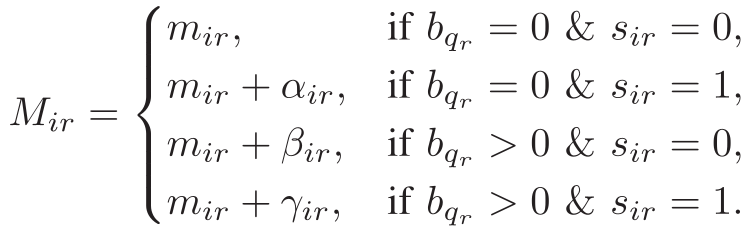
The Quality of Work (QoW) is then defined as a product of this Motivation () and the user's Reputation ():
Methodology: The Three Faces of Allocation
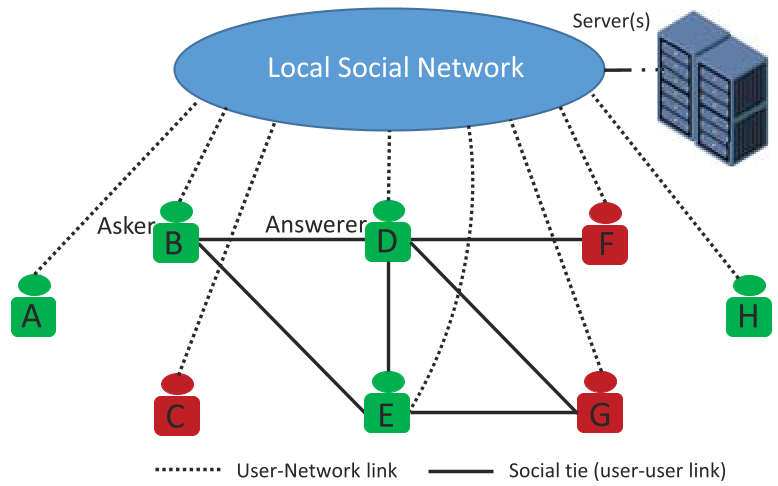
Matching questions to users in a dynamic social network is an Online Weighted Bipartite Matching problem. The authors developed three algorithms to handle different priorities:
- LOCI-RT (Real-Time): If speed is everything. It matches the first available expert to a question immediately. Great for completion rates but might miss a better expert who logs on 5 minutes later.
- LOCI-LO (Locally Optimal): Uses short-term batching. It waits and then uses the Hungarian Algorithm to find the mathematically optimal "Question-User" pairing within that batch.
- LOCI-AD (Adaptive): The smart hybrid. If a question has a tight deadline, it uses RT. If there’s more time, it puts it in a batch (LO) to find a higher-quality answerer.
Experimental Results: Speed vs. Quality
Using a combined dataset of Facebook social ties and Tokyo location check-ins, the team simulated a week of Q&A activity.
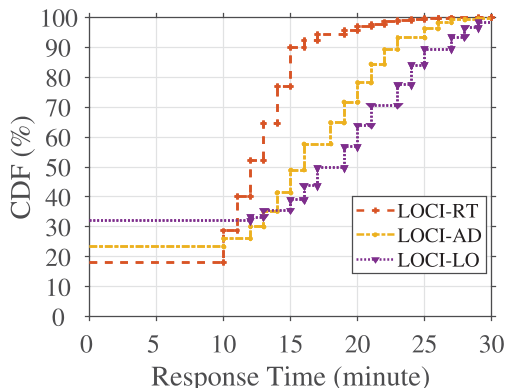
- Completion Ratio: LOCI-RT dominated here, answering 82.1% of questions. Because it acts instantly, fewer questions expire.
- Quality of Work (QoW): LOCI-LO was the winner. By waiting for the best match, the average quality of answers was significantly higher than the "quick and dirty" RT approach.
- Adaptability: LOCI-AD proved to be the "sweet spot," providing quality close to LO while maintaining a response time closer to RT (approx. 14.9 minutes).
Critical Insight & Conclusion
The LOCI system highlights a crucial shift in AI and crowdsourcing: Context matters more than raw data. By incorporating the "social graph" into the "knowledge graph," we can unlock hyper-local information that was previously unreachable.
Takeaway for the Industry: If you are building a service-oriented platform, don't just rely on tips/money to motivate users. Integrating social familiarity can be a more sustainable and powerful driver for community engagement.
Limitations: The study assumes static social tie strengths, but in reality, friendships evolve. Future research should look into how "dynamic social strength" impacts these motivation levels over time.