
LoCost: Redefining Swarm Intelligence via the Biological Survival Instincts of Locusts
LoCost: A spatial social network algorithm for multi-objective optimisation
This paper introduces LoCost, a novel Multi-Objective Particle Swarm Optimisation (MOPSO) algorithm based on spatial social networks and the biological behavior of locusts and crickets. It eliminates the need for global "guide" particles by utilizing Pareto dominance-based attraction and repulsion between nearest neighbors in Euclidean space.
TL;DR
The LoCost algorithm shifts the paradigm of Multi-Objective Particle Swarm Optimisation (MOPSO) by moving away from global "best" guides. Inspired by the avoidance behavior of crickets and locusts, it uses a localized spatial social network where particles are either attracted to or repelled by their nearest neighbors based on Pareto dominance. This decentralized approach yields superior Pareto-front coverage and solves the long-standing "guide selection" dilemma.
The "Guide Search" Bottleneck
In standard PSO, particles chase a "Global Best" (). However, in multi-objective optimization, there is no single "best" solution, but a set of trade-offs called the Pareto-optimal front.
Previous methods (Prior Work) struggled with:
- Selection Complexity: Choosing which non-dominated solution should guide the swarm is mathematically ambiguous.
- Lack of Diversity: Standard attraction often leads to "clumping" on the front, leaving significant gaps in the trade-off surface.
- Local Optima: In multimodal functions, swarms easily get trapped by deceptive fronts without a mechanism to push particles apart.
Methodology: From Cooperation to Cannibalistic Avoidance
The core insight of LoCost is derived from studies on crickets, where individuals must move to avoid being eaten by their hungry neighbors. The author translates this into a Spatial Social Network where neighborhoods are defined by Euclidean distance rather than particle indices.
The Velocity Reformulation
The traditional velocity equation is replaced with a conditional logic based on the status of the nearest neighbor ():
- Attraction (+): If the neighbor dominates the particle, move towards it.
- Repulsion (-): If the neighbor is not dominant, move away from it.
By interacting only with the single nearest neighbor (), the swarm exhibits emergent global coordination without needing an archive-wide leader.

Experimental Validation
The researcher compared LoCost against a standard MOPSO with Sigma update on the ZDT suite of test functions.
1. Superior Coverage
Qualitative analysis of the ZDT2 function (Non-convex) shows that while MOPSO captures the center of the front, LoCost "fills the gaps" and reaches the extremes of the second objective that MOPSO missed.
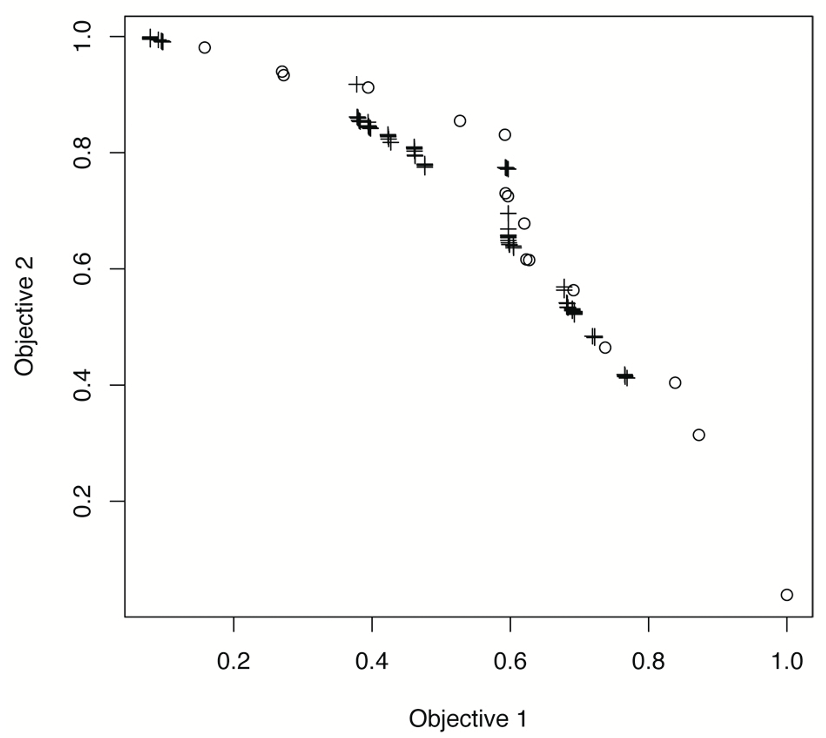 Fig 1: LoCost (o) provides a more uniform distribution than MOPSO (+) on the ZDT2 front.
2. Quantitative Dominance (Hypervolume)
In ZDT2, the hypervolume—a measure of both convergence and diversity—showed a massive leap from 0.09 (MOPSO) to 0.70 (LoCost). Even in deceptive functions like ZDT4, while MOPSO found more points, LoCost demonstrated better resilience against getting trapped in local fronts.
| Metric | ZDT1 | ZDT2 | ZDT3 | ZDT4 |
|---|---|---|---|---|
| LoCost HV | 0.33 | 0.70 | 0.07 | 0.35 |
| MOPSO HV | 0.32 | 0.09 | 0.11 | 0.32 |
Critical Insights & Future Outlook
LoCost proves that repulsion is as important as attraction. By adding a repulsive force, the algorithm naturally maintains swarm diversity and exploration, which is critical for mapping an entire Pareto front.
Limitations & Future Work
- Swarm Density: The transition from disorder to order in locusts is density-dependent. Future research needs to find the "critical mass" of particles for optimal LoCost performance.
- Scalability: While Euclidean distance is effective for 2D/3D objective spaces, it may become a computational bottleneck in high-dimensional engineering designs.
Conclusion
LoCost represents a lean, biologically grounded alternative to complex MOPSO variants. It suggests that by simply changing how we view "neighbors"—not just as guides but as warnings—we can achieve significantly more thorough optimization results.