
LLOCUS: Solving the "Both Ends Mobile" Paradox in Crowdsourced Localization
LLOCUS: Learning-based Localization Using crowdSourcing
LLOCUS is a novel learning-based system designed for real-time localization and power estimation of unknown mobile transmitters using crowdsourced RF sensing. By decoupling the localization task from power estimation and employing RSS interpolation at virtual anchor points, it achieves state-of-the-art accuracy in dynamic environments where both transmitters and receivers are mobile.
TL;DR
LLOCUS is a breakthrough learning-based system that localizes mobile transmitters using a crowd of mobile receivers. By decoupling power estimation from location prediction and using a novel "virtual receiver" interpolation technique, it outperforms traditional geometric models by up to 68% while handling the chaos of unrestricted mobility.
Context: Most localization systems (like WiFi fingerprinting) rely on static access points. LLOCUS moves localization from "fixed infrastructure" to "dynamic crowdsourcing," positioning it as a key tool for spectrum enforcement and ad-hoc networking.
The Problem: The Inconsistency of Mobile Fingerprints
Deep learning has revolutionized indoor localization through "fingerprinting"—associating specific RSS (Received Signal Strength) patterns with specific map coordinates. However, fingerprinting breaks down in a crowdsourced scenario:
- Dynamic Receivers: The receivers (phones in the crowd) are always moving. A "fingerprint" taken at Time A is useless at Time B because the receivers are no longer in the same spots.
- Unknown Transmit Power: Malicious jammers or unauthorized transmitters can change their power to confuse distance-based algorithms.
- Sparsity: You can't train for every square inch of a park or building using a mobile crowd; the data is naturally "holy."
Methodology: Decoupling and Interpolating
The core insight of LLOCUS is to transform the chaotic, moving receiver data into a stable, virtual grid.
1. Handling the "Both Ends Mobile" Challenge
To create a consistent feature set for a machine learning model, LLOCUS uses Feature Mapping. It takes the RSS readings from mobile receivers and interpolates them onto a set of Virtual Receiver Locations.
- IFVR (Fixed): Interpolates to a static grid.
- IVVR (Variable): A more accurate, though "lazier" learning approach that re-trains for every specific set of online receiver locations.
 Figure 1: The LLOCUS workflow: Decoupling power from location.
2. Regularized Radial Basis Interpolation (RRBI)
To solve the sparsity problem, the authors developed RRBI. Unlike standard kNN, which struggles when training data is spread thin, RRBI uses a kernel-based approach with least-square regularization. This prevents the model from over-relying on noisy, interpolated features and allows it to generalize transmitter locations in areas where it hasn't seen training data.
3. Power Estimation Before Localization
LLOCUS solves the "unknown power" problem by using an SVM regressor to predict the transmitter's power first. Once the power is estimated, it scales all incoming RSS values to a "baseline" power, making the transmit power variability transparent to the localization algorithm.
Experimental Performance
The researchers tested LLOCUS in three distinct environments: an outdoor park, indoor hallways, and an uneven outdoor space.
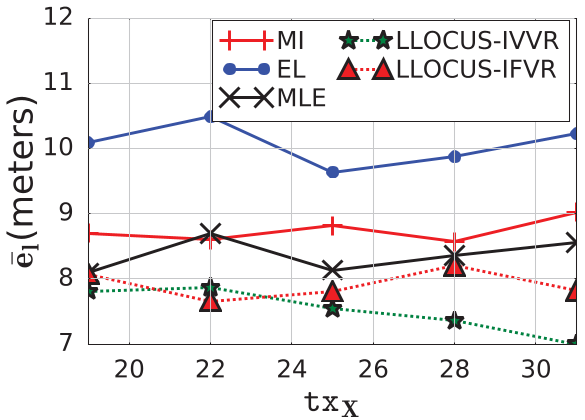 Figure 2: Localization error (e_l) comparison across different datasets. LLOCUS (red/blue) significantly decoys error vs. non-learning baselines like MLE.
Key Findings:
- Superior Accuracy: In indoor environments (Dataset B), LLOCUS achieved a 68% reduction in error compared to non-learning methods.
- Power Awareness: The power estimation module consistently stayed within 3 dB of the true value, significantly better than simple "Max-RSS" heuristics.
- Multi-Transmitter Capability: By using an adaptive neighborhood selection, LLOCUS can distinguish and localize multiple simultaneous transmitters (SATs) without the "false positive" spikes seen in previous systems like SPLOT.
Critical Insight: The Cost of Flexibility
While LLOCUS is highly effective, there is a technical trade-off. The IVVR approach (Variable Virtual Receivers) is more accurate but requires complexity, where is the number of training entries. For large-scale cities, this might require significant cloud compute. However, the IFVR variant offers a "lite" version that provides sub-second latency on standard hardware with only a slight dip in accuracy.
Conclusion
LLOCUS bridge the gap between static fingerprinting and inaccurate propagation models. By treating the crowd as a dynamic sensor fabric and using smart interpolation to "stabilize" that fabric, it provides a robust path forward for real-time spectrum monitoring.
Takeaway for the Industry: For developers of location-based services or spectrum monitoring tools, the lesson is clear: don't rely on the physics of the path loss model alone—let the environment-specific data, stabilized by virtual anchors, do the heavy lifting.