
Turning Logs into Entities: A BERT-Powered Paradigm Shift in System Analytics
Log and Execution Trace Analytics System
The paper introduces a machine learning-based log parsing system that reformulates log analysis as a Named Entity Recognition (NER) task. Utilizing the pre-trained BERT (Bidirectional Encoder Representations from Transformers) model, the system extracts structured entities from semi-structured macOS and Linux logs, achieving SOTA-level accuracy.
TL;DR
Log parsing is often the "dirty work" of system administration, traditionally dominated by brittle regular expressions. This paper proposes a sophisticated shift: treating log lines as language and using BERT-based Named Entity Recognition (NER) to extract structured data. The result? A system that achieves 99% accuracy on macOS and Linux logs with far greater adaptability than traditional rules.
Problem & Motivation: The "Regex" Bottleneck
In the world of site reliability engineering (SRE), logs are the gold mine for root cause analysis. However, they are typically semi-structured messes of timestamps, hex codes, and ambiguous strings.
The authors identify three critical pain points:
- Volume: Systems generate billions of lines, making manual inspection impossible.
- Brittleness: Rule-based parsers (Regex) break whenever a developer changes a log format in a new software version.
- Domain Specificity: Standard NLP models are trained on News or Wikipedia; they don't understand what a
kernel[0]or aPID [4718]is.
The technical intuition here is to leverage the contextual awareness of BERT to recognize the role of a token based on its surroundings, rather than its literal string match.
Methodology: Log Parsing as NER
To transform unstructured logs into high-quality structured data, the authors repurposed the NER framework. Instead of looking for "People" or "Locations," they trained BERT to identify:
- Timestamp: Temporal markers.
- Component/User: The actor or module generating the log.
- PID/Address: Technical identifiers.
- Content: The actual message payload.
Data Strategy
Since no "Gold Standard" labeled log dataset exists for NER, the authors used a clever two-pronged approach:
- Bootstrapping with Drain: They used Drain (a heuristic-based parser) to generate initial "silver" labels.
- Refining with Tagtog: A collaborative platform was used for human-in-the-loop refinement.
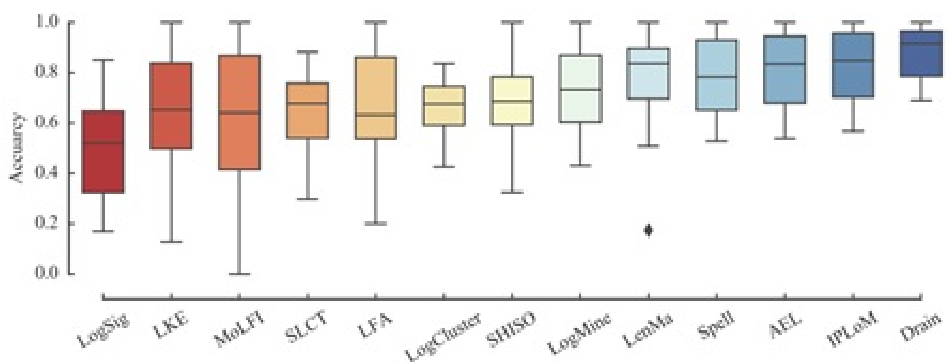 Figure: Accuracy statistics of existing Log Parsers highlighting why Drain was chosen for bootstrapping.
Experiments & Results
The model was fine-tuned on the bert-base-uncased checkpoint using the AdamW optimizer.
SOTA Performance
The results were remarkably robust:
- macOS Logs: 99% Accuracy, 98% F1-Score.
- Linux Logs: 99% Accuracy, 1% Validation Loss.
The model proved it could handle "rare words" and sub-word tokens (a common BERT challenge) by repeating labels across sub-word pieces, ensuring the integrity of technical identifiers like IP addresses or file paths.
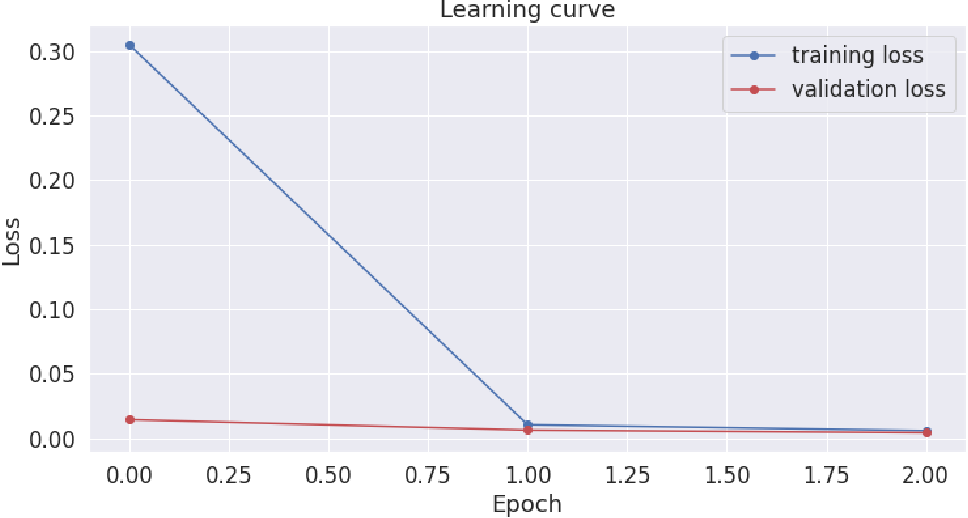 Figure: The learning curve shows rapid convergence, indicating that BERT's pre-trained weights provide a strong base for learning log-specific syntax.
Real-world Extraction
As seen in the sample below, the model correctly identifies Jun 11 as a Timestamp (TIM) and 4718 as a Process ID (PID), even in a noisy environment.
| Token | Label |
|---|---|
| Jun 11 | TIM |
| combo | LEVEL |
| su | SER |
| 4718 | PID |
Critical Insight & Conclusion
The true value of this paper isn't just the 99% accuracy—it's the generalizability. Unlike rule-based systems that require a human to write a new regex for every new log type, a BERT-based parser can be fine-tuned on a small sample of a new system's logs and "learn" the structure through transfer learning.
Limitations: While BERT is powerful, it is computationally heavier than a regex. Future industrial implementations might need to look into DistilBERT or TinyBERT for real-time, edge-node log parsing. However, as it stands, this research successfully bridges the gap between raw system traces and actionable intelligence.