
LG Centrality: Bridging Physics and Social Dynamics for Scalable Influence Ranking
Logarithmic gravity centrality for identifying influential spreaders in dynamic large-scale social networks
The paper introduces Logarithmic Gravity (LG) centrality, a novel local metric for identifying influential nodes in large-scale social networks. By integrating Degree Centrality with a physics-inspired gravity model using a logarithmic distance decay, it achieves superior ranking accuracy compared to k-shell and betweenness centrality.
TL;DR
Researchers have developed Logarithmic Gravity (LG) Centrality, a new metric that identifies influential spreaders in massive social networks by treating nodes like celestial bodies. By combining the simplicity of Degree Centrality with a logarithmic distance decay, LG Centrality outperforms traditional SOTA methods like k-shell and betweenness in both accuracy and speed, specifically designed for the demands of dynamic, large-scale systems.
Problem & Motivation: The Scalability-Accuracy Tradeoff
In the era of big data, identifying who "moves" the needle in a network—whether for viral marketing or stopping a pandemic—is a high-stakes task. However, existing tools are flawed:
- Global Metrics (Betweenness/Closeness): These require global topology knowledge and are computationally "heavy" (O(n³)). In a network with millions of users that changes every second, they are practically useless.
- Local Metrics (Degree): While fast, they are "blind." Two nodes might have the same number of friends, but one is a gatekeeper to a community while the other is in a dead-end cluster.
- Decomposition Methods (k-shell): Often produce "ties" where thousands of nodes share the same rank, offering no granular insight.
The authors' insight was to look toward physics. If human influence behaves like a force, can we model it using the Law of Universal Gravitation, but optimized for the "small world" nature of social networks?
Methodology: The Logarithmic Gravity Model
The core of the paper is the Mutual Influence (MI) formula. It posits that the influence between two nodes increases with their "mass" (degree) and decreases as the distance between them grows.
The Formula
Where:
- DC(a): Degree centrality of node 'a' (the "mass").
- D(a, b): Shortest path distance.
- Logarithmic denominator: This ensures that influence doesn't drop off too sharply (as it would with a squared distance), reflecting how information persists across social hops.
Architecture: The k-hop Boundary
To keep the algorithm efficient, the calculation is restricted to a k-hop local network. Instead of scanning the whole world, the algorithm only cares about the neighborhood within 'k' steps.
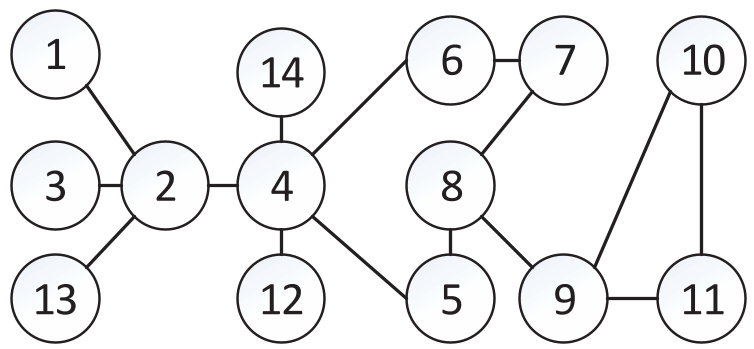 Fig 1: A sample network where LG Centrality successfully distinguishes node influence (e.g., node 6 vs node 10) where degree centrality fails.
Experiments & Results: Proving the Force
The authors validated their model using the SIR (Susceptible-Infectious-Recovered) model—the gold standard for simulating spreading dynamics.
1. Fine-Grained Discrimination
In testing with a single "patient zero," LG Centrality showed a much tighter correlation with the actual infection ratio than Degree or k-shell. It acts like a high-resolution lens, revealing "tinier differences" in node potential that other metrics miss.
2. Multi-Spreader Efficiency
The most striking results came from the "multiple spreader" scenarios. When picking the top-N most influential nodes, LG Centrality consistently led to a higher total percentage of the network being "infected."
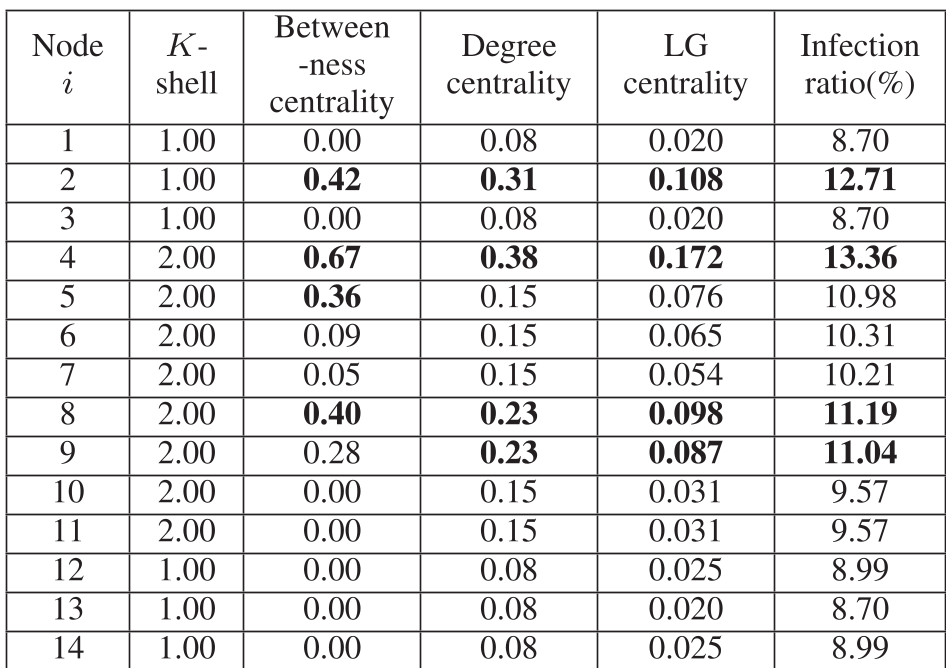 Table 1: Detailed comparison of ranking indices. Note how LG Centrality provides unique values where k-shell and Degree Centrality result in many redundant rankings.
3. Scalability
Because LG Centrality is built on local computation (O(m) where m is the local edge count), it can handle the "churn" of dynamic networks. When a new edge is added, only the local neighborhoods needs an update, not the entire global matrix.
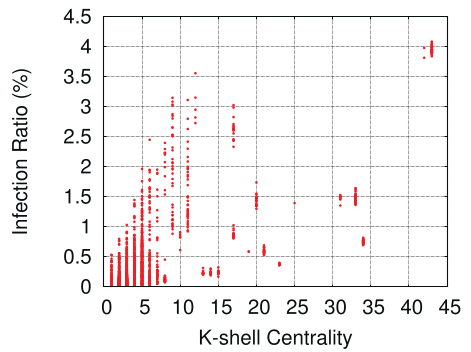 Fig 2: Comparative performance on the GR-QC dataset—LG Centrality (blue line) maintains a superior infection ratio as the number of initial seeds increases.
Critical Analysis & Conclusion
Takeaway
LG Centrality is a powerful hybrid. It takes the "cheap" data of local degrees and enriches it with a "physics-inspired" distance decay. It effectively solves the distinguishability problem of local metrics without the computational burden of global ones.
Limitations
The model currently focuses on undirected, unweighted networks. In many real-world scenarios (like Twitter/X or finance), the direction of influence (who follows whom) and the "weight" of the connection (frequency of interaction) are vital. Extending the logarithmic gravity formula to handle directed weights remains an open challenge.
Future Outlook
As social networks continue to grow, the "local-calculation-of-global-importance" paradigm seen here will become the standard. LG Centrality provides a mathematical foundation for real-time influence tracking in systems too large to ever be analyzed "globally."