
Beyond Transactions: Logical Rule Mining on Semantic Trajectories
Towards logical association rule mining on ontology-based semantic trajectories
The paper introduces a novel pipeline for mining logical Association Rules (Horn rules) from ontology-based semantic trajectories. By adapting the state-of-the-art AMIE 3 algorithm to a Foursquare mobility dataset, specifically transformed into an application-specific RDF representation, the authors achieve the extraction of complex patterns that incorporate temporal, spatial, and semantic dimensions.
TL;DR
Researchers have moved beyond simple "if bread, then milk" association rules to extract deep semantic patterns from human mobility data. By transforming the complex STEP ontology into a relation-centric format and applying the AMIE 3 algorithm, this work demonstrates how to mine Horn rules—logical statements that capture "Why", "Where", and "When" in a single relational context.
Problem & Motivation: The Relational Gap
For years, the trajectory community has been stuck between two worlds:
- Raw Spatiotemporal Data: Highly precise but semantically blind (just dots on a map).
- Ontology-based Representations: Semantically rich but computationally "heavy" for mining.
Traditional algorithms like Apriori treat trajectory points as independent transactions. However, human mobility is inherently relational. If you visit a residential building in the afternoon, there is a physical and logical probability that your next stop is a nearby transit hub. Standard methods struggle to express these multi-dimensional links (spatial proximity + temporal windows + semantic categories) in a way that is both human-readable and mathematically sound.
Methodology: Bridging Ontologies and Logic
The authors identified that standard ontologies like STEP are too verbose for direct mining. They often use intermediate "Feature of Interest" (FOI) nodes that obscure the direct relationship between a user and their location.
1. The Transformation Pipeline
The core innovation lies in a "flattening" process. By converting semantic instances (FOIs) directly into relations, the researchers reduced the triple count from ~747k to ~524k while doubling the number of descriptive relations (e.g., withinRadius, hasTime).
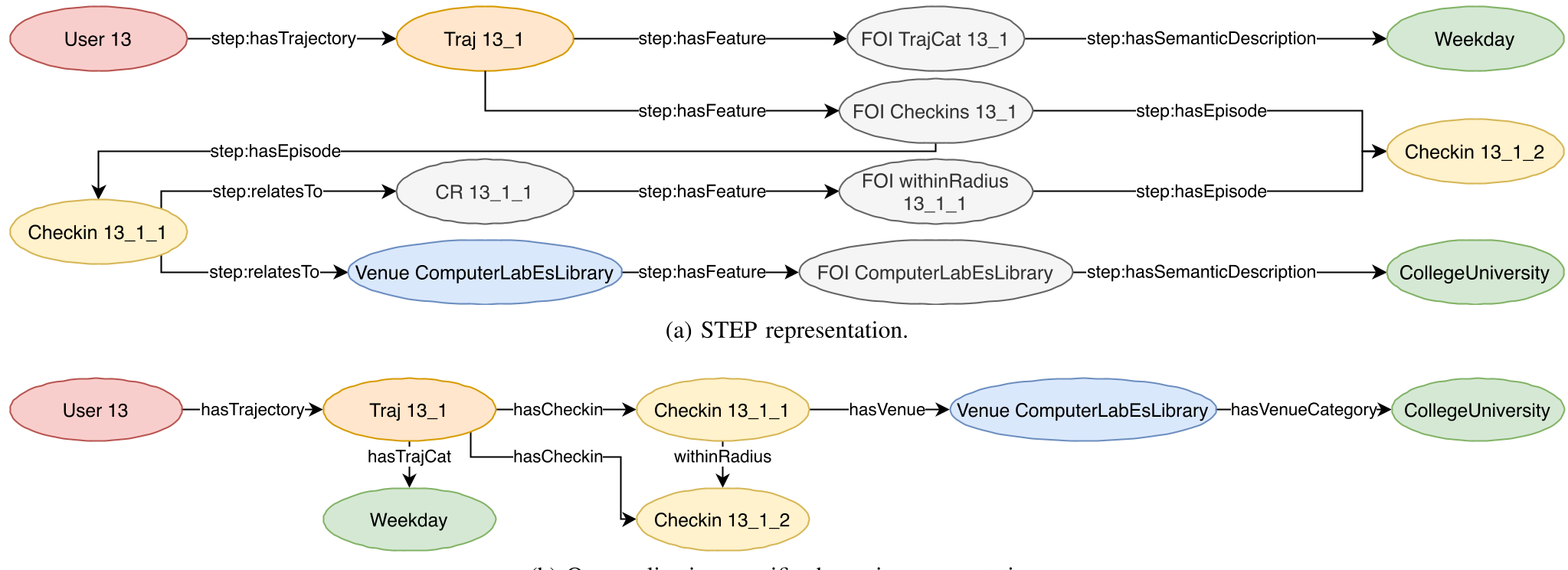 In the figure above, (a) shows the cumbersome original STEP structure, while (b) shows the streamlined, relation-centric version optimized for the AMIE 3 miner.
2. Metarules: Managing Rule Explosion
Mining a Knowledge Base (KB) often leads to thousands of redundant rules. The authors proposed Metarules—logical templates. Instead of analyzing "If at Penn Station in Afternoon → Weekday" and "If at Grand Central in Morning → Weekday" separately, they are grouped under a single template: hasCheckin(t,c), hasVenue(c, const0), hasTime(c, const1) ⇒ hasTrajCat(t, const2).
Experimental Results: Sifting Through the Data
Using a filtered Foursquare NYC dataset (35,460 check-ins), the team applied AMIE 3. The performance was impressive but highlighted the "noise" in semantic data:
- Total Rules: 459,256
- Interesting Patterns: Found 34 metarules with direct domain value (e.g., predicting trajectory categories based on specific venue visits).
- The Spurious Challenge: A significant portion of rules (Rule 6 and 7 in the paper) were either trivial tautologies or accidental correlations.
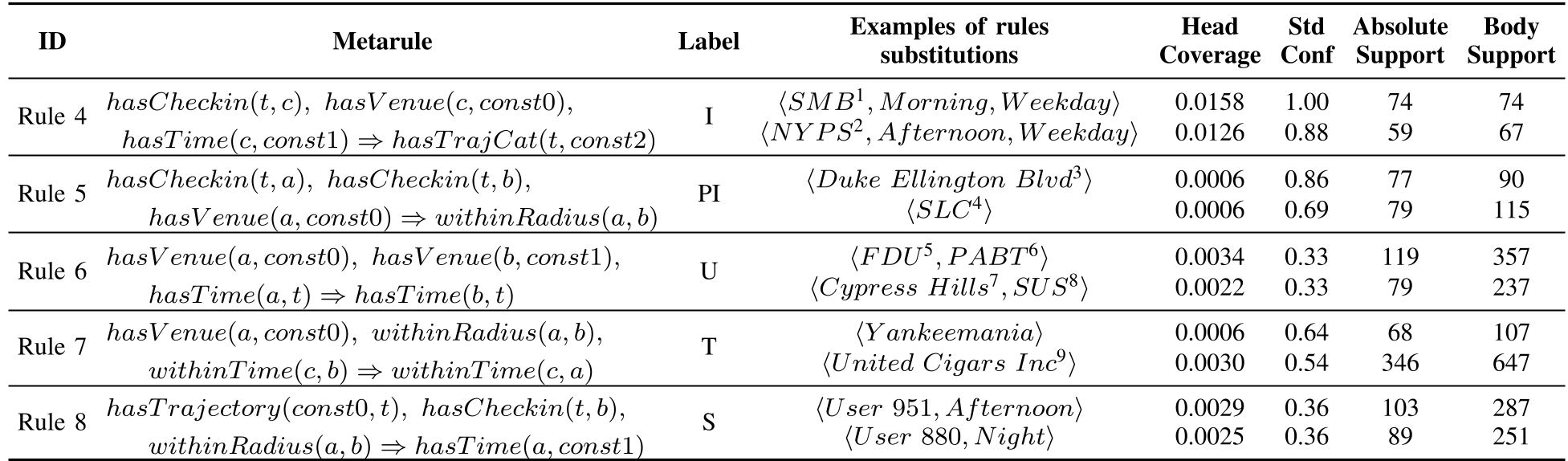 The table above categorizes the mined rules: 'I' for Interesting, 'U' for Uninteresting/Spurious.
Critical Analysis & Conclusion
This paper serves as a vital proof-of-concept. It proves that Knowledge Base Refinement techniques can be effectively "borrowed" for Trajectory Mining.
Key Takeaways:
- Efficiency: The relation-centric approach is a mandatory pre-processing step for any ontology-based mining.
- Limitations: Off-the-shelf KB miners like AMIE 3 don't understand physics. They don't know that
beforeis a transitive temporal relation or thatwithinRadiusis symmetric. This leads to redundant rule generation. - Future Work: The industry needs a Domain-Tailored Miner that treats time and space as first-class citizens rather than just strings in a database. Developing a "Numeric Rule Mining" language to automatically find optimal distance thresholds (e.g., why 2km? why not 1.5km?) is the logical next step.
Final Thought
As we move toward "Digital Twins" and hyper-contextualized LBS (Location-Based Services), the ability to automatically discover logical rules from moving data will be the difference between a system that tracks you and a system that actually understands your behavior.