
Scalable Privacy: Re-thinking Group Management in Decentralized Social Networks
Logical key hierarchy for groups management in Distributed Online Social Network
This paper introduces an efficient group management protocol for Distributed Online Social Networks (DOSNs) by integrating the Logical Key Hierarchy (LKH) model. The proposed approach optimizes content sharing privacy by reducing the computational overhead of re-encryption, achieving O(log n) complexity for group membership changes.
TL;DR
Decentralized Online Social Networks (DOSNs) aim to return data sovereignty to users, but managing privacy for large, dynamic groups is historically expensive. This paper proposes using a Logical Key Hierarchy (LKH) to move away from encryption costs. By organizing users into a d-ary key tree, membership changes (joins/leaves) now only cost , providing a massive scalability boost for privacy-centric platforms.
The Problem: The "Linearity Trap" of Privacy
In a centralized network (like Facebook), the server handles access control. In a decentralized network, we rely on cryptography.
The status quo is inefficient: when you remove a friend from a group, you must generate a new group key and encrypt it individually for every remaining member ( operations). If you have 500 friends, that is 500 asymmetric encryptions every time someone leaves. This doesn't scale. Most existing DOSNs like Diaspora or Safebook suffer from this "Linearity Trap," making real-time group updates sluggish and computationally heavy for mobile peers.
Methodology: The Power of the Tree
The authors adapt the Logical Key Hierarchy (LKH) to the DOSN context. Instead of a flat list of users, members are arranged as leaves in a d-ary Key Tree.
1. The Key-Tree Architecture
- Leaves: Each user has a unique symmetric key.
- Internal Nodes: Represent intermediate symmetric keys.
- Root: The actual "Group Key" used to encrypt shared content.
- Knowledge: A user only knows the keys on the direct path from their leaf to the root.
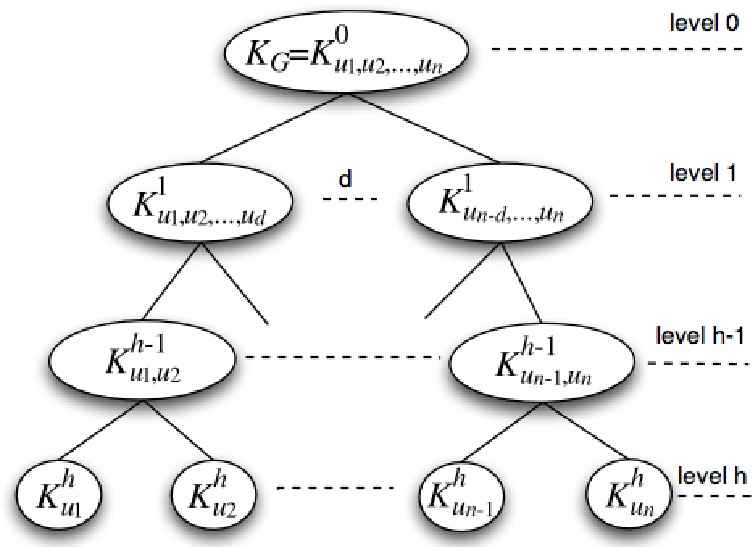 Figure 1: The d-ary tree structure where users only maintain logarithmic state.
2. Handling Dynamic Membership
- Join: When a user joins, only the keys on their specific path to the root are refreshed to ensure backward secrecy (new members can't read old posts).
- Eviction (Leave): When a user is removed, the group owner changes all keys on that user's path. Because of the tree structure, the owner can encrypt a new node key using the keys of its children, allowing remaining members to "bubble up" to the new root key without O(n) operations.
Experiments & Results
The authors didn't just test this in a vacuum; they used a real-world Facebook Dataset (SocialCircles!) consisting of 328 ego-networks and over 144,000 users to simulate realistic group dynamics.
Performance Gains
The results confirm a dramatic reduction in overhead:
- Join Costs: Remained nearly constant/logarithmic regardless of group size, requiring only about operations.
- Leave Costs: While slightly more expensive than joins, they still follow a logarithmic curve (), staying well below the linear growth of traditional methods.
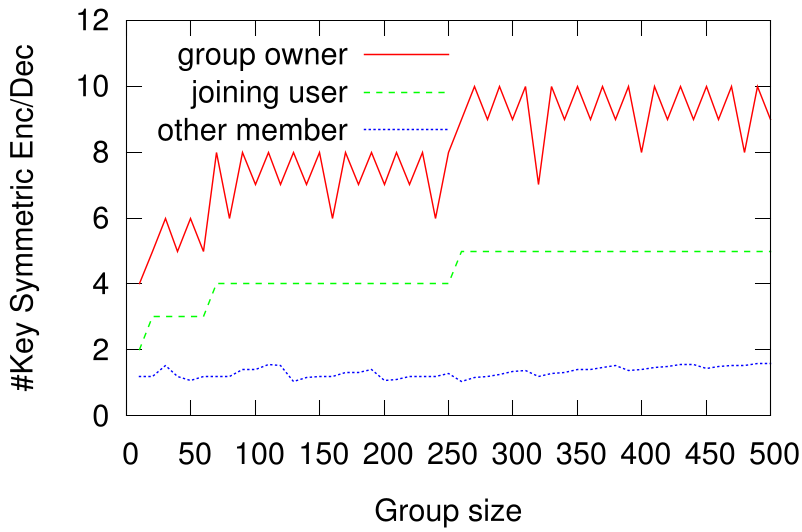 Figure 2: Performance comparison showing logarithmic scaling for Join operations.
Comparison with SOTA
The paper provides a definitive comparison table showing that while systems like LifeSocial.KOM or Safebook require encryptions for leaves, this LKH approach remains .
Critical Insight & Conclusion
The genius of this work lies in its hybrid cryptographic strategy. It uses asymmetric encryption only for the initial individual key exchange and relies on efficient symmetric encryption for the tree-based updates.
Takeaway: As we move toward Web3 and decentralized social media, the bottleneck isn't just storage—it's the management of trust. This LKH implementation proves that we can have sophisticated, granular privacy without sacrificing the performance users expect from modern social applications.
Limitations: The group owner still acts as a central point of management for their specific group's tree. Moving toward a fully "ownerless" or collaborative tree update mechanism could be the next frontier in DOSN research.