
Scaling Privacy: How Logical Key Hierarchies Save Decentralized Social Networks
A Logical Key Hierarchy Based Approach to Preserve Content Privacy in Decentralized Online Social Networks
The paper proposes a privacy-preserving framework for Decentralized Online Social Networks (DOSNs) using a Logical Key Hierarchy (LKH) model to manage group content encryption. By leveraging LKH on top of a Distributed Hash Table (DHT), the system achieves logarithmic complexity for re-keying operations, significantly outperforming traditional linear-time methods common in existing DOSN architectures.
TL;DR
Decentralized Online Social Networks (DOSNs) promise to return data ownership to users, but they face a massive "scaling wall" regarding privacy. Current methods require operations to remove a single user from a group. This paper introduces an LKH-based approach that utilizes tree-based key management to slash re-keying costs to , making large-scale, private decentralized groups practical for the first time.
The Scalability Bottleneck in Decentralized Privacy
In a centralized network (like Facebook), the provider simply checks a database to see if you are in a "Friend Group." In a DOSN, there is no central authority; data is stored on untrusted peers (DHT). To keep content private, you must encrypt it.
The industry standard has been simple:
- Create a symmetric Group Key.
- Encrypt that key with the public keys of all friends.
The Catch: If one person leaves the group, you must change the Group Key to ensure Forward Secrecy (the ex-member shouldn't read new posts). In a group of 10,000, the group owner has to perform 10,000 asymmetric encryptions. As the authors' analysis of real Facebook groups shows—where users leave and join in hundreds per day—this linear overhead is a death sentence for performance.
Methodology: The Power of Key Trees
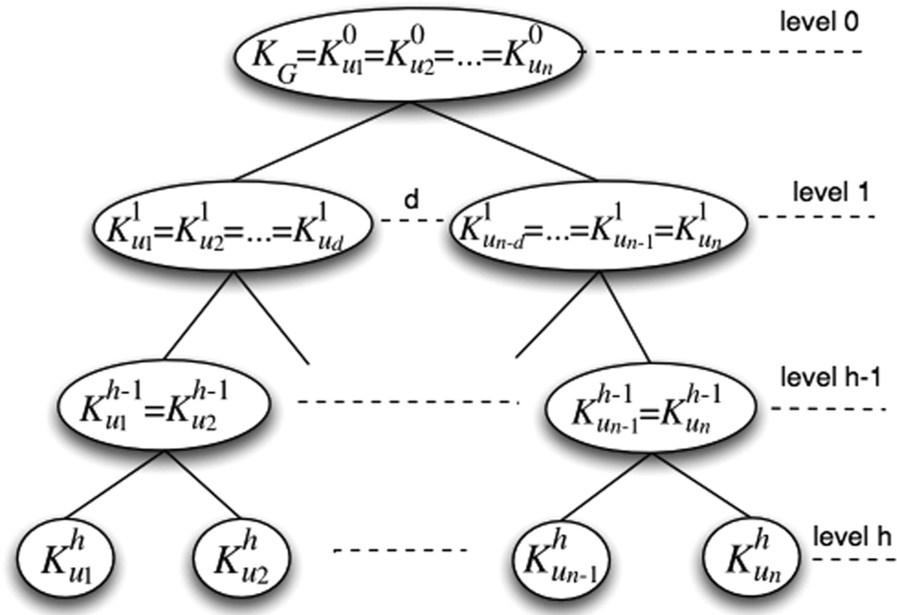
The authors pivot away from "flat" key management to a Logical Key Hierarchy (LKH). Instead of one key for everyone, users are organized into a -ary tree.
1. The Key-Tree Architecture
- Leaves: Represent individual users holding their private keys.
- Internal Nodes: Represent intermediate symmetric keys.
- Root Node: The actual Group Key used to encrypt content.
Each user only knows the keys on the path from their leaf to the root. This structure is the "secret sauce": when a user leaves, you only need to change the keys along their specific path (logarithmic height), not the entire group.
2. Optimized "All-at-once" Join
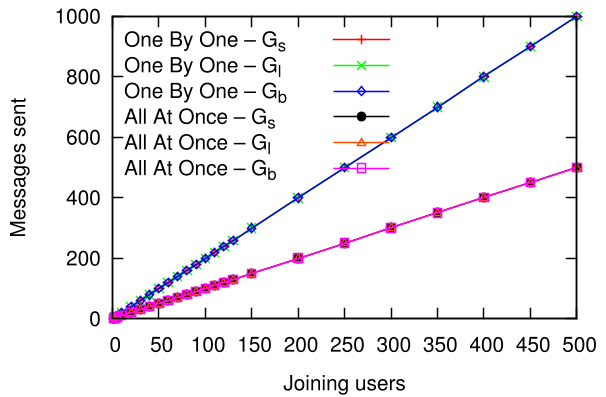
Adding one user is fast, but adding 500 users sequentially still creates redundant work. The authors propose a "Multiple-Join" strategy that groups new users into specific subtrees, allowing the owner to update large sections of the tree in a single batch operation, further boosting efficiency for high-growth groups.
Experimental Proof: Real-World OSN Data
The authors didn't just test this in a vacuum. They crawled real Facebook data, revealing that educational and entertainment groups often reach 9,000+ members with high churn.
Key Findings:
- Computational Efficiency: For a large group (Gb), the group owner's time for a "Leave" operation is almost instantaneous compared to traditional methods that would take seconds or even minutes of CPU time.
- Message Size: By using the Group Descriptor on the DHT to broadcast updates, the "All-at-once" join strategy keeps message overhead linear to the number of new users, regardless of the total current group size.
SOTA Comparison
The paper concludes with a devastating comparison against existing DOSN projects like Diaspora and Safebook. While Diaspora takes to publish and manages revocation poorly, the LKH approach maintains a steady logarithmic cost.
| Method | Join Complexity | Leave Complexity | Publish Complexity |
|---|---|---|---|
| Our Approach | |||
| Diaspora | |||
| LifeSocial |
Critical Insight & Future Outlook
The genius of this work lies in its Inductive Bias toward the structure of social groups. By recognizing that social networks are not flat but hierarchical (friends of friends, sub-communities), LKH perfectly mirrors the natural "social manifold."
However, a potential limitation is the Group Owner's Availability. In this model, the owner must be online to process joins/leaves. Future work might explore a "Delegated LKH" where trusted "administrators" can manage specific branches of the tree, further decentralizing the management load.
The Takeaway: If you are building a Web3 social platform or a privacy-first P2P app, the "encrypt for everyone" strategy is a ticking time bomb. Logarithmic hierarchies are the only path to a scalable, private social future.