
Logo Recognition in the Wild: Bridging Social Context and Visual Intelligence
Logo information recognition in large-scale social media data
The paper introduces a novel logo recognition framework tailored for large-scale social media data (Sina Weibo). It combines a new Dense Kernel Local Binary Pattern (DKLBP) feature with a social information filtering mechanism to achieve high-precision brand tracking in low-quality User-Generated Content (UGC).
TL;DR
Recognizing brand logos in social media is a "needle in a haystack" problem. This paper presents a specialized framework that uses social media metadata (who posted it and what they said) to guide a high-performance visual detector. By introducing Dense Kernel LBP (DKLBP) features and a Social Filtering mechanism, the authors outperform traditional feature-matching methods that struggle with the low-quality, "noisy" images typical of platforms like Sina Weibo.
Background & Motivation: Beyond the Pixel
In the era of social commerce, companies need to track their brand presence in real-time. However, user-generated images are notoriously difficult to process. They are often:
- Low Quality: Blurry, poorly lit, or shot at awkward angles.
- Simple Patterns: A Pepsi or Nike logo doesn't have enough "interest points" for standard SIFT-based algorithms to latch onto.
- Tiny Objects: Logos often occupy a minuscule fraction of the total pixels.
The authors realized that visual information alone is not enough. On social media, an image doesn't exist in a vacuum—it is accompanied by text, user history, and engagement metrics.
Methodology: The Fusion of Logic and Vision
1. Social Information Filtering (The "Where to Look" Logic)
Instead of scanning every image with the same intensity, the system ranks microblogs into four levels of relevance based on:
- Keywords: Direct brand names (Level 1) vs. broad category terms (Level 3).
- User Authority: Official brand accounts or known fans/sellers.
- Popularity: Metrics like repost counts and follower numbers.
The system uses a sampling formula to reduce the number of scanning windows for lower-relevance posts. This not only speeds up the process but significantly drops the False Positive (FP) rate.
2. DKLBP: Spatialized Texture Analysis
Traditional Local Binary Patterns (LBP) are great for texture but often lose spatial context. The proposed DKLBP addresses this by dividing patches into blocks and applying a Gaussian Kernel:

This ensures that pixels closer to the block's center contribute more to the histogram, making the feature more robust to slight misalignments and background noise.
Experimental Validation
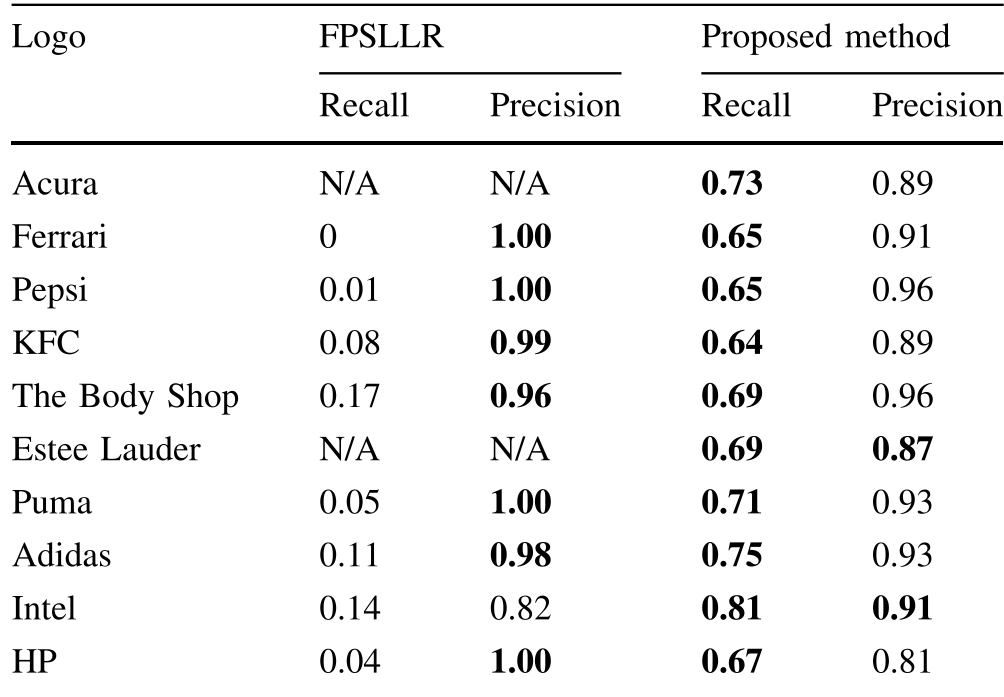
The authors tested their approach against the state-of-the-art FPSLLR (Feature Point Spatial Layout-based Logo Recognition).
- Robustness: For logos like "Acura" or "Estee Lauder," which are simple or small, the traditional method could not even build a model (Recall 0). The proposed method maintained a steady recall of 0.65 - 0.81.
- Efficiency: By filtering windows based on social context, they achieved higher precision (up to 0.98 for Pepsi) compared to raw sliding window searches.
Critical Insight & Conclusion
The true genius of this work lies in its Heuristic Efficiency. In 2014, before the total dominance of Deep Learning (CNNs), this paper anticipated the need for "Attention"—not through neural weights, but through Social Metadata.
Takeaways for Modern AI:
- Context is King: Even today's CLIP or YOLO models can be improved by "priors" derived from text metadata.
- Kernel Efficiency: Spatial weighting in local features remains a powerful inductive bias for handling noisy textures.
Limitations: While effective, the relevance levels were manually defined. In a modern pipeline, these "social clues" would likely be processed by a secondary transformer-based ranker to automate the filtering process.
Future Directions
This research opens doors for Multimodal Brand Intelligence, where the vision system doesn't just "see" a logo but understands the sentiment and influencer status of the post simultaneously to provide a 360-degree brand health report.