
Beyond the Screen: Why Freshmen Turn to Facebook for Connection and Comfort
Loneliness, anxiousness, and substance use as predictors of Facebook use
This study explores psychographic and behavioral predictors of social media engagement among college freshmen. Using linear regression on a sample of 229 students, it identifies how loneliness, anxiousness, alcohol use, and marijuana use correlate with Facebook Connection Strategies and Emotional Connectedness.
TL;DR
Is Facebook a bridge for the lonely or a crutch for the anxious? This study moves beyond simple "usage time" to reveal that social anxiety and alcohol use are primary drivers of emotional attachment to social media, while loneliness serves as a catalyst for seeking connections rather than emotional bonding with the platform itself.
The "Freshman Gap": Problem & Motivation
The transition to college is a volatile period characterized by social re-orientation. While we know students use social networking sites (SNS) to stay in touch, the underlying psychological mechanisms are complex. The researchers identified a critical gap: Does feeling "lonely" drive you to use Facebook differently than feeling "anxious"? Moreover, how do common health behaviors—specifically alcohol and marijuana use—interact with our digital lives?
The authors hypothesized that while alcohol (often viewed as a social lubricant in "normative" college culture) might increase Facebook attachment through social photo-sharing, marijuana use (potentially more clandestine and less "social" in a dormitory setting) might actually decrease it.
Methodology: Measuring the Digital Psyche
The researchers surveyed 229 freshmen, focusing on two distinct dimensions of Facebook behavior:
- Emotional Connectedness (Facebook Intensity): How much is the site part of your daily internal life?
- Connection Strategies: Are you using it to find new friends (Initiation), learn about classmates (Information Seeking), or keep old ones (Maintaining)?
They utilized the UCLA Loneliness Scale and the Feingstein Self-Consciousness Scale to map the participants' internal states against their substance use patterns.
Core Findings: The "Suppressor" Effect
The study’s most intriguing revelation comes from the divergent paths of loneliness and anxiousness.
1. The Anxious Attachment
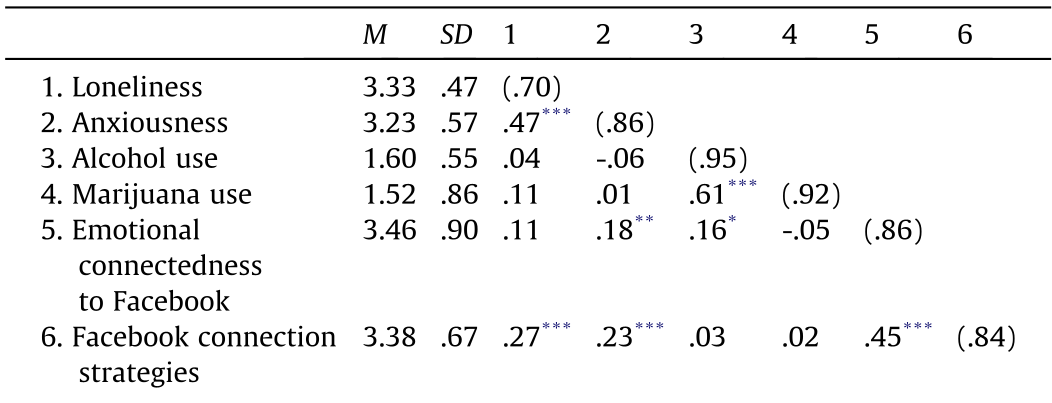
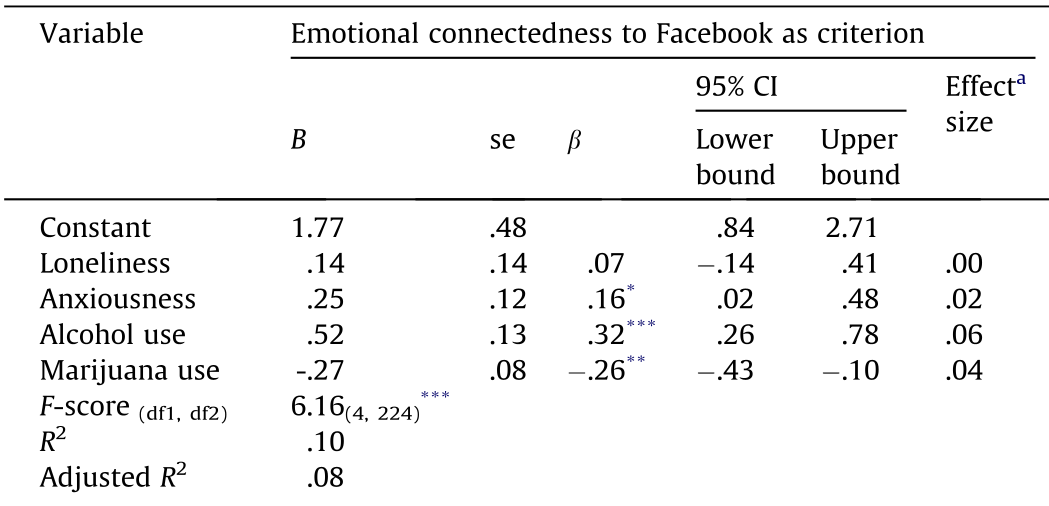
Socially anxious individuals were significantly more likely to be emotionally attached to Facebook and use it as a primary connection strategy. This supports the Social Compensation Hypothesis: the digital realm provides a "safer" interface for those who find face-to-face interaction daunting.
2. Loneliness vs. Connection
Loneliness was a strong predictor of Connection Strategies but not Emotional Connectedness. This suggests that lonely students view Facebook as a utility—a tool to bridge the gap to others—rather than an object of emotional dependence.
3. Alcohol vs. Marijuana
The impact of substance use was starkly different:
- Alcohol Use: Strongly predicted emotional attachment (Beta = .32). The "cool" factor of posting party photos creates a feedback loop of attachment.
- Marijuana Use: Negatively predicted emotional attachment (Beta = -.26). The illegal nature and less "broadcast-friendly" status of marijuana consumption may lead users to distance themselves from the platform.
Critical Insight & Conclusion
This work highlights that loneliness and anxiousness are not interchangeable predictors. One drives digital utility; the other drives digital dependency.
Takeaway for Educators and Mental Health Professionals: If a student is heavily "attached" to their social media presence, the root cause is more likely to be social anxiety or a desire for "normative" peer approval (often through alcohol culture) rather than simple loneliness.
Limitations: The study relies on self-reported data from a convenience sample (Intro to Psychology students), which may involve social desirability bias, especially regarding illegal substance use. Furthermore, as a cross-sectional study, it cannot definitively prove that anxiousness causes Facebook use—it only proves they move together.
Future Outlook
As the social media landscape shifts from Facebook to algorithmic-heavy platforms like TikTok, we must ask: Do these same psychological predictors hold when the "connection" is no longer with "friends," but with an "interest feed"?