
LSmP: Decoding the Hidden Rhythms of How We Make Friends on WeChat
Long Short Memory Process: Modeling Growth Dynamics of Microscopic Social Connectivity
The paper proposes the Long Short Memory Process (LSmP), a stochastic temporal point process model designed to capture individual social connectivity growth. Validated on a massive WeChat dataset (300M users, 4.75B links), LSmP accurately reproduces both long-term power law growth and short-term bursty behaviors.
TL;DR
Researchers from Tsinghua University and CMU have cracked the code on how individuals grow their social circles. By analyzing two years of WeChat data, they developed the Long Short Memory Process (LSmP)—a mathematical model that explains why some users grow their networks steadily while others experience sudden "bursts" of friendship. It proves that social growth isn't just random; it's a sophisticated interplay of long-term habits and short-term triggers.
Background: The Microscopic Discovery
While traditional network science focuses on the "big picture" (like the famous Six Degrees of Separation), this study goes microscopic. It asks: How does one person add friends over time?
Previous models like the Barabási-Albert (BA) model predicted a simple square-root growth (), but the WeChat data tells a far more chaotic story. Some users accelerate (Rich-get-Richer), some plateau, and almost everyone experiences intense bursts of activity followed by long silences.
The Problem: Why Current Models Fail
Traditional models suffer from "Mean-Field" syndrome—they assume everyone behaves like the average. Specifically:
- Poisson Processes predict linear growth, ignoring the reality of bursts.
- Hawkes Processes capture bursts but often spiral into unrealistic exponential growth.
- BA Models can't handle the "densification" where links grow faster than nodes.
Methodology: The Three Ingredients of LSmP
The authors propose that human social timing is governed by three specific effects, combined into a single hazard function :
- Average-Effect (The Long Memory): Your current rate of making friends is proportional to your lifetime average. This generates the long-term Power Law growth.
- Multiscale-Effect (The Short Memory): Human response times are multi-modal. We have "quick actions" (seconds), "daily routines," and "long vacations."
- Correlation-Effect: Events aren't independent. If you just added a friend, you are statistically more likely to add another one immediately (e.g., meeting a group at a party).
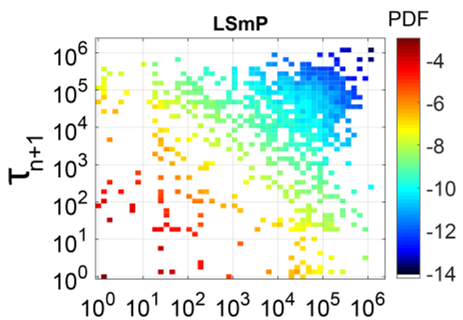 Figure: Empirical observations of (a) Accelerating, (e) Decelerating, and (i) Linear growth patterns correctly captured by the model.
Experiments & Results: Precision at Scale
Using a subset of 300 million users, the LSmP was tested against four major baselines. The results were decisive:
- Accuracy: LSmP's error rate in predicting the number of friends was 1.6 to 4.9 times lower than other models.
- Statistical Validity: 87.1% of the generated data passed the Kolmogorov-Smirnov test, meaning the model's "fake" data was mathematically indistinguishable from real human behavior.
Key Statistical Insights
- The 7-Day Cycle: Most humans have a long-term rate () suggesting one new social connection every 7.3 days.
- The 6-Second Burst: The "short-term scale" () peaks at 6 seconds, likely driven by features like WeChat's "Shake" or QR code scanning at events.
- Power Law Complexity: The exponent isn't fixed at 0.5. It follows a distribution, meaning social "gravity" varies wildly between individuals.
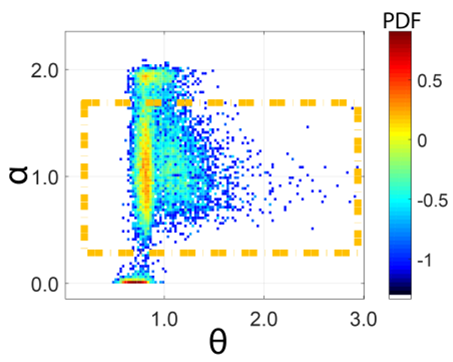 Figure: The joint distribution of growth rate and power-law exponent reveals distinct "clusters" of social behavior.
Critical Insight: Beyond Social Media
The genius of LSmP lies in its parsimony. With just a few parameters (), it explains complex human dynamics. It can be used to:
- Predict Future Growth: Identifying which users will become "super-connectors."
- Detect Outliers: Tagging "bot" behavior or abnormal social spikes that don't fit the human multiscale signature.
- Cluster Behaviors: Distinguishing between "social butterflies" (accelerating growth) and "stable rotators" (linear growth).
Conclusion
The Long Short Memory Process bridges the gap between microscopic human action and macroscopic network evolution. It proves that our "bursty" nature is a feature, not a bug, of social systems. As digital connectivity continues to evolve, models like LSmP will be essential for building platforms that respect the natural rhythms of human interaction.
Limitations: The model focuses on link creation but does not yet account for link decay or unfriending, which is a vital component of long-term network stability.