
Unlocking the Soundscape: Year-Long Deep Learning Monitoring in New York's Capital Region
Long-term deep learning-facilitated environmental acoustic monitoring in the Capital Region of New York State
This study presents a long-term passive acoustic monitoring (PAM) framework utilizing a 2D Convolutional Neural Network (CNN) to analyze 12 months of environmental audio (8000+ hours) from New York State. The method achieves high-fidelity classification across 19 categories of biophony and anthrophony, enabling the construction of species-specific annual phenology records.
TL;DR
Researchers at Rensselaer Polytechnic Institute have successfully bridged the gap between theoretical deep learning and practical ecology. By deploying a year-long microphone array and a 4-layer CNN, they transformed over 8,000 hours of raw audio into a detailed record of species-specific activity, proving that deep learning can "listen" to the environment more effectively and granularly than traditional acoustic indices.
Background: Beyond the Noise
Passive Acoustic Monitoring (PAM) is a cornerstone of modern conservation. However, ecologists have long reached a stalemate: manual analysis is too slow, and "Acoustic Indices" (mathematical proxies for biodiversity) don't tell you which species are singing. This paper provides a methodological blueprint for using Convolutional Neural Networks (CNNs) to extract species-specific records (phenology) over 12 continuous months.
The Problem: The High Cost of Listening
Existing methods often fail because:
- Data Volatility: Environmental audio is noisy, and species calls often overlap or fade.
- Sampling Errors: Many surveys use "intermittent sampling" (e.g., 1 minute every 10), which the authors prove misses critical transient vocalizations.
- Generalization Gap: Models trained on clean databases like ImageNet often struggle with the "messy" reality of a New York suburban forest.
Methodology: A Tailored CNN for Soundscapes
The researchers chose a pragmatic 4-layer CNN architecture rather than a bloated ResNet50. This choice was deliberate: a simpler architecture is less prone to overfitting in sparse soundscapes and allows for rapid retraining (under 20 minutes).
Key steps in the pipeline:
- Input: 8-second clips converted to log-mel spectrograms (mapping sound frequency to vertical pixels and time to horizontal pixels).
- Architecture: Four convolutional layers (3x3 kernels) with batch normalization and max-pooling to extract hierarchical features.
- Multi-label Handling: Using a sigmoid activation instead of softmax, allowing the model to detect multiple species or handle "uncertainty" in faint signals.
 Figure 1: The CNN architecture used to classify 19 distinct sound categories.
Ecological Insights: What the Data Revealed
The results provide a fascinating look at the "pulse" of the Capital Region:
- The Abiotic Connection: Bird calls (Northern Cardinal, Robin) were tightly synchronized with daylight hours (sunrise/sunset), whereas insect activity (Crickets, Cicadas) was governed by temperature.
- The Sampling Trap: The study compared continuous recording against the common "intermittent" standard. For rare or transient birds like the Bluejay, intermittent sampling resulted in significantly lower correlation (0.74), potentially leading to erroneous ecological conclusions in other studies.
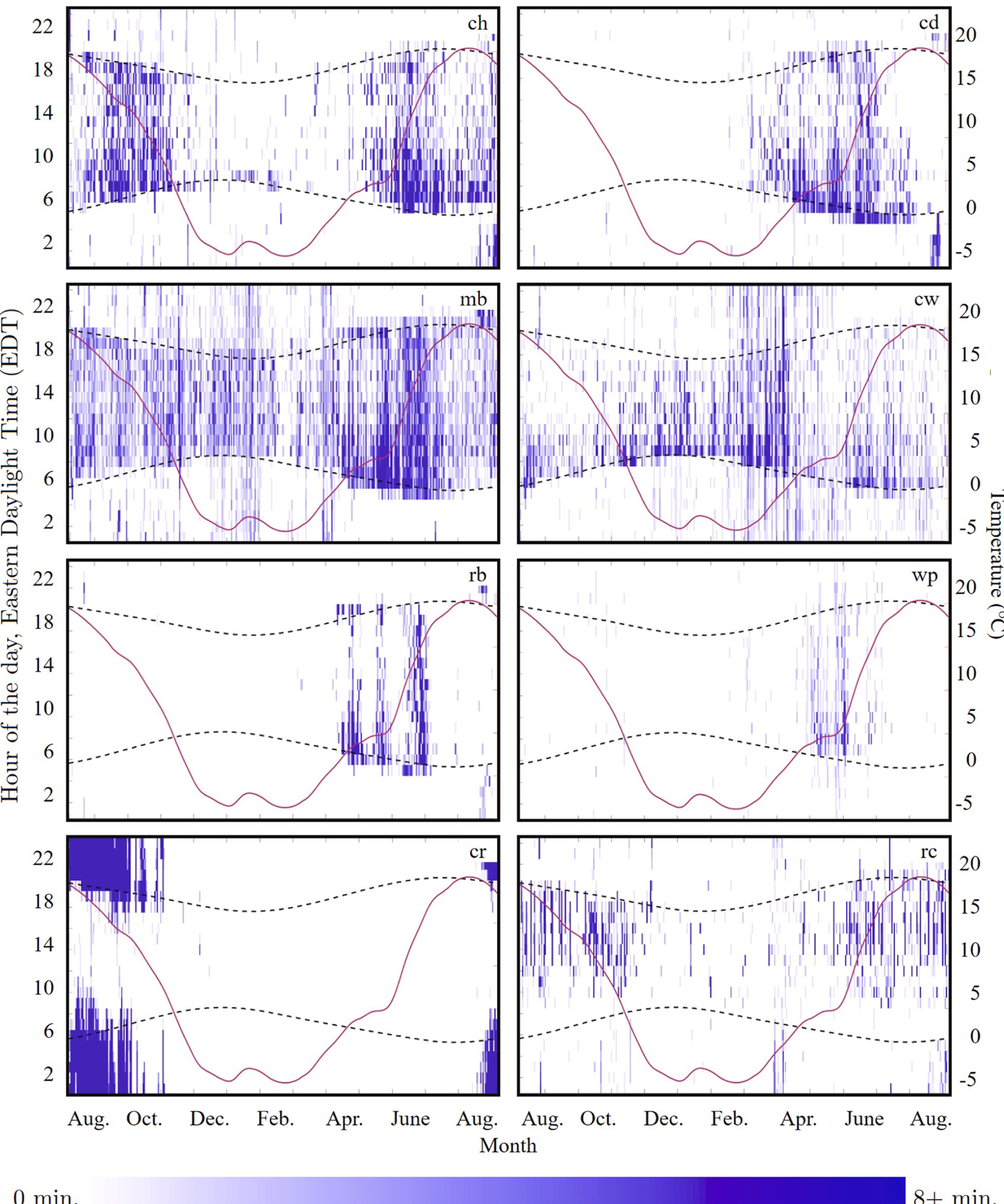 Figure 2: Heatmap visualizing species activity across months (x-axis) and time of day (y-axis), overlaid with temperature and sunrise/sunset lines.
Critical Analysis & Conclusion
Takeaway
The real value of this work is its efficiency. By annotating only 1-3% of the total data (approx. 150 hours), the researchers unlocked the insights within the remaining 8,700 hours. It shifts the role of the ecologist from a "listener" to a "supervisor" of AI models.
Limitations & Future Work
While successful, the study notes that CNNs are "site-specific." A model trained in Albany, NY, might not immediately work in the Amazon. The authors suggest that future research should focus on Transfer Learning and Semi-supervised Learning to make these models more portable across geographies.
Ultimately, this study proves that with the right AI tools, we can monitor the health of our ecosystems not just through broad metrics, but by listening to the individual voices of the species within them.