
Social Robots as Mediators: Long-term Therapeutic Benefits for Severe ASD and ADHD
A Long-term Study of Robot-Assisted Therapy for Children with Severe Autism and ADHD
This paper presents a long-term study on Robot-Assisted Therapy (RAT) using social robots to mediate social interaction for children with severe Autism Spectrum Disorder (ASD) and ADHD. The core method introduces a novel imitative behavior set covering non-verbal communication, achieving significant engagement improvements and social skill gains across a cohort of 15 children.
TL;DR
This study investigates the impact of long-term Robot-Assisted Therapy (RAT) on children with severe Autism (ASD) and ADHD. By implementing a suite of social behaviors—ranging from joint attention to complex imitative gestures—researchers demonstrated that robots can maintain high engagement levels and catalyze improvements in eye contact and verbal communication in children where traditional methods often struggle.
Problem & Motivation: The Challenge of Severe ASD
Autism Spectrum Disorder (ASD), particularly in its severe form, is characterized by persistent deficits in social communication and the presence of restricted, repetitive patterns of behavior. For therapists, engaging these children is often a hurdle because social interaction itself is a source of stress or confusion for the child.
The authors identify a critical gap: while social robots are promising, there is a lack of long-term evidence regarding their effectiveness for children who have both severe ASD and ADHD. These children face additional challenges with concentration, spatial planning, and "working memory," making it vital to design an intervention that is both predictable (the robot's nature) and highly engaging.
Methodology: The Imitative Leap
The research utilized the NAO robot (implied by typical RAT setups and the "Nao" utterance mentioned in results) to conduct sessions lasting 15-20 minutes. A key innovation in this study is the Imitation Behavior Set.
The Interaction Loop:
- Contextual Introduction: The robot introduces a social action (e.g., a "high-five" or a "handshake") with a situation-based story to capture attention.
- Demonstration: The robot performs the non-verbal action.
- Prompted Action: The robot asks the child to repeat the gesture with their parent or therapist.
- Positive Reinforcement: Upon compliance, the robot applauds and uses clapping sounds to praise the child.
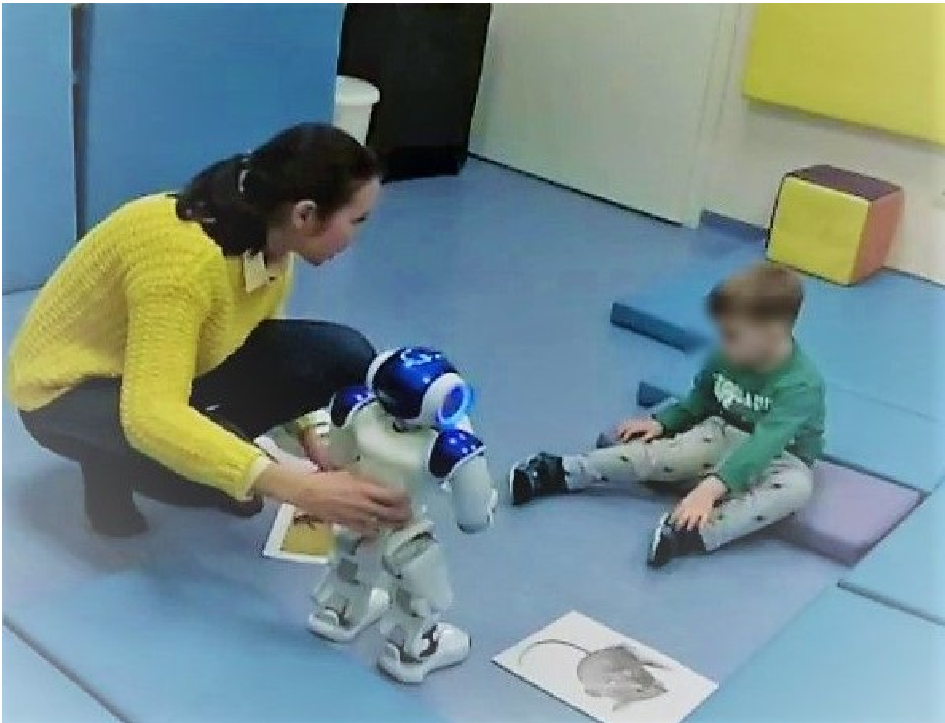 Figure 1: The experimental setup illustrates the robot acting as a social bridge between the child and the human adult (therapist/parent).
Experiments and Preliminary Results
The study involved 15 male children (ages 3-12). The researchers measured Engagement Time (defined by eye gaze, positive facial expressions, and compliance) against the total session time.
Key Quantifiable Findings:
- Statistical Significance: A repeated-measures ANOVA confirmed significant changes in engagement across sessions ().
- Longevity of Interest: Unlike the "novelty effect" where children lose interest in a toy after one session, the robot maintained a "satisfactory level of engagement" throughout at least 7 sessions.
- Clinical Observations: Non-verbal children began using functional language like "Bye" and "Tick-Tack" (mimicking a clock sound mentioned in therapy).
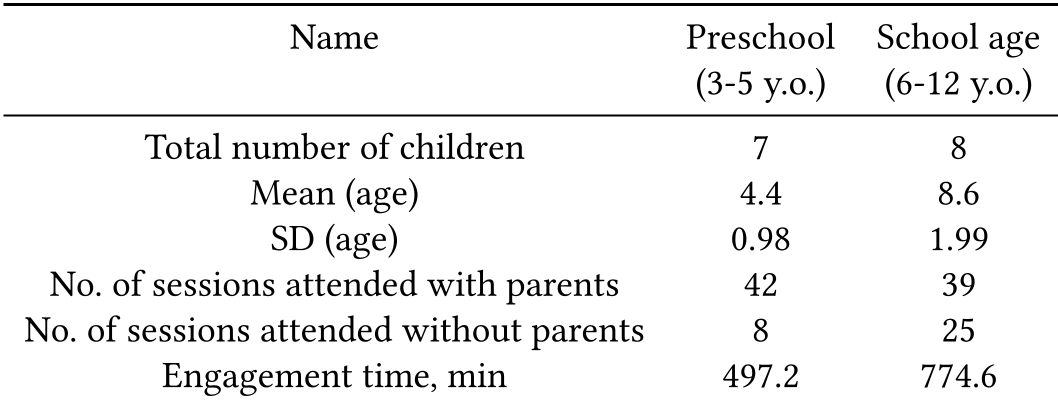 Table 1: Data overview showing higher total engagement time in school-age children (774 min) compared to preschool children (497 min).
Critical analysis & Conclusion
This work highlights the "Robot-as-Mediator" paradigm. The robot is not a replacement for a therapist but a tool that reduces the social "noise" that can overwhelm children with ASD.
Takeaway: The study proves that social robots can facilitate "Triadic Interaction" (Child-Robot-Adult). By focusing on imitation, the robot bridges the gap between solitary play and human-to-human social communication.
Limitations: The study cohort was entirely male, which is common in ASD research but limits generalizability to females. Furthermore, the variability in the number of sessions attended with vs. without parents (as seen in Table 1) suggests that the "parental presence" variable needs more controlled isolation in future studies to see if it acts as a catalyst or a distraction in RAT.
Future Outlook: As these robots become more autonomous and use AI to adapt their behaviors in real-time, we could see "personalized RAT" that adjusts its difficulty level based on the child's daily mood and progress.