
[2026 Tech Trend] LongCoT: The New Frontier of 100K-Token Reasoning and Why Frontier Models are Failing
LongCoT: Benchmarking Long-Horizon Chain-of-Thought Reasoning
LongCoT is a new, large-scale benchmark containing 2,500 expert-designed problems across five domains (Chemistry, Math, CS, Chess, and Logic) designed to measure long-horizon Chain-of-Thought (CoT) reasoning. It targets the ability of frontier models to maintain coherence over 10k to 100k+ tokens, with the best model (GPT 5.2) currently achieving only 9.8% accuracy.
TL;DR
The "Long-Context" era is shifting from reading long documents to thinking in massive volumes. A new benchmark, LongCoT, introduces 2,500 problems that require models to generate tens to hundreds of thousands of Chain-of-Thought (CoT) tokens to reach a single verifiable answer. Despite their hype, frontier models like GPT 5.2 and Gemini 3 Pro are hitting a "reasoning wall," with the highest accuracy barely reaching 9.8%.
The "Easy Step, Impossible Chain" Paradox
Current LLM evaluation is often biased by "esoteric knowledge"—asking a model a PhD-level math question is hard because the step is hard. LongCoT flips this. It uses "individually tractable" steps—atomic sub-problems that any frontier model can solve in isolation—and chains them into massive dependency graphs.
The failure of models to solve these problems reveals a critical flaw: Long-Horizon Drift. As the reasoning trace grows:
- Context Degradation: Subtle errors in early steps propagate.
- Plan Drift: The model loses the "meta-goal" of the original prompt.
- Backtracking Failure: Models struggle to recognize a dead-end and return to a previous valid state.
Methodology: Engineering the Reasoning Graph
The authors categorize the problems into two structural types:
- Explicit (Compositional): The prompt defines a Directed Acyclic Graph (DAG) of math or chemistry problems where the output of node A is the input for node B.
- Implicit (Procedural): The model must explore a latent search space, such as a 30x30 Chessboard Minimax game or complex Sokoban puzzles.
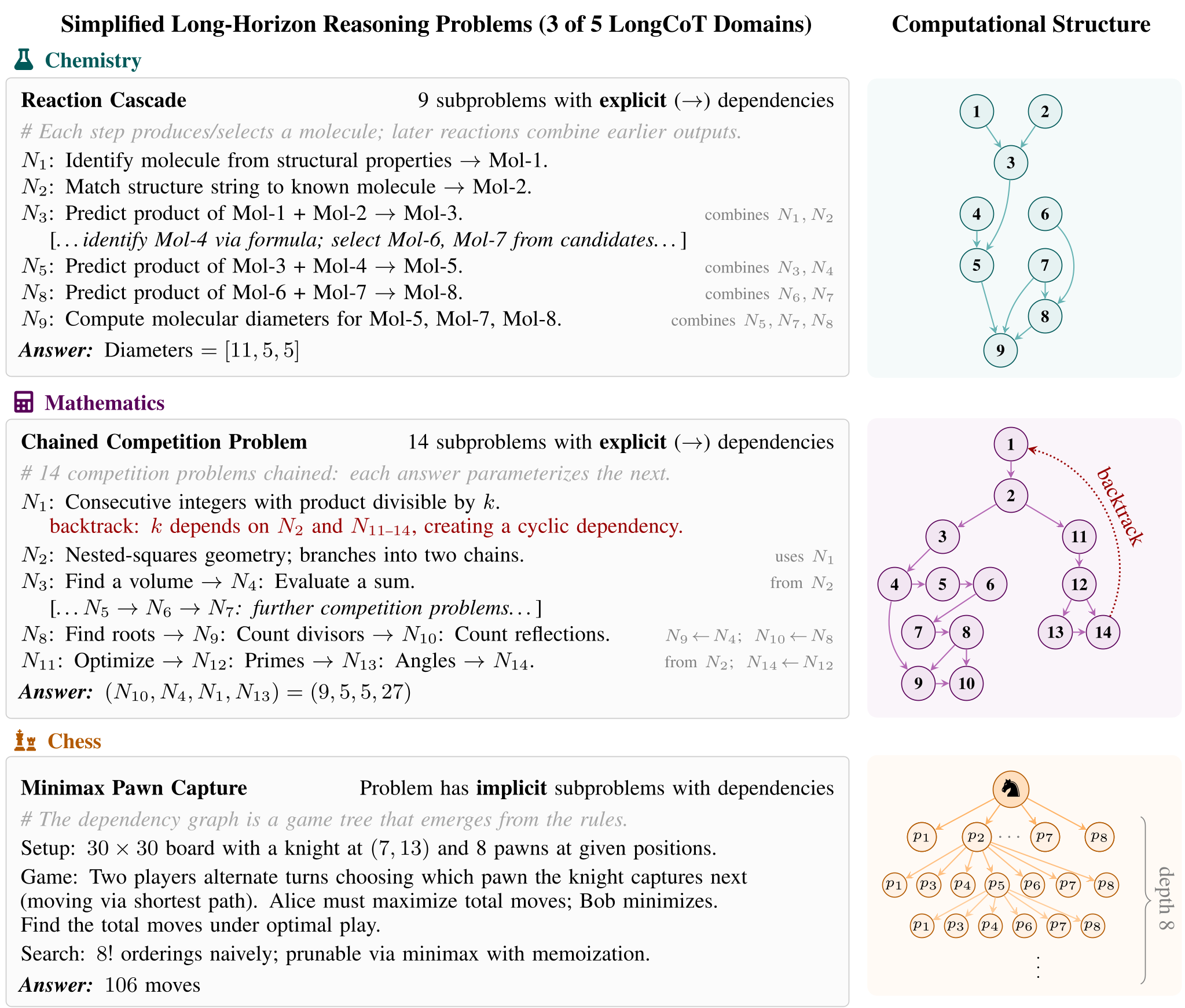 Figure 1: LongCoT forces models to navigate computational dependency graphs involving search trees, cyclic graphs, and execution traces.
The Results: A Reality Check for LLMs
The evaluation results prove that long-horizon reasoning is not just "more of the same."
- GPT 5.2: The only model showing significant "stamina," utilizing an average of 62,046 tokens per problem to achieve 9.83% accuracy.
- The Sharp Drop: As the number of nodes in a reasoning DAG increases from 1 to 40, accuracy doesn't just decline—it falls off a cliff.
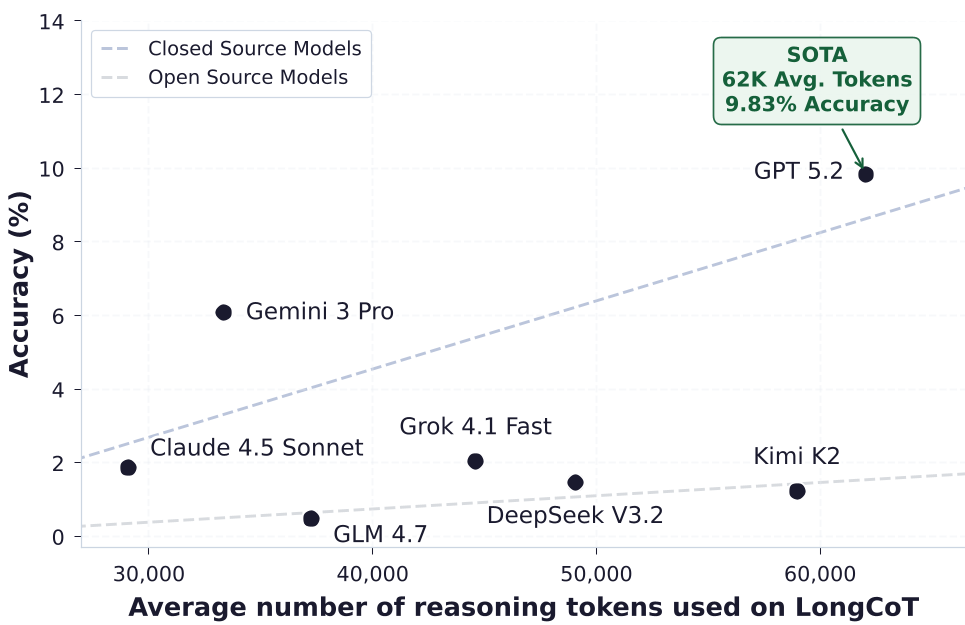 Figure 2: There is a direct correlation between token budget usage and accuracy, yet even at maximum capacity, frontier models struggle.
Deep Insight: Composition vs. Context Length
A crucial ablation study in the paper compared Independent vs. Composed questions. When the same 40 math problems were presented independently, GPT 5.2 scored 55%. When the same problems were linked in a dependency chain, the score tanked to 4%.
The Takeaway? It's not the length of the output that kills the model; it's the logic weight of the dependencies. The model's "mental" state becomes increasingly fragile with each dependent step.
Qualitative Failure Modes
By analyzing traces from open-source models like DeepSeek V3.2 and Kimi K2, the authors identified that:
- Incorrect Early Planning: Committing to a strategy that is mathematically doomed.
- Premature Giving Up: Models often "hallucinate" a conclusion or stop reasoning mid-way when the complexity peaks.
- Backtracking Overhead: Correct traces spend significantly more time in "Setup" (comprehension), while failing traces spend more time in a "Stuck" or "Backtracking" loop that goes nowhere.
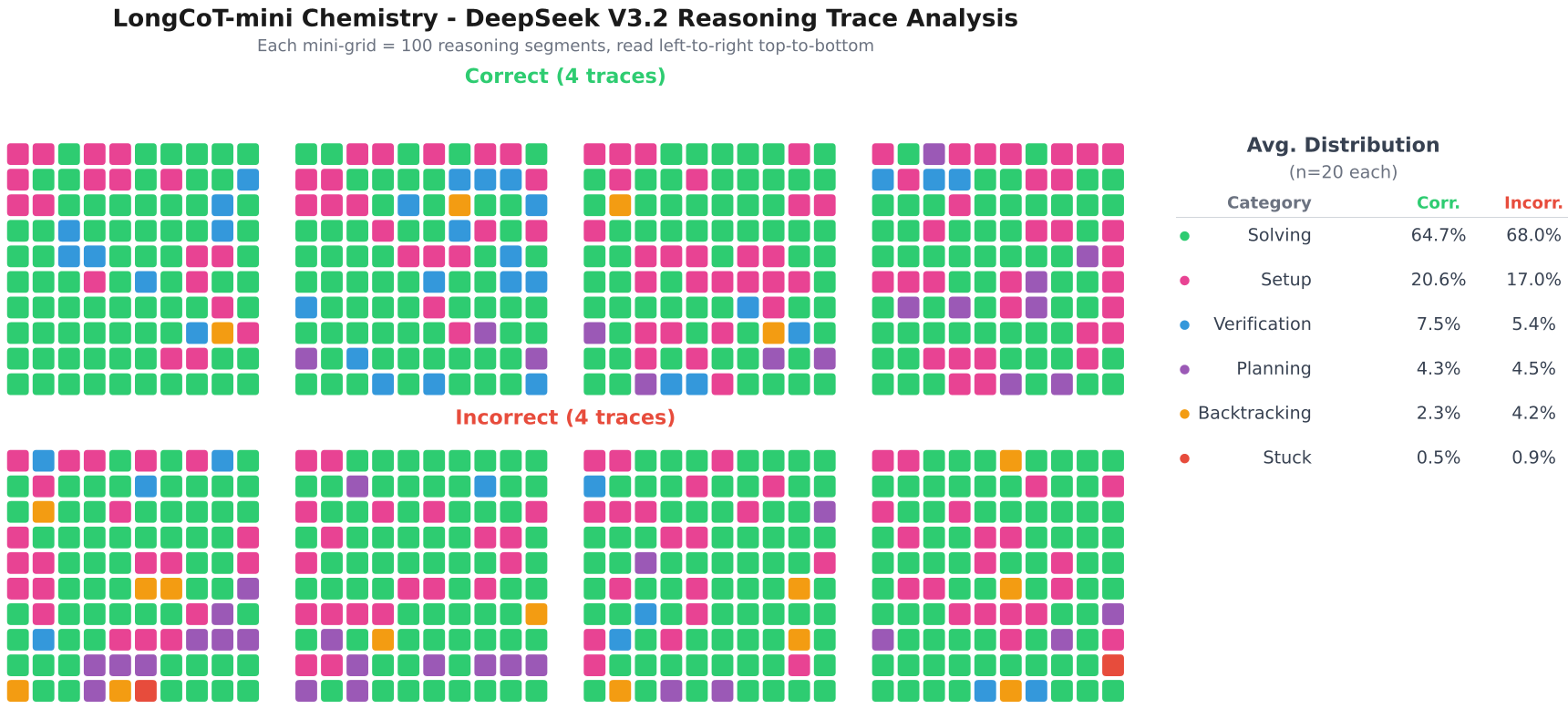 Figure 3: Visualization of reasoning stages—Notice how incorrect traces (bottom) are plagued by "Stuck" (red) and "Backtracking" (orange) segments.
Conclusion: The Path Forward
LongCoT proves that the industry's shift toward Agentic AI will be hamstrung by the core model's inability to maintain internal state over long trajectories. Tool-use (code execution) helps on procedural tasks but fails on compositional ones (Math/Chemistry).
To reach the next level of "Economic AI," we need:
- Training for Long-Horizon Stability: RL-based training on verifiable long chains.
- Inference-Time Scaling: Algorithms that prioritize early-stage planning and verification.
- Recursive Architectures: Moving beyond monolithic CoT toward structured, modular sub-agent calls that preserve state.
LongCoT isn't just a benchmark; it's a map of the obstacles standing between current LLMs and true autonomous intelligence.