
Specialized Minds: How Intellectual Human Capital Drives Exploratory Innovation
A Longitudinal Study of the Influence of Intellectual Human Capital on Firm Exploratory Innovation
This longitudinal study investigates the impact of specialized intellectual human capital—categorized as pure scientists, pure inventors, and bridging scientists—on two forms of exploratory innovation: recombinatory and pioneering innovation. Using a sample of 222 biotechnology firms, it establishes that specific human capital configurations significantly predict a firm's ability to create path-breaking technologies.
TL;DR
Innovation isn't a monolithic activity—it’s a delicate dance between scientific discovery and technological recombination. This study reveals that a firm's success in "exploratory innovation" depends on how it mixes three types of experts: Pure Scientists, Pure Inventors, and the elusive Bridging Scientists. While inventors build the machines, scientists provide the maps, and the best results happen when they facilitate each other’s unique strengths.
The "Local Search" Trap
Why do successful companies eventually stop innovating? The literature calls this the "familiarity trap." Firms naturally explore knowledge that is close to their existing expertise, leading to technological exhaustion. To break free, companies must engage in Exploratory Innovation, which manifests in two ways:
- Recombinatory Innovation: Mixing existing technologies in novel ways.
- Pioneering Innovation: Creating "de novo" solutions based on fundamental science with no technological predecessors.
Methodology: The Three Archetypes of Genius
The author argues that to understand innovation, we must look at the people behind the patents. The study categorizes R&D workers based on their output:
- Pure Scientists: High academic output (publications) but no patents. They live in the "Open Science" world.
- Pure Inventors: High patent output but no publications. They are the masters of "Proprietary Tech."
- Bridging Scientists: The "Ambassadors" who both publish and patent, linking the two domains.
The Conceptual Framework
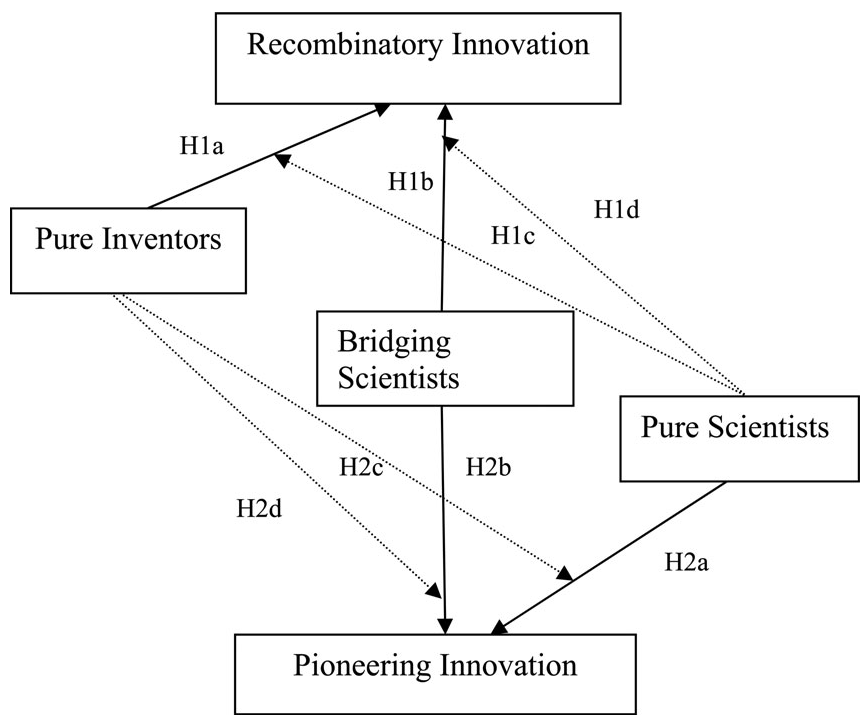 The model hypothesizes that while certain groups have direct effects, the "Pure" counterparts act as critical catalysts (moderators) for the others.
Key Findings: The Power of Moderation
1. Recombinatory Innovation: The Inventor’s Domain
The study finds that Pure Inventors and Bridging Scientists are the primary drivers of recombination. However, Pure Scientists provide a massive boost here. Even though they don't patent, their theoretical understanding helps inventors "see" which combinations are physically possible, reducing the uncertainty of trial-and-error.
2. Pioneering Innovation: The Scientist’s Domain
As expected, Pure Scientists and Bridging Scientists lead the charge in pioneering new frontiers. But here lies the "twist": Pure Inventors significantly enhance these scientific efforts. By highlighting industrial challenges, inventors guide scientists toward "useful" breakthroughs. Firms with a high proportion of inventors saw their pioneering patents achieve a 21% broader application scope.
3. The Performance Matrix
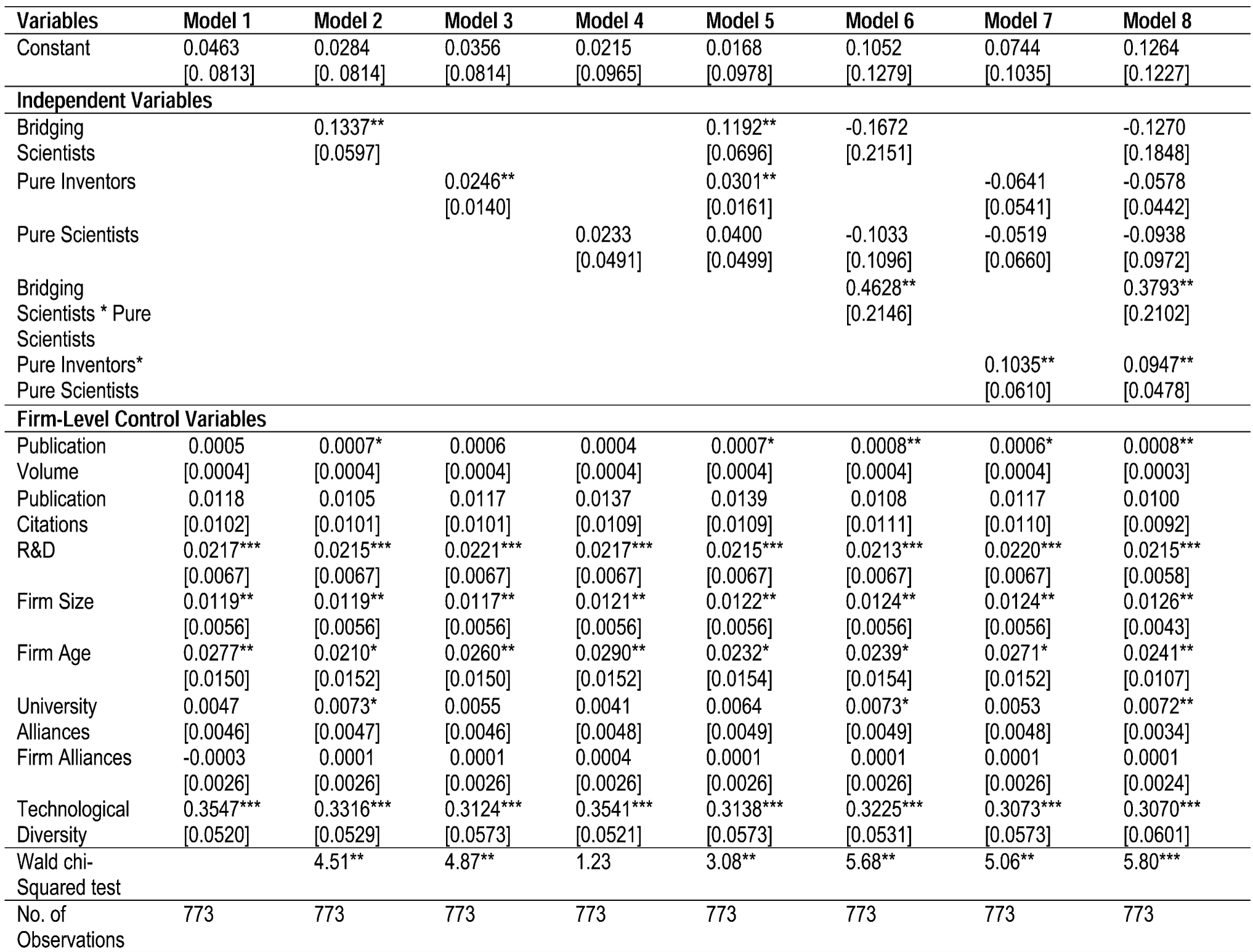 The regression data confirms that the interaction terms (e.g., Bridging Scientists * Pure Scientists) are statistically significant, proving that synergy is better than solo effort.
Critical Insight: Why "Bridging" Isn't Enough
A common management mistake is to assume that "Bridging Scientists" can do it all. While they are vital, the study shows that Pure Scientists possess a "deep-rooted tacit component of scientific knowledge" that even bridgers lack. Similarly, Pure Inventors have a gritty, application-focused experience that keeps research grounded.
The Takeaway for Tech Leaders: Don't just hire "all-rounders." A high-performing R&D department needs specialists. The "Pure" types provide the depth, while the "Bridgers" provide the connectivity.
Limitations and Future Work
The study is focused on the Biotechnology sector, where the line between science and technology is famously blurred. Whether these dynamics hold true in more "applied" industries like software engineering or consumer electronics remains an open question. Furthermore, the reliance on patent citations—where 40% are added by examiners rather than inventors—presents a measurement challenge that future researchers must refine.
Conclusion
This longitudinal study proves that intellectual human capital is not a monolithic resource. By understanding the interplay between those who seek "truth" (scientists) and those who seek "utility" (inventors), firms can better orchestrate their R&D portfolios to achieve both incremental improvements and revolutionary breakthroughs.