
Attractor Models: Solving the Loop for Scalable Latent Reasoning
Solve the Loop: Attractor Models for Language and Reasoning
The paper introduces "Attractor Models," a novel architecture that refines language model latent representations by solving for a fixed point in the output embedding space. By combining a Transformer backbone with a recurrent attractor module using implicit differentiation, it achieves SOTA results in language modeling and reasoning, matching the performance of a 1.3B Transformer with only 770M parameters.
TL;DR
Attractor Models revolutionize iterative refinement in AI by treating the "loop" as a fixed-point problem rather than a finite sequence of layers. By using a backbone to "propose" and an attractor to "converge," this architecture achieves constant-memory training, delivers a Pareto improvement in language modeling (improving perplexity by up to 46.6%), and solves complex reasoning tasks—like Sudoku-Extreme—where even GPT-4o and o3-mini fail.
The Motivation: Why Latent Thinking is Broken
The AI community has long sought to move beyond the "one-pass" computation of standard Transformers. If a model could "think" or refine its internal thoughts before committing to a token, it should be more efficient. However, current "Looped Transformers" face a trilemma:
- Memory Fatigue: Memory grows linearly with the number of loops.
- Training Instability: Recurrent gradients often vanish or explode.
- Train-Test Mismatch: If you train with 8 loops but use 16 at test time, the model often collapses.
Attractor Models solve this by viewing the refinement as a dynamical system seeking an equilibrium, effectively "solving" the loop rather than just unrolling it.
Methodology: Propose, Refine, Internalize
The architecture consists of two distinct stages:
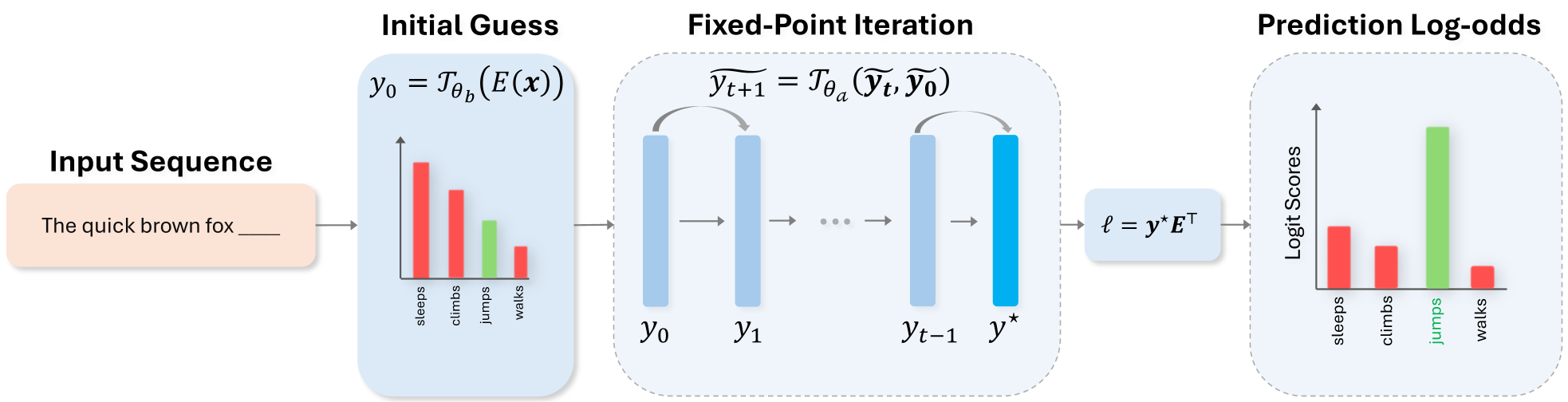
- The Backbone (The Intuition): A standard Transformer that maps inputs to an initial "guess" in the output embedding space ().
- The Attractor (The Logic): A weight-tied module that iteratively refines until it reaches a fixed point () where further refinement changes nothing ().
The Secret Sauce: Implicit Differentiation
To train this without running out of memory, the authors use the Implicit Function Theorem (IFT). Instead of storing every step of the loop for backpropagation, they calculate the gradient of the converged state directly. This makes the memory cost O(1) relative to the number of refinement steps.
Experimental Results: Beating the Giants
The results are split into two impressive regimes:
1. Large-Scale Language Modeling
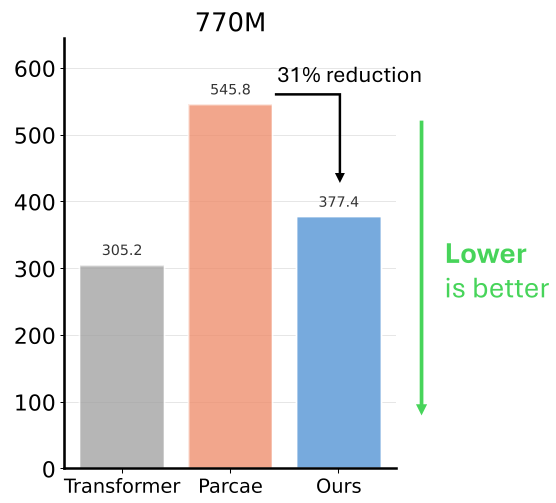
The Attractor Model (770M) significantly outperformed a Transformer nearly double its size (1.3B) while using fewer training tokens. It demonstrated a massive 46.6% improvement in Lambada perplexity, a common benchmark for long-range reasoning.
2. Hard Reasoning (Sudoku & Mazes)
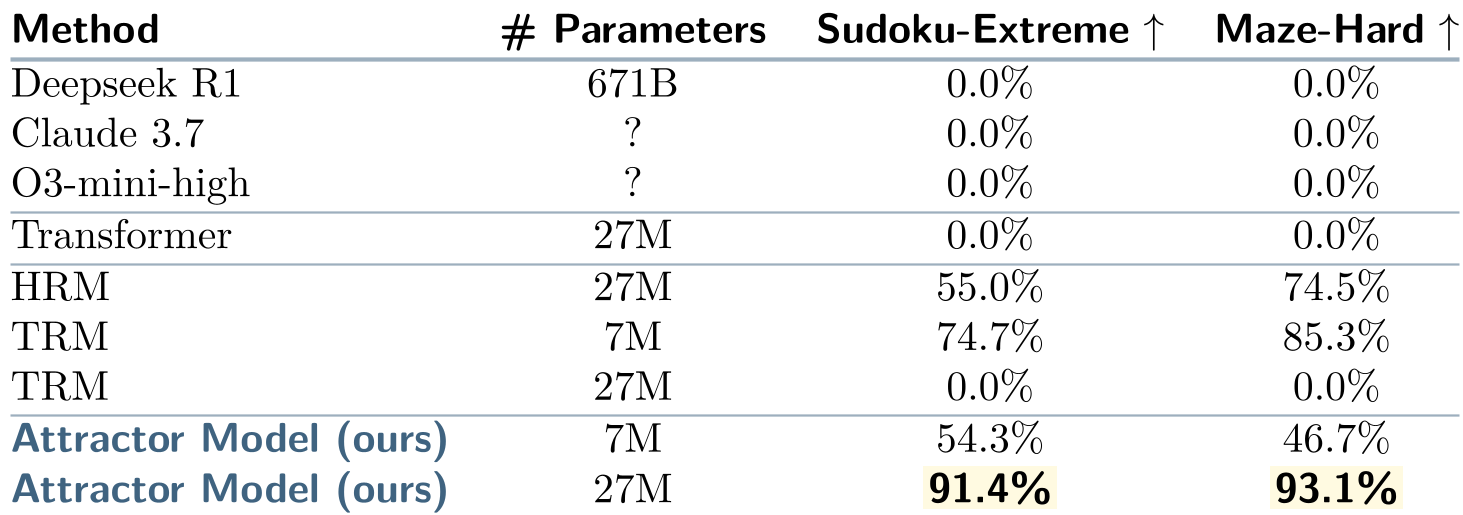
While frontier models like DeepSeek R1 and Claude 3.7 fail on the "Sudoku-Extreme" task, a tiny 27M Attractor Model achieves 91.4% accuracy. Unlike previous tiny recursive models that collapsed when scaled up, Attractor Models exhibit clean scaling laws.
A Novel Phenomenon: Equilibrium Internalization
Perhaps the most striking finding is Equilibrium Internalization. During training, the attractor module acts as a "teacher" for the backbone. Over time, the backbone learns to "predict" what the attractor would have arrived at.
The result? At inference time, you can often remove the attractor entirely (). The backbone’s "initial guess" is already so close to the equilibrium that the refinement becomes redundant. This provides the efficiency of a feed-forward model with the "intelligence" gained from recurrent training.
Critical Analysis & Future Outlook
Strengths
- Constant Memory: Enables "infinitely" deep refinement during training.
- Stability: The implicit gradient naturally biases the model toward contractive (stable) dynamics.
- Adaptive Compute: At test time, hard tokens can be refined longer, while easy tokens pass through instantly.
Limitations
- Solver Overhead: While memory-efficient, the root-finding process (Anderson acceleration) still adds sequential time overhead during the forward pass.
- Complexity: Implementing IFT-based training is significantly more complex than standard BPTT.
Conclusion
Attractor Models suggest that the future of LLMs isn't just "more layers," but smarter computation graphs. By internalizing iterative refinement, we can build models that compute like a Transformer but reason like a recurrent system.
Senior Editor's Note: This work effectively bridges the gap between Deep Equilibrium Models (DEQ) and the Transformer era, offering a practical path to "latent thinking" without the historic stability issues of RNNs.