
Loop Composition: Why Your Quantum Subroutines Are Running Too Slowly
The paper introduces "Loop Composition," a quantum algorithm framework that generalizes subroutine composition beyond straight-line programs. By modeling algorithms like Grover’s search as recursive loops rather than unrolled sequences, it achieves optimal variable-time complexity, matching Ambainis's SOTA -average bounds.
TL;DR
Standard quantum circuit models treat algorithms as "straight-line" programs—one gate after another. However, this view is inefficient when dealing with subroutines that take different amounts of time depending on the input. This paper introduces Loop Composition, a framework that models quantum control flow (like Grover iterations) as loops, allowing for variable-time composition that scales with the average subroutine time rather than the maximum.
The Problem: The "Max-Time" Bottleneck
In classical programming, if you call a function inside a loop, the total time is the sum of the times of each call. If one call is fast and another is slow, they average out. In the standard quantum circuit model, if you call a subroutine on a superposition , the circuit must remain "open" for the maximum possible time any might take.
If we unroll Grover’s algorithm (which repeats an iterate times) into a long straight line and plug in subroutines, we lose the structural advantage of the loop. Previous composition theorems resulted in: This is the "max-time" bottleneck. It means one slow branch in your superposition ruins the speedup for everyone else.
The Insight: Don't Unroll the Loop
The authors argue that the issue isn't Grover's algorithm itself, but how we model the composition. By treating the algorithm as a loop using the quantum walk formalism, we can allow branches of the superposition to "finish" at different times and interfere correctly.
Architecture: The Overlap Graph
The core of the method lies in the "Overlap Graph." Instead of a single path, the authors construct a graph that represents the states and their transitions.
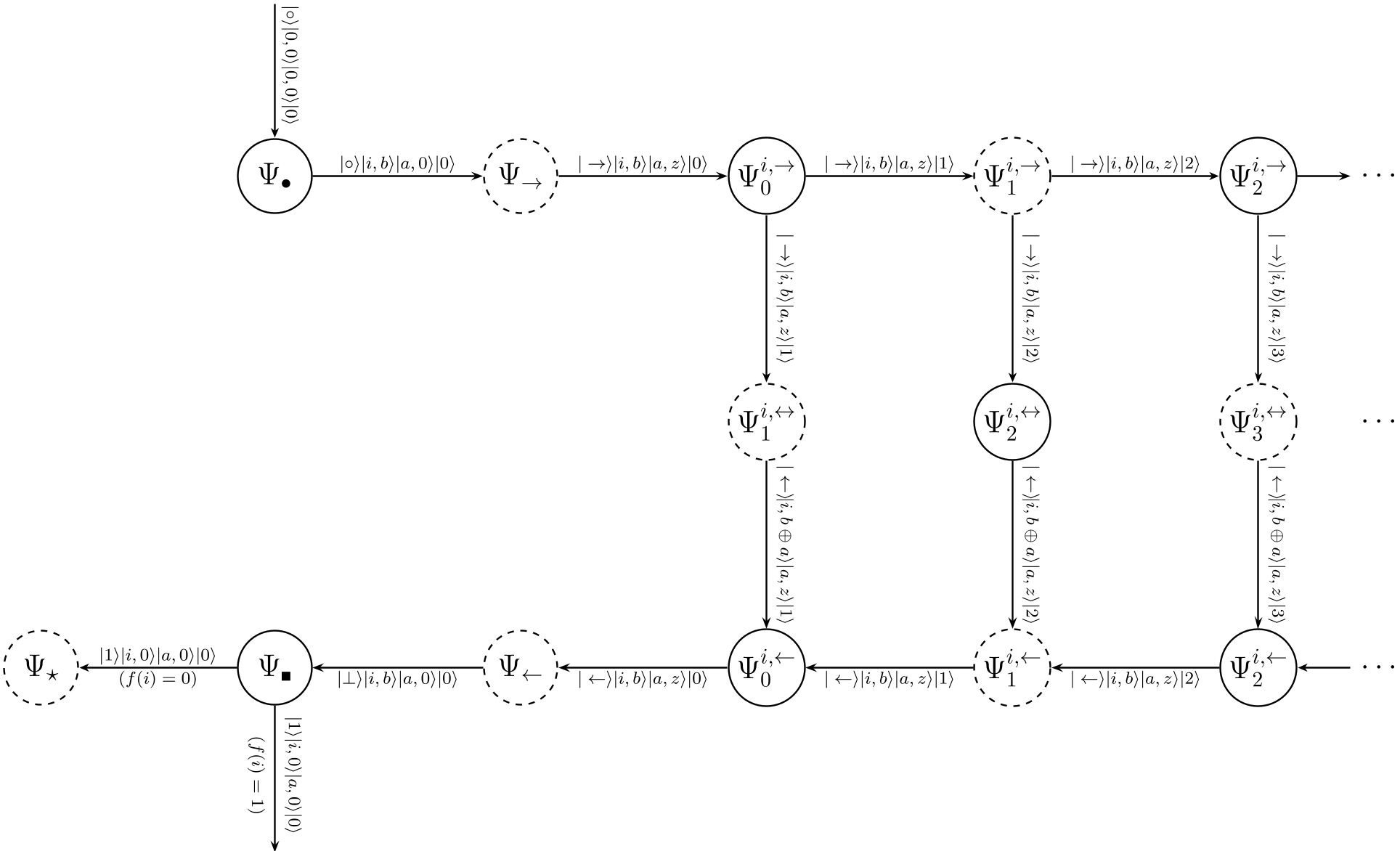 Figure 1: The overlap graph for a subroutine. Solid nodes belong to subspace A, dashed to subspace B. By "stitching" these together in a loop, the algorithm can handle branching without unrolling.
Methodology: Phase Estimation and Witnesses
The authors reformulate the search problem as a Phase Estimation task. They define two subspaces, and , such that:
- Positive Case (Marked item exists): There is a "Positive Witness" vector orthogonal to both and .
- Negative Case (No marked item): The initial state can be decomposed into vectors in and .
By analyzing the "Negative Witness" size, they determine the complexity. The "Loop" structure allows them to tune weights () that balance the "cost" of moving through the subroutine steps. This mathematical flexibility is what allows them to match Ambainis’s bounds:
Breaking Down the Results
The paper provides a hierarchy of bounds. Depending on whether you know the expected time of your subroutines in advance, you can choose different "Loop" parameters to optimize:
| Setting | Complexity Bound | Benefit | | :--- | :--- | :--- | | Naive | | Easy to implement, but slow. | | (Known) | | Optimal if you know subroutine costs. | | (Unknown) | | Matches Ambainis (SOTA). |
 Table 1: Comparison of variable-time search upper bounds ().
Critical Insight: Program Control Flow Matters
The most striking takeaway is that Straight-line composition is not enough. Even for a simple algorithm like Grover’s, treating the iterations as a sequence (unrolling) is mathematically "forgetful." By acknowledging the cyclic nature of the algorithm, Loop Composition preserves the interference patterns necessary to achieve true variable-time speedups.
Conclusion
This work highlights a shift in quantum algorithm design: moving away from "flat" circuit diagrams and toward structured "programs" with sophisticated control flow. For developers of quantum subroutines, this means that the average performance of your code might finally matter more than the worst-case scenario—provided you use the right composition framework.
Limitations
The current model assumes subroutines have no error (though they suggest log-factor overheads can fix this). Future work involves extending these "loop" structures to more complex recursive algorithms, like Quantum Divide and Conquer.