
Loop, Think, & Generalize: Why Recurrent-Depth Transformers Succeed Where Vanilla Transformers Fail at Implicit Reasoning
Loop, Think, & Generalize: Implicit Reasoning in Recurrent-Depth Transformers
This paper studies implicit multi-hop reasoning with recurrent-depth transformers, a weight-shared decoder-only architecture that reuses the same transformer block across multiple iterations. On controlled synthetic knowledge-graph tasks, the method substantially outperforms vanilla transformers on both systematic generalization and depth extrapolation, showing that extra inference-time recurrence can unlock deeper reasoning beyond training depth. The work positions recurrent-depth transformers as a strong architectural alternative for compositional reasoning over parametric knowledge.
Executive Summary
TL;DR
This paper asks a sharp question: can a model compose what it already knows inside a single forward pass, without external Chain-of-Thought? The answer, for standard transformers, is often no. Even when the underlying atomic facts are memorized, vanilla transformers struggle to systematically combine them in unseen ways and almost completely fail to extrapolate to deeper reasoning chains.
The proposed fix is structurally simple but conceptually important: reuse the same transformer block multiple times along depth. This recurrent-depth design turns depth into an iterative computation process rather than a one-shot static stack. In controlled synthetic experiments, that single change enables two behaviors that vanilla transformers lack: systematic OOD composition and depth extrapolation via inference-time recurrence scaling.
The paper is not just another benchmark improvement. It is best read as an architectural argument: if reasoning requires iterative reuse of the same transformation, then weight sharing across depth may be a better inductive bias than allocating independent parameters to each layer.
Positioning in the literature
This is not a frontier-LLM leaderboard paper. It is a controlled-mechanism paper with strong architectural implications. Its contribution is closest to a causal diagnosis of why standard transformers fail at implicit composition, and why recurrent-depth transformers partially fix that failure.
Problem & Motivation
Large language models are clearly capable of storing enormous amounts of factual knowledge. But storage is not composition.
The target setting here is implicit reasoning: given a prompt like a head entity followed by a sequence of relations, the model must output the final entity reached after traversing the corresponding path in a knowledge graph. There is no explicit intermediate reasoning trace. No scratchpad. No Chain-of-Thought. The model must perform the composition internally.
The paper isolates two failure modes:
- Systematic generalization: can the model combine atomic facts that were seen individually but never used in compositions during training?
- Depth extrapolation: if trained on up to, say, 5-hop reasoning, can it solve 10-hop reasoning?
Why is this hard for vanilla transformers?
The paper’s intuition is compelling:
- In a standard transformer, different layers tend to specialize differently.
- If one fact is accessible in shallow layers and another must be used later in deeper layers, there is no guarantee the architecture can retrieve and compose them at the right stage.
- Since layers do not share parameters, “the operation needed for hop 1” and “the same operation needed for hop 2” are not naturally represented as the same reusable computation.
Put differently, vanilla transformers are deep but not inherently iterative. Multi-hop reasoning, however, is fundamentally iterative.
That mismatch is the heart of the paper.
Methodology: The Core Idea
The proposed architecture is a recurrent-depth transformer. Instead of using a depth-(D) transformer with independent parameters at each layer, the model uses a smaller block of (L) layers and applies it repeatedly for (R) iterations.
Formally, if (f_ heta) is the shared transformer block and (h^{(0)}) is the embedded input, then
[ h^{(r+1)} = f_ heta(h^{(r)}; m), \quad r = 0, \dots, R-1 ]
where (m) is the causal mask.
The effective depth becomes (D = L imes R), but the parameters are shared across iterations.
Why this should help
The advantage is not merely parameter efficiency. It is an inductive bias toward reusable computation.
If each recurrent pass learns something like “take the current latent entity state and apply the next relation-mediated transition,” then:
- the same operation can be reused for each hop,
- deeper reasoning can emerge by simply running more iterations,
- extrapolation becomes plausible because the model is not forced to dedicate separate layers to separate hop counts.
This is the same basic reason recurrent algorithms can extrapolate better than fixed-depth feedforward pipelines in many algorithmic settings.
Stabilization via zero-initialization
Reusing the same block many times can be unstable. The paper therefore adopts zero-initialization of the output projection matrices in attention and MLP blocks, making each recurrent block approximately an identity map at initialization.
This matters because:
- repeated application of unstable transformations can explode or collapse hidden states,
- stable Jacobians are essential if one wants to unroll recurrence more deeply at inference time than during training.
This detail is more important than it looks. The appendix shows that default initialization leads to much noisier and less reliable recurrence behavior.
Fixed vs dynamic recurrence
The paper studies two training strategies:
- Fixed iteration: always train with the same number of recurrent steps.
- Dynamic iteration: sample the number of recurrent steps from a clipped Poisson distribution.
Dynamic recurrence better matches real deployment scenarios where task difficulty is unknown in advance and compute should be allocated adaptively.

Interpretation of Figure 1: the architecture is deceptively minimal. No complicated halting controller, no explicit latent scratchpad, no input reinjection in the base setup. The main intervention is simply looping the same block. That simplicity is precisely why the empirical gains are interesting: the paper is isolating the effect of recurrence itself.
Task Setup: Why the Evaluation Matters
A strength of this paper is that it does not rely on vague “reasoning benchmarks.” It constructs synthetic knowledge-graph tasks where the desired compositional structure is fully controlled.
Each example is:
- input: a head entity and a relation sequence ((r_1, \dots, r_k)),
- output: the tail entity obtained by traversing the graph.
This setup cleanly separates:
- memorizing atomic facts,
- composing them in-distribution,
- composing unseen combinations,
- extrapolating beyond trained hop depth.
The paper also identifies a subtle but critical pitfall: naive dataset construction allows shortcut solutions, where the final answer can often be guessed from the suffix of the relation sequence. To prevent this, the authors use a permutation-based graph construction in the extrapolation setting so that the full chain must actually be composed.
That design choice substantially increases the credibility of the extrapolation claims.
Systematic Generalization: The Most Important Result
The first main result is simple and strong:
- vanilla transformers fail at systematic generalization,
- recurrent-depth transformers succeed.
In the 2-hop OOD setting, the OOD compositions are formed only from atomic facts that were never used in training compositions. So the model must genuinely infer how to combine learned pieces, not just interpolate within familiar combinations.
The result is stark:
- R = 1 (a standard 4-layer transformer) stays near failure on OOD.
- R = 2 already achieves non-trivial OOD generalization.
- R = 4 and R = 8 learn much faster.
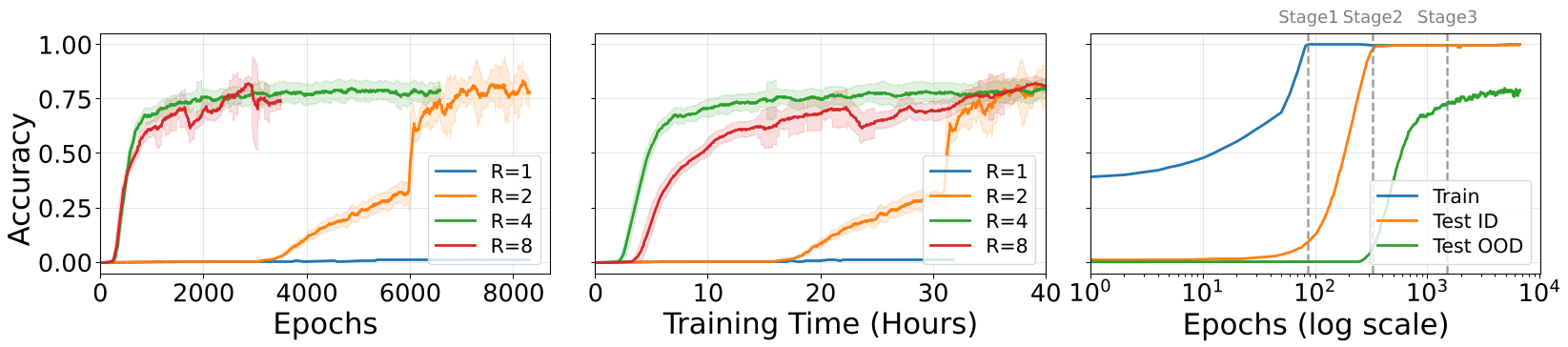
What Figure 3 shows: recurrence is not just improving sample efficiency. It changes the qualitative endpoint. The vanilla transformer never crosses into systematic behavior, while the recurrent models do.
Three-stage grokking
One of the most interesting observations is that systematic generalization does not appear smoothly. It emerges through a three-stage grokking process:
- Memorization
Training accuracy improves, but test generalization does not. - In-distribution generalization
After prolonged training, the model begins solving held-out compositions from the same compositional regime. - Systematic OOD generalization
Much later, the model begins combining facts never compositionally paired during training.
This is conceptually important. It suggests that systematicity is not merely a stronger version of memorization, but a qualitatively later phase transition in representation learning.
Mechanistic analysis with logit lens
The logit-lens analysis clarifies what changes internally.
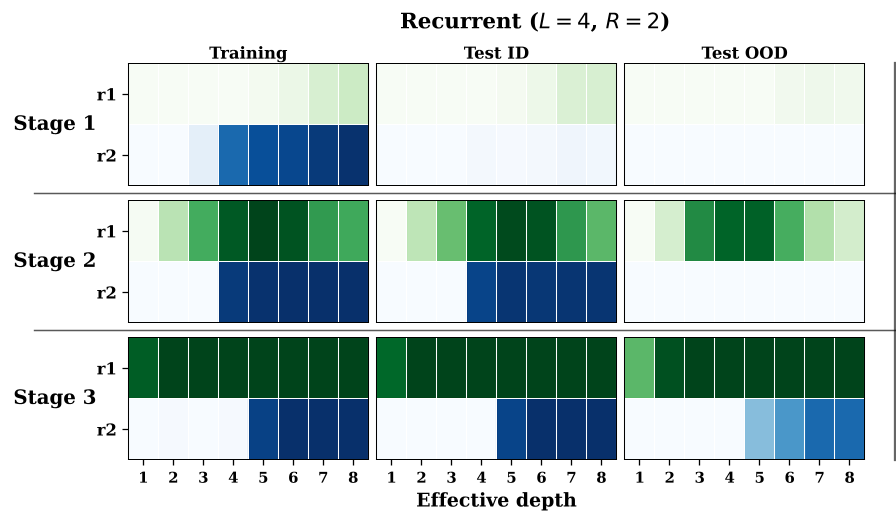
The paper probes whether intermediate layers/iterations can decode:
- the bridge entity after the first relation,
- the final target after the second relation.
The recurrent-depth model shows a clean progression:
- early stage: target sometimes predicted without a stable bridge representation, consistent with memorization,
- middle stage: the bridge becomes decodable, then the target follows on ID examples,
- late stage: this compositional internal structure extends to OOD examples.
The vanilla model can sometimes recover the bridge on OOD but fails to complete the second hop. This is a subtle but important finding. The issue is not simple inability to retrieve facts. It is inability to iteratively reuse retrieved structure in a systematic way.
That is exactly what recurrence is supposed to help with.
Depth Extrapolation: Can More Test-Time Compute Buy More Reasoning?
The second main contribution is about depth extrapolation.
Here the question is harder: if the model is trained only up to a certain hop depth, can increasing recurrence at inference time allow deeper reasoning?
The answer is: yes, partially.
In-distribution learnable depth grows with training recurrence
When training with larger recurrent depth, models can learn higher hop tasks during curriculum learning. This is intuitive: more training recurrence increases effective depth and therefore the capacity to represent iterative composition.
Dynamic recurrence performs especially well. It tends to reach larger learnable recursion depth than fixed recurrence under the same rough compute budget.
Inference-time scaling unlocks extrapolation
The key result is that when test-time recurrence exceeds train-time recurrence, models can solve harder tasks than those seen in training.
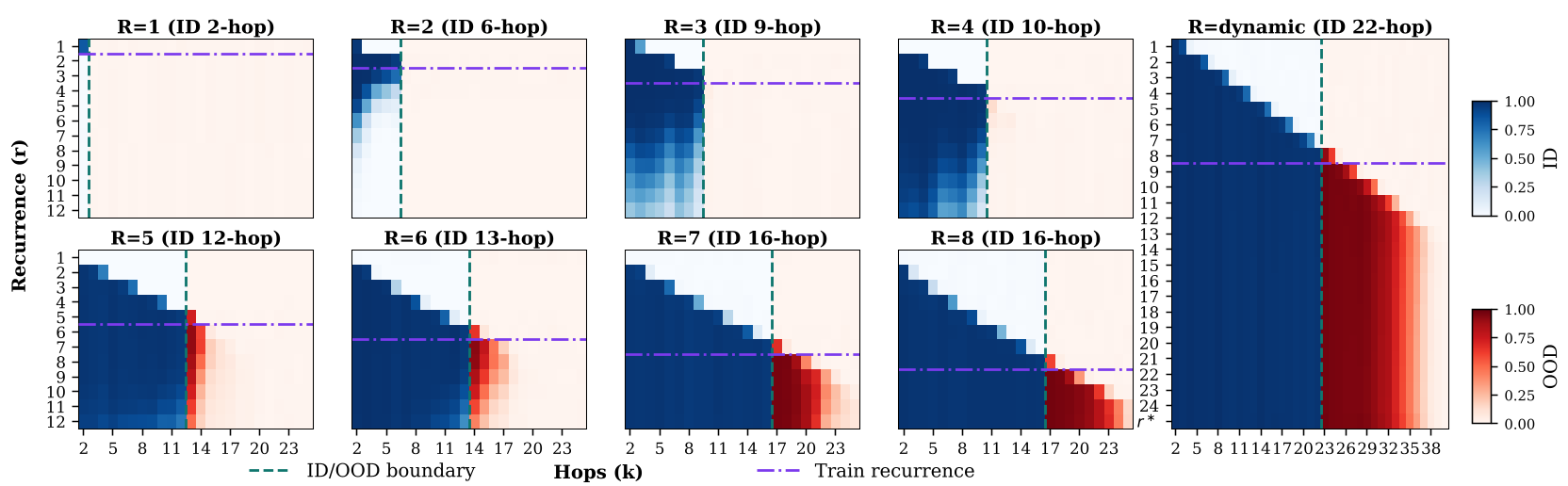
Reading Figure 5 carefully:
- If you keep inference recurrence equal to training recurrence, extrapolation is weak.
- If you increase inference recurrence, the model can solve deeper-hop problems.
- This only becomes robust once training recurrence is sufficiently large, roughly beyond (R > 4).
This is one of the most policy-relevant findings in the paper. It supports the broader idea that test-time compute scaling can improve reasoning, but only if the architecture and training procedure have already induced an iterative computation pattern worth extending.
In other words: more test-time steps help only when the model has learned a reusable internal algorithm.
Dynamic recurrence is not just regularization
The comparison in Figure 7 is especially useful because it controls for training data complexity by training all models only up to 12-hop.
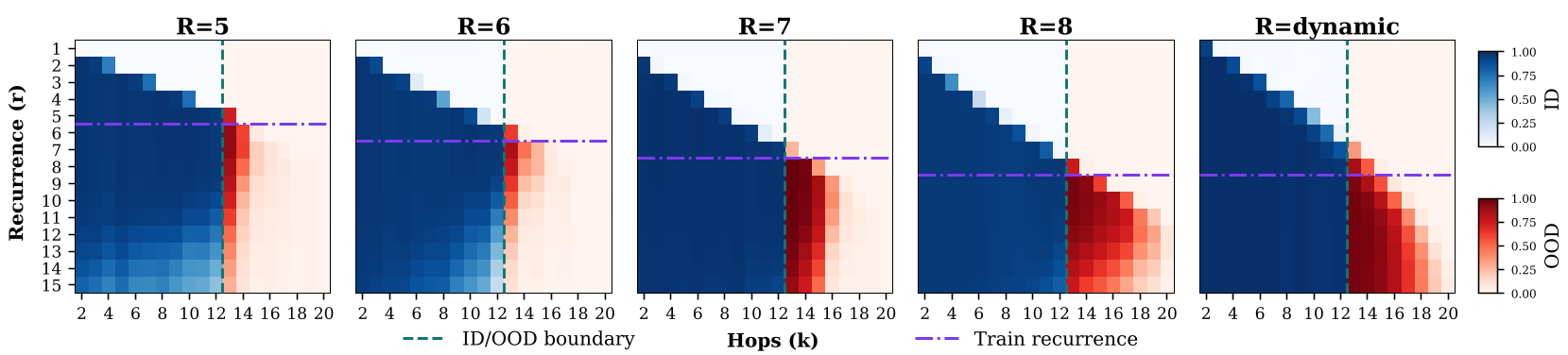
Under this controlled setup:
- fixed (R=6) extrapolates to roughly 14-hop,
- fixed (R=8) extrapolates to roughly 19-hop,
- dynamic recurrence reaches a similar extrapolation limit to (R=8).
The authors’ interpretation is sharp:
- the maximum recurrence seen during training determines the extrapolation range,
- dynamic recurrence helps the model better exploit that range, because it also improves in-distribution learnable depth.
This is a useful design principle for future recurrent LLM training.
Overthinking: The Main Limitation
The paper does not present recurrence as a free lunch. Its main failure mode is overthinking.
If you keep increasing recurrence indefinitely, performance eventually degrades.
Why?
The logit-margin analysis suggests:
- prediction confidence rises with recurrent steps at first,
- reaches a peak,
- then decays as recurrence continues.
This means the model often “gets the answer” at some intermediate iteration, then moves away from it under further updates.
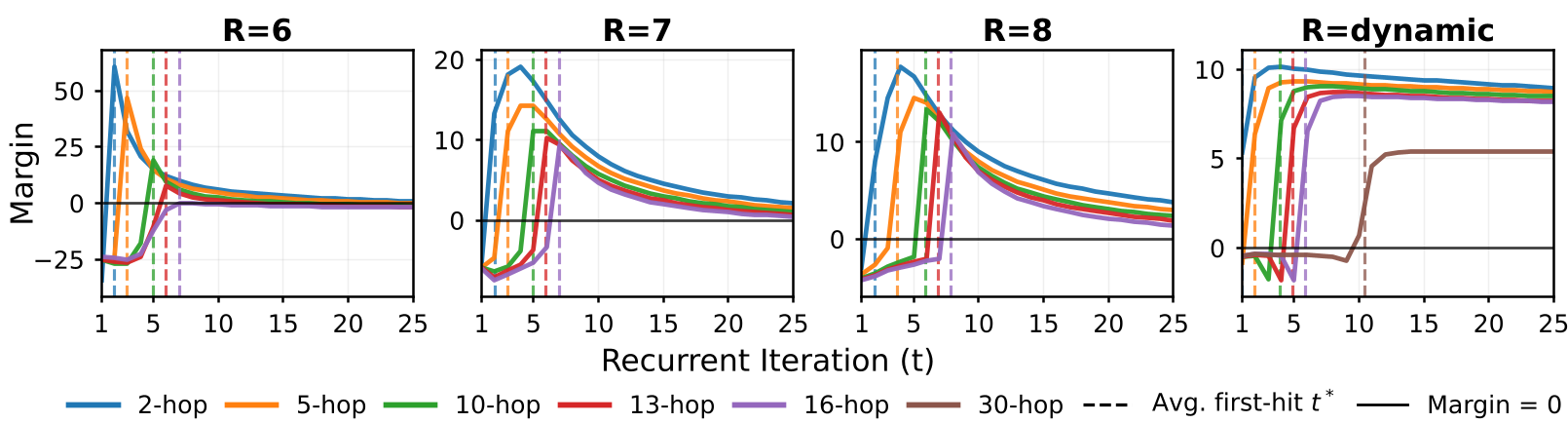
Two patterns stand out:
- more complex tasks have smaller peak margins,
- dynamic recurrence decays more slowly than fixed recurrence.
So dynamic recurrence does not eliminate overthinking, but it makes the model more robust to it.
This limitation has broader significance. It says recurrent-depth models are not simply “the deeper the better.” They require some notion of when to stop thinking.
Adaptive halting
The paper tests adaptive halting strategies and shows that KL divergence alone is not enough: the output distribution can stabilize while still remaining high-entropy and uncertain.
Their improved criterion combines:
- small KL change between successive iterations,
- low entropy of the current output distribution.
This better matches the actual reasoning dynamics.
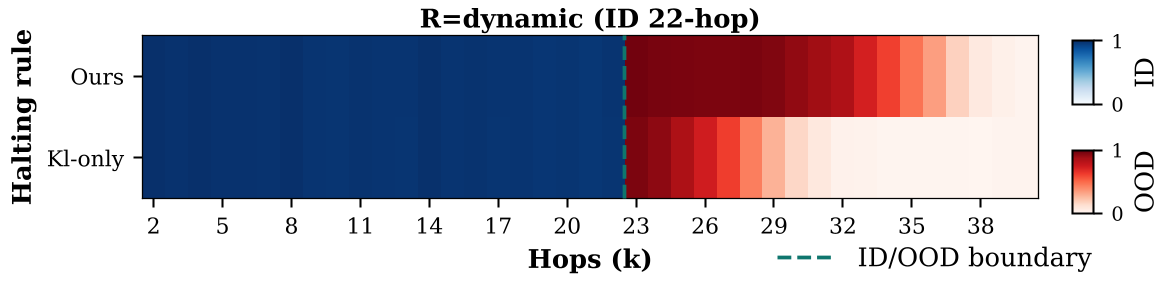
The practical message is simple: convergence of logits is not the same as confident convergence.
Why Recurrence Helps: A Deeper Interpretation
The strongest conceptual takeaway is that recurrent-depth transformers restore something vanilla transformers lack: iteration as an architectural prior.
Standard transformers can be deep, but their depth is largely allocated as a heterogeneous pipeline:
- early layers do one kind of transformation,
- middle layers another,
- later layers another.
That is useful for many tasks, but it is not ideal for repeated rule application.
Multi-hop implicit reasoning is closer to:
- identify current latent entity,
- apply relation transformation,
- update latent entity,
- repeat.
That repeated operator view aligns naturally with weight sharing.
So the gain here is not mysterious. It is an instance of a broader principle:
- if the target computation is iterative,
- then an iterative architecture should generalize better than a static unrolled one with unrelated parameters at each depth.
This is why the paper feels more like an algorithmic generalization result than a mere empirical tuning paper.
Critical Analysis
What is genuinely strong here
- Clean task formulation: The synthetic setup isolates composition from language noise.
- Careful dataset design: The permutation-based graph removes shallow shortcuts.
- Mechanistic evidence: The logit-lens analysis supports the behavioral claims.
- Training-design insight: zero-initialization and dynamic recurrence are not minor details; they materially affect extrapolation.
- Honest limitations: the paper directly studies overthinking rather than hiding it.
What remains limited
The main limitation is external validity.
These tasks are still:
- synthetic,
- tokenized with dedicated entity and relation symbols,
- low-entropy compared with natural language,
- free from paraphrase, distractors, ambiguity, and noisy retrieval.
So one should be careful not to over-claim: this paper shows that recurrence can fix a real architectural bottleneck under controlled conditions, but it does not yet prove that large recurrent LLMs will systematically solve real-world implicit reasoning.
Another limitation is that the recurrent model still does not extrapolate indefinitely. Overthinking and degradation remain significant, especially for very deep compositions.
Finally, the paper studies mainly decoder-only looped transformers with a simple recurrence mechanism. There is still open space around:
- better halting policies,
- recurrence with state compression,
- hybrid retrieval-plus-recurrence systems,
- scaling laws at realistic LLM size.
Takeaways for Research and Product Design
If you are building reasoning-oriented language models, this paper suggests three concrete lessons.
1. Architecture matters as much as scale
Some reasoning failures are not just “not enough data” or “not enough parameters.” They reflect a mismatch between the computation required and the computation the architecture naturally supports.
2. Test-time compute scaling works only when the model has learned an iterative algorithm
Simply running more steps is not enough. The training setup must teach the model a reusable operation that benefits from recurrence.
3. Halting is a first-class problem
A recurrent model that thinks longer can also think worse. Efficient and reliable stopping rules are central if this family of models is to become practically useful.
Conclusion
This paper makes a clear and important claim: implicit compositional reasoning improves when transformer depth becomes recurrent rather than static.
The empirical story is strong:
- vanilla transformers fail on systematic composition,
- recurrent-depth transformers pass it,
- larger inference-time recurrence enables depth extrapolation,
- but only up to the point where overthinking begins to hurt.
The deeper lesson is architectural. Reasoning often requires repeated application of the same latent operator. Weight sharing across depth gives the model a better chance of learning exactly that. In that sense, recurrent-depth transformers are not just a parameter-sharing trick; they are a more faithful computational prior for multi-step internal reasoning.
For future work, the obvious question is whether this inductive bias survives contact with real language, noisy corpora, and large-scale pretraining. If it does, recurrent-depth models may become one of the most principled ways to convert additional test-time compute into deeper reasoning.