
LoopMDM: Selective Looping is the New Depth for Masked Diffusion Models
Looped Diffusion Language Models
LoopMDM introduces selective layer looping into Masked Diffusion Models (MDMs), improving training efficiency and reasoning performance. By repeatedly applying shared early-middle transformer layers, it matches standard MDM performance with up to 3.3x fewer training FLOPs and achieves a +8.5 point gain on the GSM8K math benchmark.
TL;DR
LoopMDM is a breakthrough in Masked Diffusion Models (MDMs) that replaces deep, parameter-heavy stacks with a "selective loop" mechanism. By iterating through shared early-middle layers, the model treats masked positions as a workspace to solve complex problems. The results? 3.3x better training efficiency and an 8.5% boost in math reasoning (GSM8K) compared to standard MDMs of the same size.
Background: The Latent Efficiency Gap
In the world of Large Language Models (LLMs), we usually scale in two ways: more parameters or more data. While Autoregressive Models (ARMs) have dominated, Masked Diffusion Models (MDMs) are closing the gap. However, MDMs have a unique advantage often left on the table: the masked positions. In a single denoising step, an MDM looks at a sequence full of [MASK] tokens. These aren't just empty slots; they are potential "mental workspace" for the model to refine its thoughts before committing to a word.
Standard MDMs treat these masks linearly. LoopMDM changes this by asking: What if we let the model "think" multiple times on these masks within a single step?
Methodology: Selective Looping & The Masked Workspace
The core innovation of LoopMDM isn't just looping—it's Selective Looping. The authors found that looping the entire model is inefficient. Instead, they divide the Transformer into a Head, a Looped Mid-block, and a Tail.
1. The Architecture
The model identifies that general token representations form in the early-middle layers. By sharing the weights of these layers and looping them times, the model gains "effective depth" without adding a single extra parameter.
2. Masked Positions as "Scratchpads"
The paper provides a stunning theoretical and empirical proof: masked positions act as a parallel workspace. In a restricted Sudoku experiment, a shallow model fails because it can't "plan" ahead. LoopMDM, using the same number of parameters, uses the internal loops to communicate across masks, resolving global inconsistencies before outputting the final grid.
Experiments: Doing More with Less
The authors tested LoopMDM against standard MDMs across three major corpora (FineWeb-Edu, OWT, LM1B).
Training Efficiency
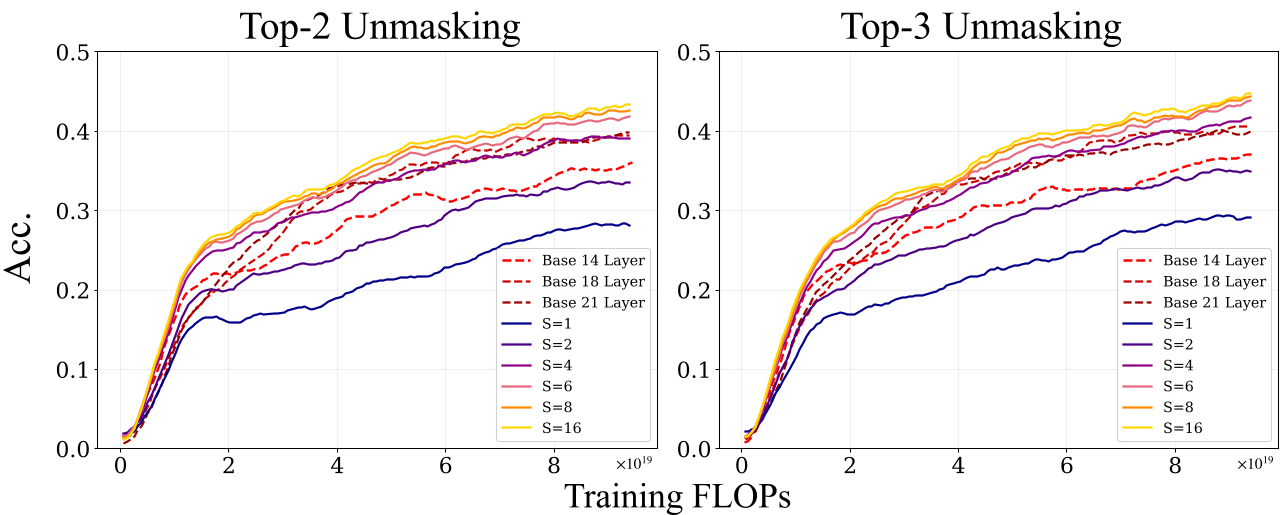
LoopMDM reached the same performance (NLL) as the baseline but required significantly fewer FLOPs. On LM1B, it was 3.34x more efficient. This means you can train a model to the same quality in 1/3 of the time.
Reasoning Prowess
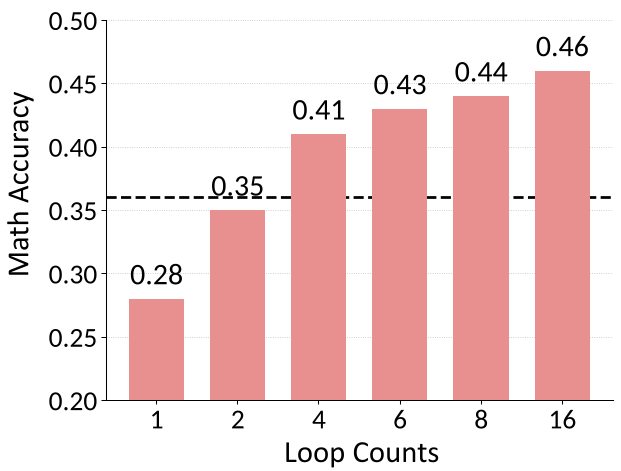
On the GSM8K math benchmark, LoopMDM didn't just beat same-sized models; it beat deeper models that used the same amount of compute per step. This proves that weight-sharing and recursion are inherently better for logic-bound tasks than simply stacking more unique layers.
Deep Insight: Adaptive Inference
One of the coolest features of LoopMDM is Adaptive Inference. Not every word is hard to predict. Some steps in the diffusion process need more "thought" than others.
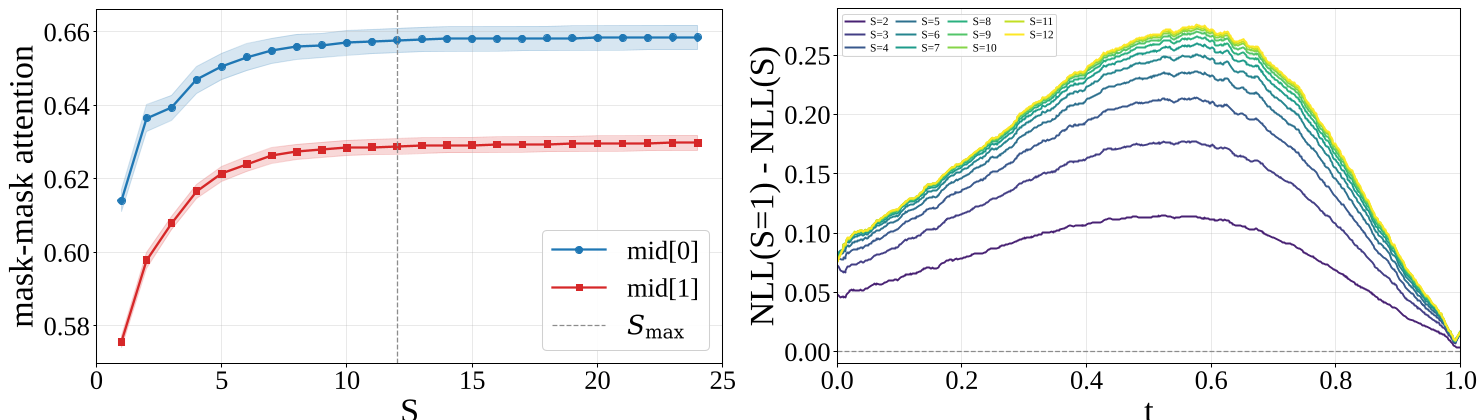
- The Insight: Looping is most useful at intermediate timesteps—when the model has some context but hasn't finalized the tokens.
- The Solution: The authors stop looping when the hidden states stabilize. This halves the compute needed at inference time (from 12 loops to ~5) without losing accuracy.
Conclusion & Takeaways
LoopMDM demonstrates that the architecture of a diffusion model should be fundamentally different from its autoregressive cousins. By leveraging the specific "workspace" nature of masked tokens, we can build models that are:
- More Efficient: 3x reduction in training costs.
- Smarter: Superior reasoning via iterative refinement.
- Flexible: Compute can be scaled up or down at test-time without retraining.
The future of efficient AI might not be about making models "larger," but about making them "loop" more effectively on the information they already have.