
EEG Under Pressure: How Much Data Can We Lose Without Forgetting Who You Are?
Investigating the effects of lossy compression on age, gender and alcoholic information in EEG signals
The paper investigates the effects of lossy compression (DWT-ACC and DWT-SPIHT) on extracting age, gender, and alcoholic information from EEG signals. By comparing traditional AR-PSD features with paralinguistic features and using an SVM classifier, researchers achieved high recognition stability even at significant Compression Ratios (CR), maintaining over 90% accuracy.
TL;DR
Managing large-scale EEG data usually requires a trade-off between file size and data integrity. This paper proves that lossy compression is not only viable but highly efficient for biometric tasks (Age, Gender, and Alcoholism recognition). By utilizing paralinguistic features borrowed from speech processing, the researchers maintained over 90% accuracy even when data was compressed by a factor of 40x.
The Bottleneck: Big Data in Small Brainwaves
Electroencephalogram (EEG) signals are a goldmine for biometrics and medical diagnostics. However, they come with a "Big Data" problem. With channel counts exceeding 256 and sampling rates up to 2000 Hz, storing and transmitting long-term recordings is a nightmare.
Lossless compression is safe but weak (only achieving 2x-3x reduction). Lossy compression (like JPEG for images) offers much higher ratios but introduces "artifacts." The critical question is: Does stripping away the "noise" to save space also strip away the person's identity or health status?
Methodology: Beyond the Standard Spectrum
The authors tested two primary lossy compression algorithms:
- DWT-ACC: Discrete Wavelet Transform followed by Adaptive Arithmetic Coding.
- DWT-SPIHT: Set Partitioning in Hierarchical Trees, originally an image compression giant.
What makes this study unique is the comparison of Feature Extraction strategies:
- AR-PSD (The Traditionalist): Autoregressive models and Power Spectral Density. These focus on low frequencies (1-30 Hz), where the meat of the brain signal usually resides.
- Paralinguistic Features (The Specialist): Methods like MFCC (Mel-Frequency Cepstral Coefficients) that look up to 300 Hz.
 Figure 1: Conceptual overview of the impact of compression on EEG information.
The Secret Sauce: Why High Frequencies Matter
The experimental results were striking. As compression increased (higher CR), accuracy naturally dipped. However, systems using paralinguistic features were incredibly resilient.
While traditional AR-PSD features failed to stay above 90% accuracy in many scenarios (especially for gender in DS2), paralinguistic features thrived. The reason? EEG signals are complex and non-stationary. Even though most energy is in low frequencies, vital biological markers for age and gender are hidden in the higher frequency "whispers" of the brain. Wavelet-based compression preserves significant coefficients across frequencies; paralinguistic features are simply better at picking them up.
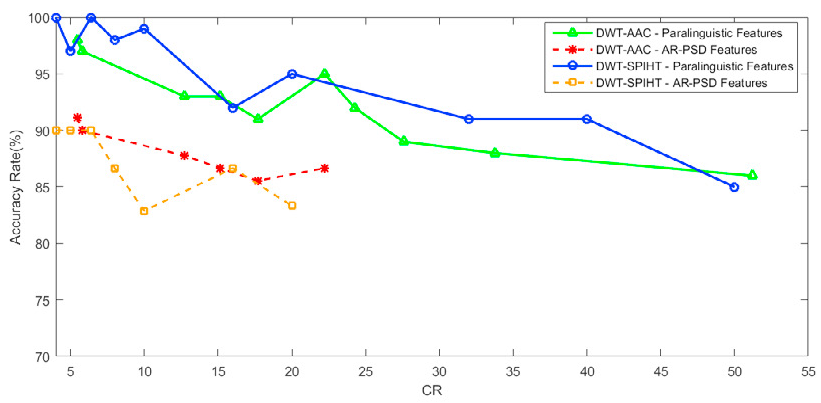 Figure 2: Age recognition accuracy vs Compression Ratio (CR) for different datasets.
Key Findings & Performance Thresholds
The researchers established a 90% accuracy "usability threshold":
- Age Recognition: Tolerates a CR of up to 41 (DWT-SPIHT) with paralinguistic features.
- Gender Recognition: Tolerates a CR of up to 39.
- Alcoholic Recognition: Tolerates a CR of up to 41.
In contrast, using standard AR-PSD features often limited stable CR to below 10.
Critical Analysis
The Win
The study successfully bridges audio processing and neurology. It demonstrates that the "gold" in EEG isn't just in the low-frequency oscillations we've studied for decades, but in the textural, high-frequency details that speech-based algorithms are designed to catch.
The Limitations
The study relies on traditional SVM classifiers. While robust, it doesn't explore how Modern Deep Learning (CNNs/Transformers) might handle the compression artifacts. Furthermore, the datasets (DS1, DS2, DS3) are relatively small in terms of subject variety (10-20 people), which might overfit the biometric recognition.
Conclusion: The Path Forward
The takeaway for developers of Brain-Computer Interfaces (BCI) and wearable medical tech is clear: don't be afraid of lossy compression. By shifting from narrow-band spectral features to wide-band paralinguistic features, we can reduce storage needs by 97.5% (CR 40) without losing the clinical or personal validity of the data.
Future work should investigate if these results hold for more complex tasks like emotion recognition or intention decoding in real-time robotic control.