
Lost in the Middle: The Hidden "U-Curve" of LLM Reasoning
Lost in the middle: How language models use long contexts
The paper "Lost in the Middle" investigates how large language models (LLMs) utilize information across long input contexts. Through multi-document question answering and key-value retrieval tasks, it identifies a "U-shaped" performance curve where models excel at accessing information at the beginning or end of a context but struggle significantly with information in the middle.
TL;DR
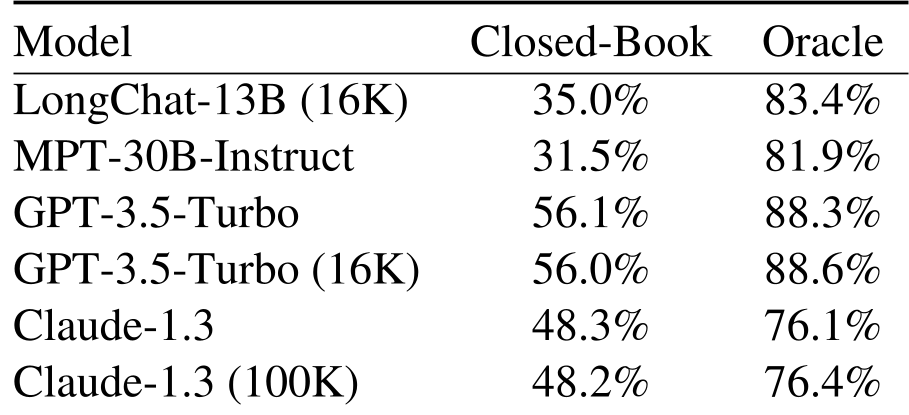
Expanding the context window to 100K tokens is an engineering feat, but this paper reveals a cognitive limitation: Large Language Models (LLMs) are significantly better at using information at the very beginning (primacy bias) or the very end (recency bias) of a prompt. When the answer is buried in the middle, performance plummets—sometimes even falling below the level of the model guessing from its own internal memory without any context at all.
The "Serial Position" Problem: Why Long Context Fails
In human psychology, the "Serial Position Effect" describes our tendency to remember the first and last items in a list. This paper proves that LLMs suffer from a nearly identical digital pathology.
The researchers identified a critical disconnect: while Perplexity (the model's ability to predict the next token) might improve as context grows, Downstream Task Accuracy (the ability to actually use that data to solve a problem) does not.
The Core Experiment: Needle in a Haystack
The authors tested this using two primary tasks:
- Multi-Document QA: Providing documents where only one contains the answer.
- Key-Value Retrieval: A "clean" synthetic test requiring the model to find the value associated with a specific UUID key.
Methodology: Mapping the Valley of Death
The authors systematically moved the "relevant" information through various positions in the input context.
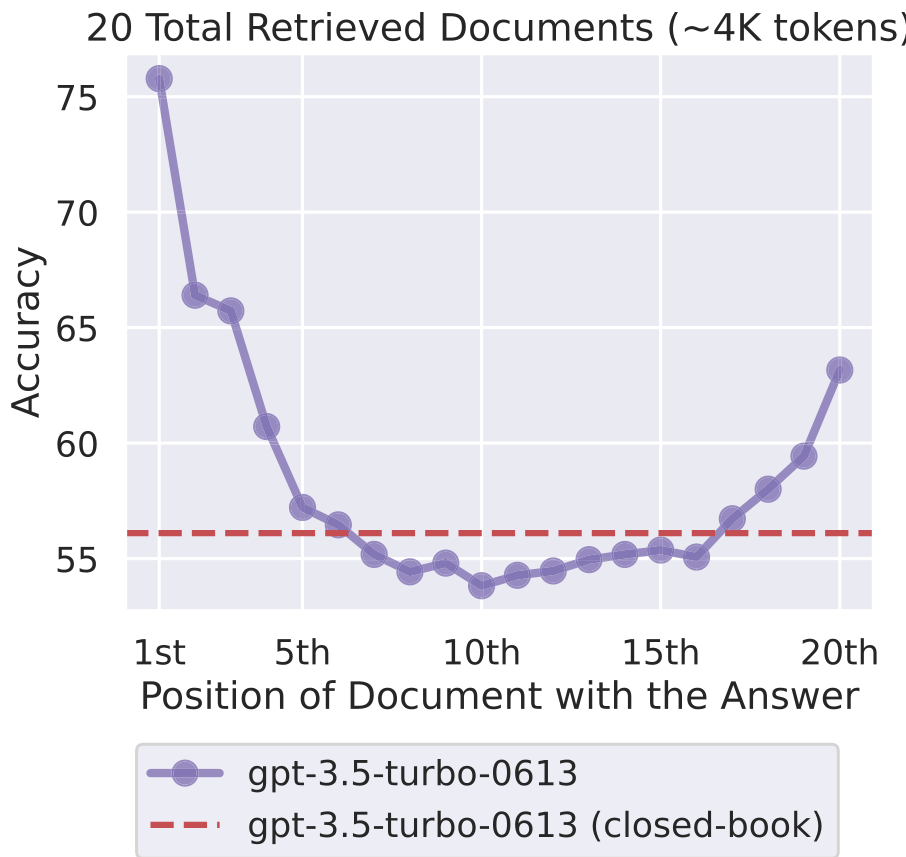 Figure 1: The U-shaped curve. Accuracy is high at the start (Position 0) and end, but dips significantly in the center.
Key Insights from the Data:
- Architecture Matters: Encoder-decoder models (like Flan-UL2) are surprisingly robust to position until the input exceeds their training sequence length.
- Instruction Tuning is Blameless: Even base models (pre-tuning) show this U-curve. It is likely an emergent property of the Transformer architecture or the distribution of data on the web (where introductions and conclusions are most data-dense).
- The "Context Trade-off": Adding documents instead of in a RAG system often only adds noise and latency for a marginal (~1.5%) accuracy gain.
Deep Dive into Model Comparison
The paper reveals that simply "bolting on" a larger context window (e.g., GPT-3.5-Turbo 16K) doesn't fix the underlying retrieval logic. The 16K model performed almost identically to the 4K model when the relevant document was in the middle of a 4K prompt.
How to Fix It? (The Developer's Takeaway)
If you are building Retrieval-Augmented Generation (RAG) applications, this paper suggests two vital optimizations:
- Reranking is Key: Don't just retrieve the Top-20 documents and dump them in the prompt. Use a re-ranker (like Cohere or BGE) to ensure the most "relevant" matches are at the very top of the prompt.
- Query-Aware Contextualization: Interestingly, placing the query before and after the context can help the model "eye" the correct information earlier, though this is primarily effective for simple retrieval rather than complex reasoning.
Conclusion: A New Standard for Long-Context Evaluation
"Lost in the Middle" effectively killed the "Bigger is Better" context window hype. It established that for a model to be a true "Long Context" model, it must demonstrate Positional Robustness. Until models can reason over their middle-context as effectively as their start-context, we are still functionally limited to the information we can fit in the "ears" of the prompt.
Limitations
The study focused on Llama-2, MPT, and early GPT-3.5/Claude models. Since publication, newer architectures (like those using Ring Attention or State-Space Models like Mamba) and better SFT (Supervised Fine-Tuning) data have attempted to flatten this U-curve. However, for most production-grade RAG systems today, the "middle" remains a dangerous place for your data.