
LoTrust: Why Interaction Recency and Semantic Similarity are the Keys to Digital Trust
LoTrust: A social Trust Level model based on time-aware social interactions and interests similarity
2016-12-01
Summary
Problem
Method
Results
Takeaways
Abstract
This paper introduces LoTrust, a novel social trust level model designed for personalized recommendation systems. It combines semantic interest similarity (extracted from RDF/FOAF profiles) with time-aware social interactions (e.g., messages, comments) to quantify trust between users in an egocentric network.
## TL;DR
Static social graphs are a poor proxy for real-world trust. This paper presents **LoTrust**, a computational model that mines Facebook-like interactions and semantic profiles to calculate a "Trust Level." By prioritizing **recent interactions** and using a **dynamic threshold**, it achieves a 14-50% improvement in precision over baseline models.
## The Decay of Digital Intimacy: The Motivation
In most Online Social Networks (OSNs), a "friend" is a binary status. However, trust is a spectrum that evolves. Previous SOTA models like *TidalTrust* or *TrustWalker* often treated relationships as static or focused on "relationship age" (how long you've been friends).
The authors argue this is flawed: A high-school friend you haven't messaged in five years is less "trustworthy" for a modern recommendation than a colleague you interact with daily. The missing ingredient in the literature was a **Time-Aware Interaction** metric that captures the "pulse" of a relationship.
## Methodology: The LoTrust Architecture
The LoTrust mechanism operates in three phases: Egocentric Analysis, Trust Computation, and Dynamic Filtering.
### 1. Modeling the Interaction Pulse
The core innovation is the **Time-aware Interaction Degree ($DoI$)**. Unlike simple frequency counts, it measures the ego's interactions with a specific friend relative to all interactions within the same time window ($\Delta t$).
$$DoI(ego, u_j)_{\Delta t} = \frac{NI_f(ego, u_j, \Delta t)}{NI_{all}(ego, \Delta t)}$$
### 2. Semantic Soulmates
Trust isn't just about how often you talk, but what you have in common. Using **RDF/FOAF** social profiles, the model calculates interest similarity ($DoS$) via the Jaccard Coefficient.
### 3. The Global Trust Score
These values are aggregated using weights ($\alpha, \beta$):
$$LoT(ego, u_j) = \alpha imes DoI + \beta imes DoS$$
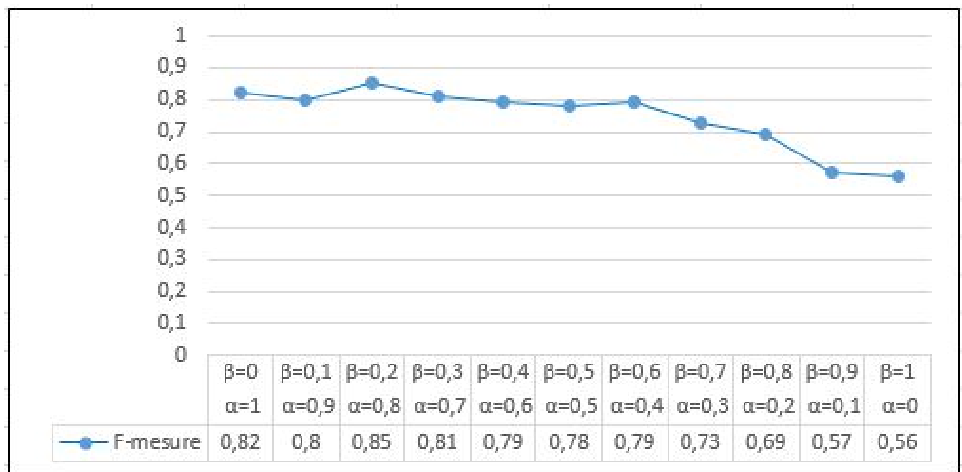
*Fig 1: Optimization of weights showing that $\alpha=0.8$ (Interaction) is the dominant factor for trust.*
## Experimental Insights: Breaking the Static Threshold
One of the paper's strongest contributions is the move away from a "one-size-fits-all" trust threshold. Usually, nodes are pruned if $Trust < 0.5$. LoTrust introduces a **Dynamic Threshold ($\gamma$)**, which is the average of an individual's distinct trust values. This accounts for different social behaviors—some users are "easy trusters," while others are more selective.
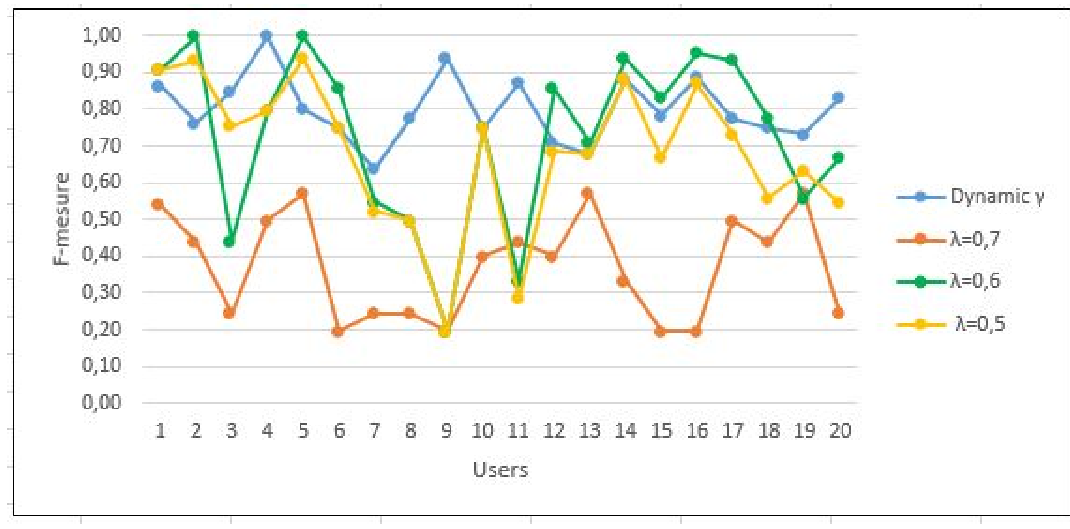
*Fig 2: The dynamic threshold $\gamma$ consistently yields a higher F-Measure than fixed lambda values.*
## Results & Comparative Performance
LoTrust was tested against:
1. **Temporal Trust**: Ranks friends by relationship age (newest = best).
2. **Closest Friends**: Uses interactions only, ignoring time.
LoTrust crushed the **Closest Friends** model in precision (76.94% vs 25.85%), proving that identifying *past* close friends as *current* trusted sources is a major source of error in recommendation systems.
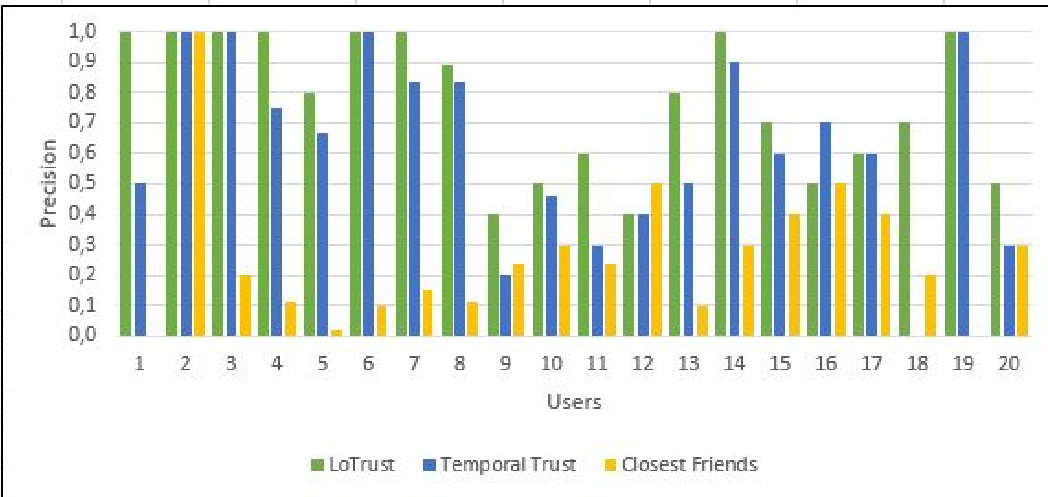
*Fig 3: LoTrust demonstrates a 14% lead over the age-based Temporal Trust model.*
## Critical Analysis & Conclusion
**Takeaway:** If you are building a social recommender, the "Social Interaction Degree" over time is your most valuable feature.
**Limitations:** The model currently ignores the **Context of Trust**. I might trust a friend for a movie recommendation but not for medical advice. The authors acknowledge this and plan to include context-awareness in future iterations.
**Future Outlook:** As privacy regulations (like the Facebook API changes mentioned) make data extraction harder, the future of such models may lie in **Federated Learning** or on-device trust computation where raw interaction data never leaves the user's phone.