
Cross-Layer Optimization: Redefining Efficiency in Wearable Cardiovascular Healthcare
A Low Power Cardiovascular Healthcare System With Cross-Layer Optimization From Sensing Patch to Cloud Platform
This paper presents a "sensing patch-mobile-cloud" hybrid cardiovascular healthcare system utilizing cross-layer optimization and a custom SoC. It achieves an on-patch ECG compression ratio of 12.07 with only 2.29% distortion and delivers a 97% disease prediction accuracy through cloud-based AdaBoost classification.
TL;DR
Researchers have developed a wearable ECG monitoring system that intelligently splits the computational workload between a custom sensing patch, a smartphone, and the cloud. By moving heavy threshold training to the phone and high-precision diagnosis to the cloud, they achieved a 76% reduction in transmission power and a 97% disease detection accuracy, all while maintaining a miniaturized footprint.
The "Trilemma" of Wearable Health
In the world of Internet of Medical Things (IoMT), engineers face three conflicting goals:
- Form Factor: It must be small and comfortable for long-term wear.
- Battery Life: Transmission of raw ECG data at high sampling rates drains batteries in hours.
- Accuracy: Simple edge-only processing often misses subtle arrhythmia markers.
Previous attempts often failed by being too bulky or having poor signal quality. This work breaks the deadlock through Cross-Layer Optimization.
Methodology: The Hybrid Computing Framework
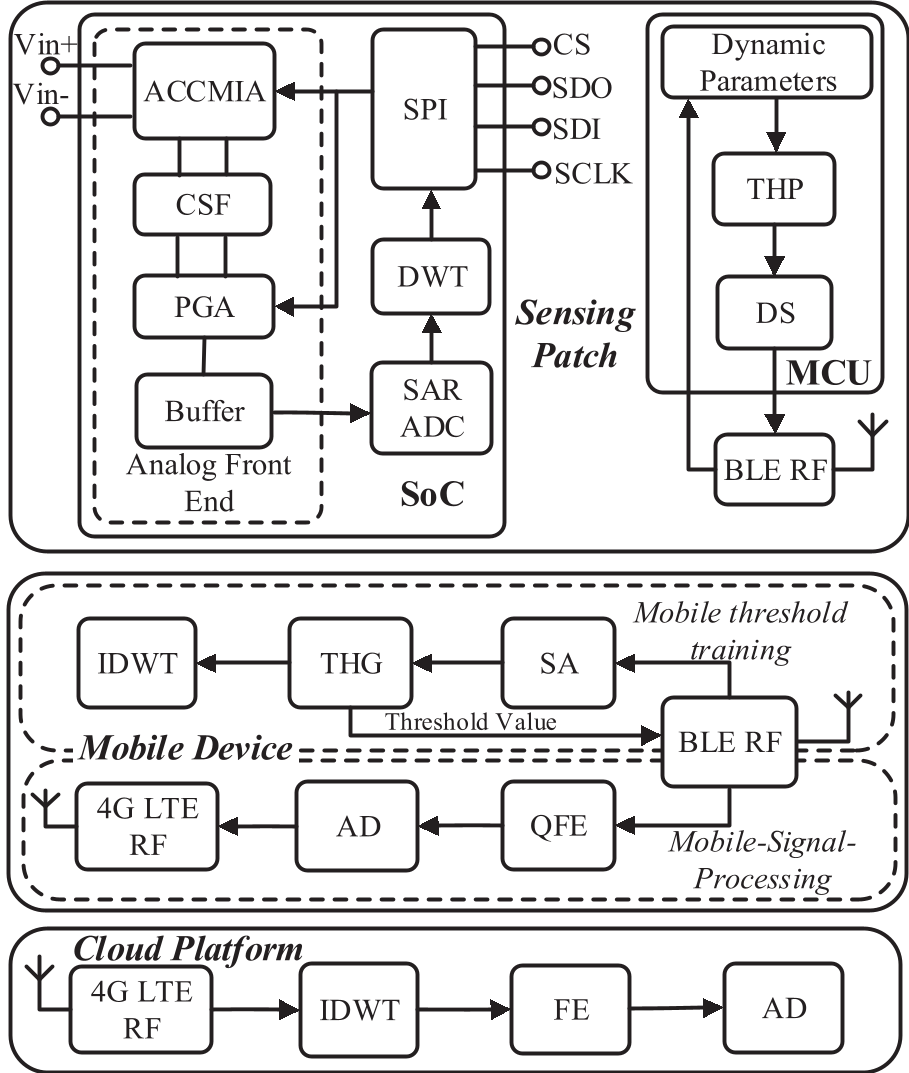
The core innovation is not just the hardware, but the functional distribution. Instead of treating the patch as a "dumb" sensor or a "heavy" computer, the system utilizes a three-tier architecture:
1. The Sensing Patch (Edge Layer)
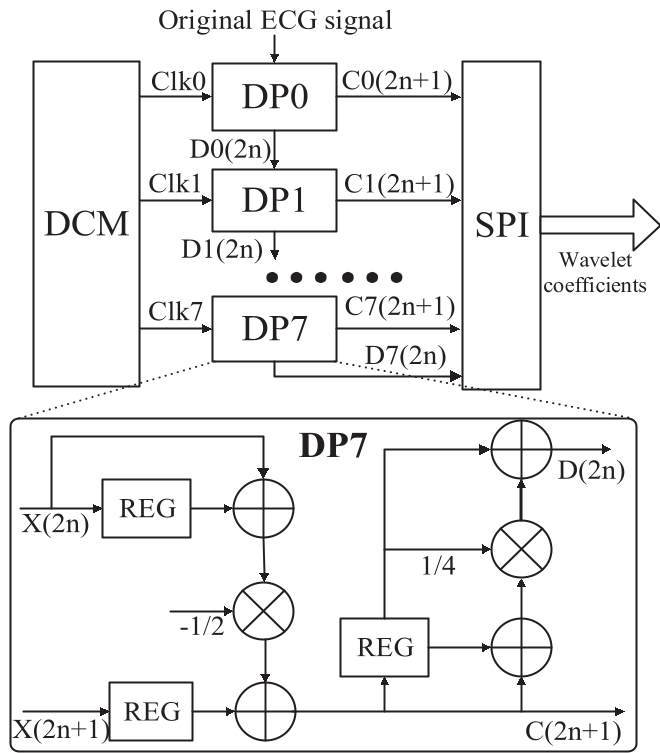
Equipped with a custom E9625 SoC and a hardware DWT (Discrete Wavelet Transform) accelerator, the patch performs real-time denoising and compression. By applying a "combined threshold table" provided by the mobile device, it processes signals in the wavelet domain, significantly reducing the amount of data that needs to be sent over Bluetooth.
2. The Mobile Device (Coordination Layer)
The smartphone acts as the brains of the operation. It runs a threshold training algorithm to calculate the optimal parameters for signal denoising and compression. These parameters are sent back to the patch, ensuring the edge processing remains "smart" but lightweight. It also offers "Quick Feature Extraction" in the compressed domain for low-latency alerts.
3. The Cloud Platform (Analysis Layer)
The cloud handles the heavy lifting: signal reconstruction via IDWT, archival storage, and high-precision classification using the AdaBoost algorithm.
Experimental Results & Performance
The system's performance was validated using both the MIT-BIH database and live human subjects across different activities (sitting, walking, running).
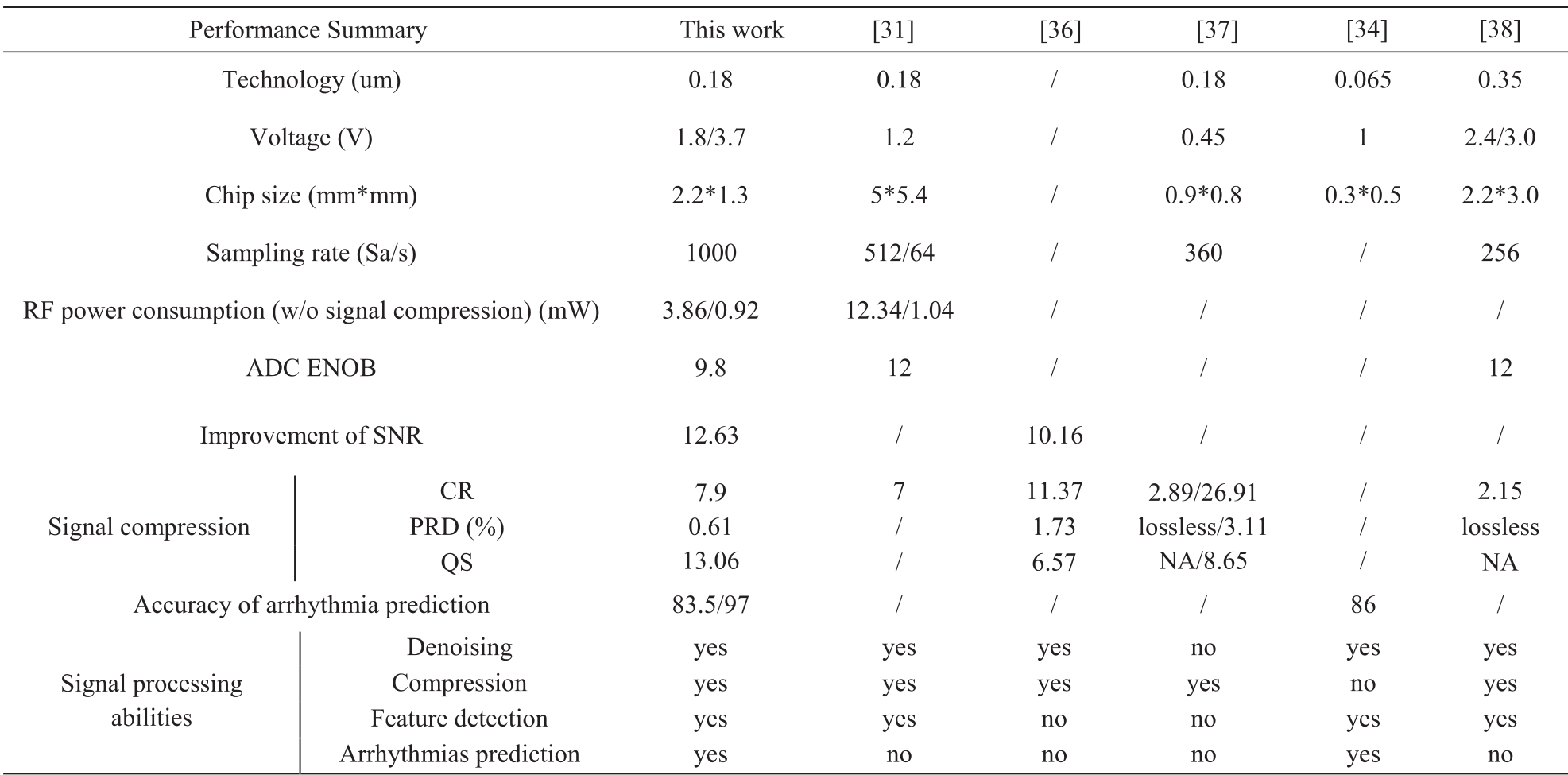
- Signal Quality: Signal-to-Noise Ratio (SNR) improved by 12.63 dB, meaning the DWT-based denoising is highly effective even during physical movement.
- Energy Efficiency: Transmission power dropped by 76%. This is critical because RF transmission is usually the most power-hungry event in a wearable device.
- Diagnostic Precision: While mobile-based detection reached 83.5% accuracy, the cloud-based AdaBoost model achieved 97% overall accuracy, effectively identifying Left/Right Bundle Branch Blocks (LBBB/RBBB) and Paced Beats.
Deep Insight: Why Why Does This Matter?
The brilliance of this work lies in the dynamic thresholding used for compression. Most systems use static compression, which either loses vital information or saves too little power. By calculating thresholds on the mobile device (where memory is abundant) and applying them on the SoC (where speed/power is vital), the system achieves a "best-of-both-worlds" scenario.
The transition from the Time Domain to the Wavelet Domain allows the system to target specific noise frequencies (like 50/60Hz power line interference or muscle artifacts) without destroying the morphological features of the ECG signal (like the P-wave or QRS complex).
Conclusion & Limitations
This cross-layer approach proves that IoMT devices don't need excessive on-chip intelligence if they are part of a well-architected ecosystem. However, the authors note that data security and cloud connectivity stability remain challenges. Future iterations will likely focus on implementing encrypted transmission and handling intermittent network disconnects.
For healthcare providers, this technology represents a leap toward "invisible" hospitals, where patients can be monitored with clinical-grade accuracy while going about their daily lives.