
LoRA Redux: Bridging Modern LLM Fine-Tuning with Classical Signal Processing
Low-Rank Adaptation Redux for Large Models
This paper provides a comprehensive technical overview of Low-Rank Adaptation (LoRA) through the lens of Signal Processing (SP). It unifies diverse LoRA variants into a structured taxonomy of architectural designs, optimization strategies, and broad applications in Large Language Models (LLMs).
TL;DR
Low-Rank Adaptation (LoRA) has become the industry standard for fine-tuning Large Language Models (LLMs). This survey reinterprets LoRA through the lens of Signal Processing (SP), revealing that what we see as "adapter training" is actually a modern iteration of classical matrix sensing and subspace tracking. By understanding the underlying geometry—specifically Gauge Invariance—we can design more efficient architectures and optimizers that go far beyond vanilla matrix multiplication.
Problem & Motivation: The Memory Wall
The primary bottleneck in modern AI isn't just compute—it's memory. A standard 8B parameter model requires ~128GB of VRAM for full fine-tuning. LoRA solves this by freezing the backbone and updating only a low-rank bottleneck: .
However, most researchers approach LoRA as a "black box" empirical tool. This leads to two major issues:
- Underutilization: Often, internal ranks are redundant, yet we allocate budget uniformly.
- Optimization Drift: Because , there are infinite ways to represent the same update. Standard SGD drifts aimlessly along these "gauge orbits," slowing down convergence.
Methodology: The Architecture-Optimization Duality
The paper categorizes the LoRA ecosystem into two axes: how we build the model (Architecture) and how we train it (Optimization).
1. Beyond Matrix Factorization: Tensorization
While vanilla LoRA treats each layer as an island, Tensor-based adapters (like LoRTA or Fact-TT) view the entire model as a high-order tensor . By using Canonical Polyadic (CP) or Tucker Decompositions, we can capture correlations across layers, reducing the parameter count from to .
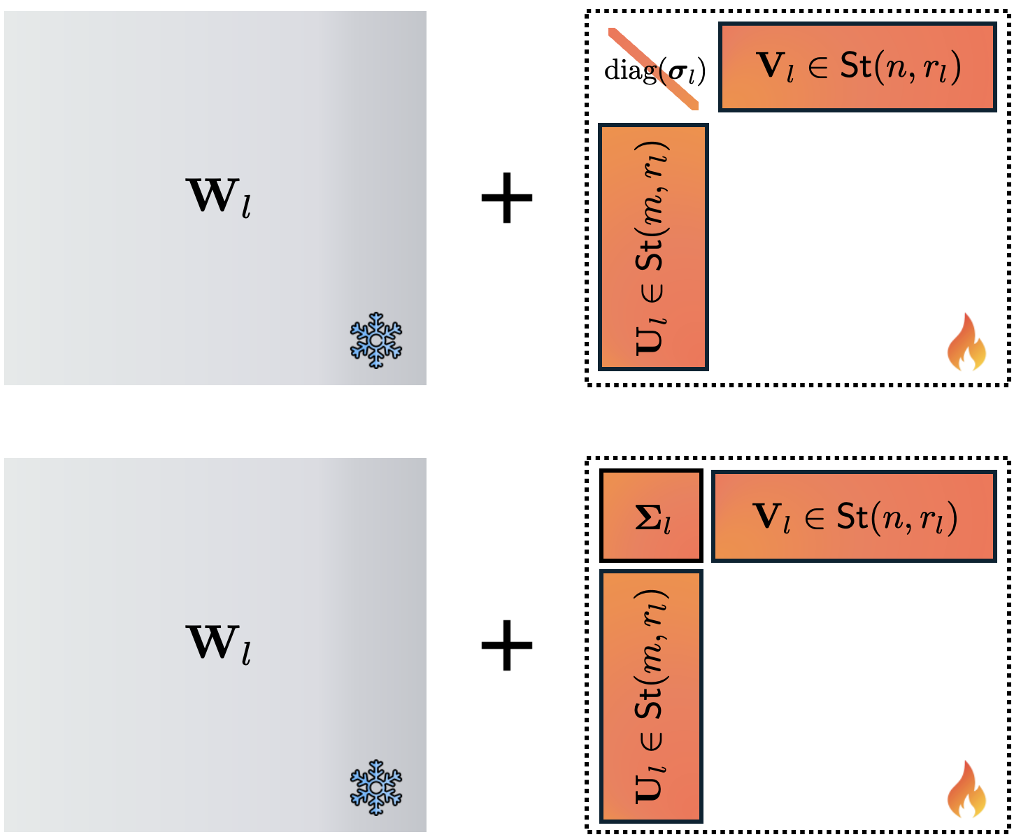 Figure: Comparison between LoRA, AdaLoRA (dynamic rank), and SVD-based parameterizations.
2. Solving the Gauge Problem
The most profound insight is the treatment of Gauge Invariance. Since the loss only cares about the product , the specific values of and are secondary.
- ScaledGD: Rescales the gradient by the inverse Gram matrix of the factors.
- RefLoRA: Uses a gauge-invariant Riemannian metric to ensure the update moves purely in the "horizontal space," avoiding redundant motion along the gauge orbit.
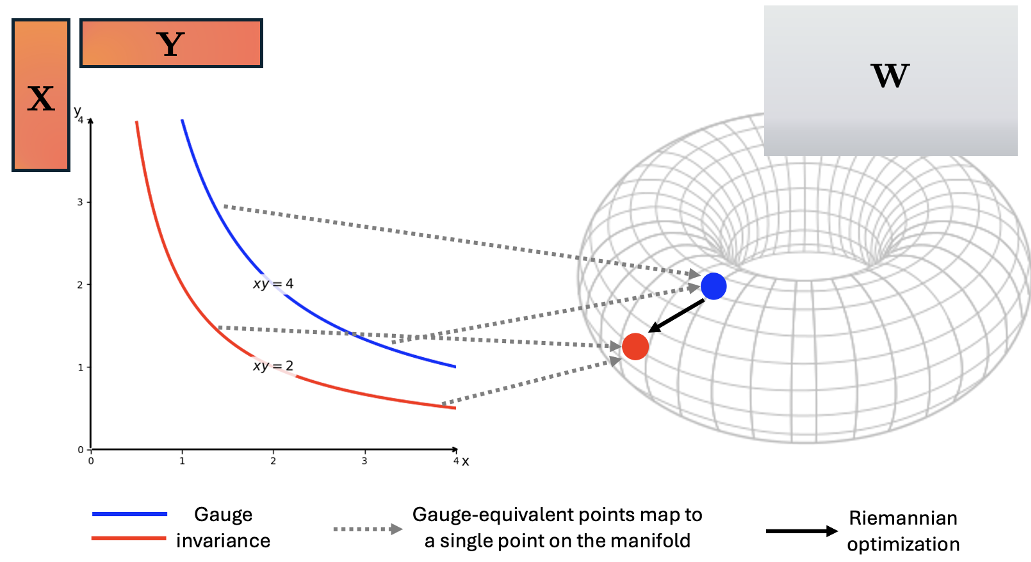 Figure: The geometry of the quotient manifold where gauge orbits collapse into single points.
Experiments & Results: Efficiency Gains
The paper synthesizes results from various SOTA variants:
- Initialization Matters: Using Nyström sketching or SVD (e.g., PiSSA) to align the starting subspace can accelerate convergence from to in ideal settings.
- Utilization: SVD-based methods like PoLAR maintain a much higher "stable rank" than vanilla LoRA, meaning they actually use the expressiveness researchers pay for in their rank budget.
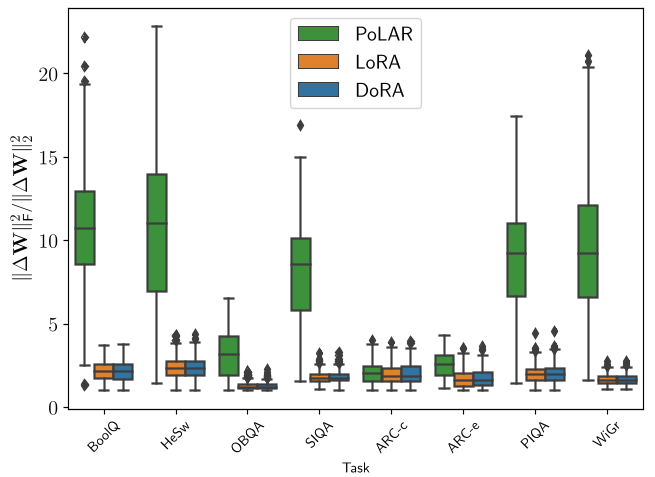 Figure: Stable rank comparison showing that advanced optimizers leverage higher expressiveness than vanilla GD.
Critical Insight & Conclusion
The "Redux" highlights a vital transition: we are moving from empirical experimentation to principled design.
- Takeaway: If you want to improve LoRA, don't just change the rank. Look at the initialization (to align subspaces) and the metric (to handle symmetry).
- Limitation: Tensorized and gauge-invariant methods provide superior scaling but often require more complex implementation (like solving Sylvester equations) which are not yet fully optimized in standard CUDA kernels.
Future Outlook: The next frontier is Pre-training with LoRA (like GaLore or ReLoRA) and Multi-modal adaptation, where shared low-rank subspaces could act as a bridge between vision and language.