
Speed Limits of Social Wisdom: Why Sampling Matters in Network Learning
Lower bounds on the rate of learning in social networks
This paper investigates the convergence rate of Bayesian learning in social networks, comparing "immediate neighbor sampling" and "random sampling." It establishes that under signals with unbounded likelihood ratios, the error probability decays at a polynomial rate for the former and a much slower logarithmic rate for the latter.
In the realm of social learning, "asymptotic learning"—the idea that a group will eventually figure out the truth—is often taken for granted given enough time. However, in the real world, the speed of that learning is everything. If it takes a trillion agents to correct a popular misconception, learning is effectively impossible.
A seminal paper from MIT, "Lower Bounds on the Rate of Learning in Social Networks," tackles this head-on. By comparing different ways we observe our peers, the authors reveal a stark reality: the structure of who we watch determines whether we learn at the speed of light or the speed of a snail.
TL;DR
The researchers prove that the rate at which a society identifies the "correct" action depends heavily on the network topology. Observing your immediate predecessor leads to fast, polynomial-rate learning. However, picking a random person from history to follow slows the process down to a sluggish logarithmic crawl.
The Friction in Information Flow
Why do some networks aggregate information better than others? The core tension lies in how "fresh" information enters the social consciousness.
In a Random Sampling network, each new agent looks back at any random person from the past. Because early agents are "sampled" infinitely often as the network grows, their potentially noisy or incorrect signals continue to echo through the system. This creates a bottleneck where new, higher-quality signals are diluted by the sheer volume of "old news."
Method: The Calculus of Belief
To solve this, the authors moved away from complex probability matrices and introduced an elegant continuous-time approximation.
The ODE Bounding Method
By defining as the probability of making the correct decision at time , they modeled the discrete jump in group knowledge as a differential equation:
- Immediate Neighbor Sampling:
- Random Sampling:
Notice the factor in the second equation. As time (or the number of agents ) increases, the rate of improvement in a random network drops off sharply.
 Figure 1: The decision rule used by agents to determine whether to follow their own signal or mimic their neighbor.
Key Findings: Polynomial vs. Logarithmic
The disparity in learning speed is mathematically dramatic:
- Immediate Neighbor Sampling: The probability of error is . This is polynomial decay. In practical terms, this is relatively fast—doubling the population significantly reduces error.
- Random Sampling: The probability of error is . This is logarithmic decay. In this scenario, you might need an exponentially larger population to achieve the same reduction in error.
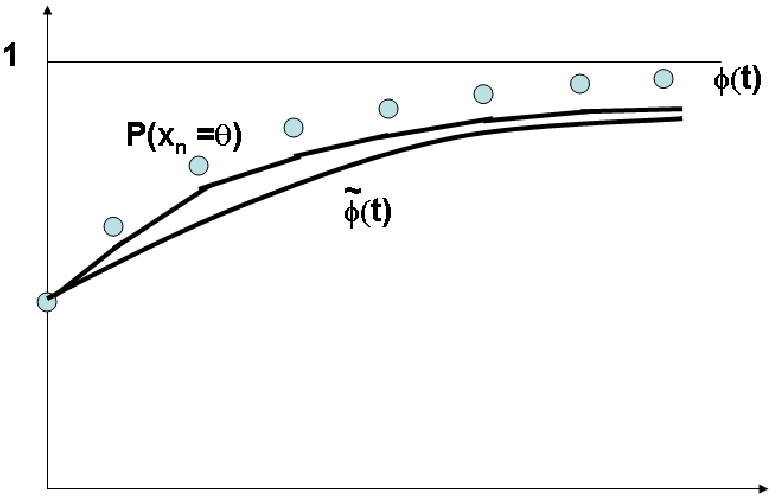 Figure 2: The graphical representation of the lower bound used to prove the convergence rates.
Why This Matters (The Takeaway)
This research provides a mathematical foundation for why "echo chambers" or "re-sampling" the same influencers is dangerous. If a social system keeps recycling the same old voices (Random Sampling), the arrival of new, correct information is suppressed.
The Insight: To maximize collective intelligence, a network must prioritize the incorporation of new members' signals. Systems that "re-sample" the same individuals lead to a stagnation of social belief, where the group takes vast amounts of time to correct early mistakes. This work sets the stage for designing better algorithms for sensor networks and understanding the limits of human consensus-building.