
CCS: Revolutionizing Mobile Crowdsourcing by Doing "More with Less"
More with less: Lowering user burden in mobile crowdsourcing through compressive sensing
This paper presents Compressive CrowdSensing (CCS), a framework that applies Compressive Sensing (CS) to mobile crowdsourcing to reduce user data collection burden. By leveraging inherent data correlations, CCS reconstructs large-scale phenomena (e.g., urban surveys, sensor heatmaps) from significantly fewer manual contributions, achieving state-of-the-art accuracy in sparse data recovery.
TL;DR
Mobile crowdsourcing is essential for urban monitoring but is plagued by "user fatigue." This paper introduces Compressive CrowdSensing (CCS), the first framework to successfully apply Compressive Sensing (CS) to multi-dimensional user survey data. By discovering hidden correlations in data, CCS allows systems to reconstruct complete city-wide datasets while asking users for only a fraction of the usual effort—effectively slashing the "participation tax" without sacrificing data quality.
The Bottleneck: The Burden of Participation
Modern cities rely on "Citizen Science" to track everything from air quality to rat infestations. However, the Achilles' heel of these systems is the user burden. Manually filling out surveys or responding to pings multiple times a day leads to low opt-in rates and high churn.
Previous attempts to solve this used simple interpolation (guessing the middle ground between two points). But humans and urban environments aren't that simple. A rat sighting in North Houston doesn't linearly relate to one in South Houston. There are complex, "non-obvious" structures—like industry types, building ages, or seasonal shifts—that traditional math misses.
Methodology: Mining the Hidden Structure
The core innovation of CCS is its ability to treat survey responses like signals.
1. Data Structure Conversion
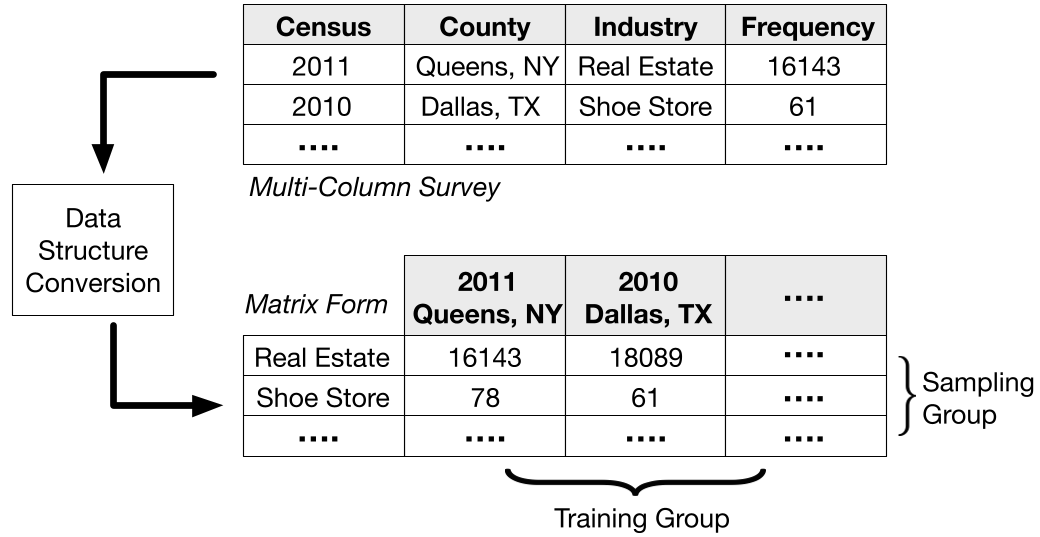
Standard Compressive Sensing works on 1D signals (like sound). Survey data is a mess of columns (Year, Location, Industry, Count). CCS introduces an algorithm to split these columns into:
- Sampling Dimensions: Factors that are highly correlated with the target (e.g., Industry Type).
- Training Dimensions: Independent factors used to build a historical "dictionary" (e.g., County).
2. Custom Base Learning (K-SVD)
Most CS applications use standard transforms like Fourier (sine waves) or DCT (used in JPEGs). These fail for survey data because there is no "frequency" in a rat sighting. CCS uses K-SVD to learn a custom dictionary from historical data. This dictionary "learns" what a typical data pattern looks like, allowing for ultra-sparse representation.
Validating the Theory: Urban Battlegrounds
The researchers put CCS to the test against NYC Open Data.
Case Study: Rat Infestations & Noise
In the NYC Rat Sighting dataset, CCS outperformed Kriging (the gold standard for geography) significantly. While Kriging assumes things near each other are similar, CCS's learned base captured deeper city-wide patterns.
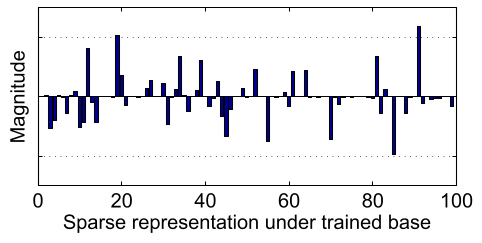 Figure: The bottom row shows how CCS's learned base produces a much "sparser" signal (fewer spikes) than the standard Fourier transform, making it easier to reconstruct from few samples.
Key Results
- Efficiency: 60% accuracy achieved with just 20% user participation.
- Superiority: CCS consistently beat Linear, Spline, and Kriging interpolation across all error margins ().
- Versatility: It worked for physical sensor data (Noise) and socio-economic data (Non-employer statistics) alike.
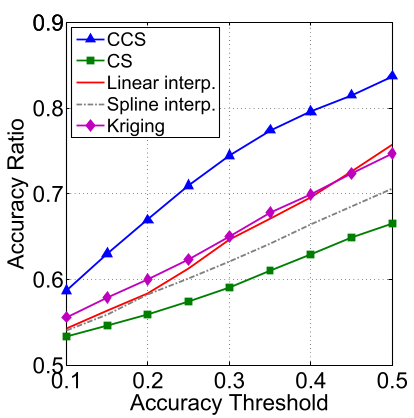 Figure: Across different urban scenarios, the red line (CCS) consistently stays above baselines, demonstrating higher accuracy at lower sampling rates.
Critical Insights & The Road Ahead
The "secret sauce" of CCS isn't just the math; it's the inductive bias that urban data is not random. It is highly structured by human behavior and city planning.
Limitations:
- Cold Start: CCS requires historical data to "learn" its initial base. If a city undergoes a sudden structural change (e.g., a pandemic or a major rezoning), the old base may fail.
- Missing Data: In very high-dimensional surveys, the resulting matrix can be "holey," requiring more advanced matrix completion techniques.
Conclusion
CCS represents a shift from "brute-force" crowdsourcing to "intelligent" crowdsensing. By understanding the underlying physics and logic of our cities, we can build systems that provide high-resolution insights while respecting the most valuable resource of the citizens: their time.