
Beyond Seed Selection: Optimizing Community Loyalty in Social Networks
Loyalty improvement beyond the seeds in social networks
This paper introduces the "Influence Improving" (ILMSN) task in modular social networks, which shifts focus from selecting seeds to optimizing the loyalty/influence of existing members. The authors formulate the problem under Independent Cascade (IC) and Linear Threshold (LT) models and propose greedy-based algorithms (EAIL) to maximize global community influence under a bounded budget.
TL;DR
While most research focuses on who to pick as initial influencers (seeds), this paper asks a different question: "Once the seeds are set, how do we invest in other members to maximize the total impact?" By treating influence as "loyalty" that can be boosted with a budget, the authors provide a new NP-hard framework and greedy algorithms that significantly outperform traditional heuristics in modular social networks.
Problem & Motivation: The Limitation of Seed-Only Strategies
In social network analysis, "Influence Maximization" is a classic problem: find nodes to start a viral trend. However, in real-world modular structures—like a corporation—the "seeds" (executives) are often fixed. The real challenge for a CMO or a community manager isn't just finding new seeds, but figuring out which "Common Users" (MUs) should be incentivized to strengthen their ties to the community.
The authors identify a gap: previous work treats edge weights as static. In reality, weights (loyalty) are variables that can be improved through targeted investment. This leads to the ILMSN (Improving Loyalty in Modular Social Networks) problem, which is mathematically harder because it involves cost-benefit optimization over a continuous or integer-stepped budget rather than a simple set selection.
Methodology: Bridging IC and LT Models
The paper tackles the problem across the two most prominent propagation models:
- Independent Cascade (IC) Model: Influence flows like a virus. The probability of node influencing is increased by investing in .
- Linear Threshold (LT) Model: A node is activated only if the sum of weights from its active neighbors exceeds a random threshold.
The Core Insights
The authors prove that ILMSN is NP-hard by reducing it to the Bounded Knapsack Problem (BKP). To solve it, they propose a two-stage approach:
- Phase 1 (Computation): Efficiently estimate the current influence of the community.
- Phase 2 (Allocation): A greedy strategy that selects nodes with the highest "Influence-to-Cost" ratio.
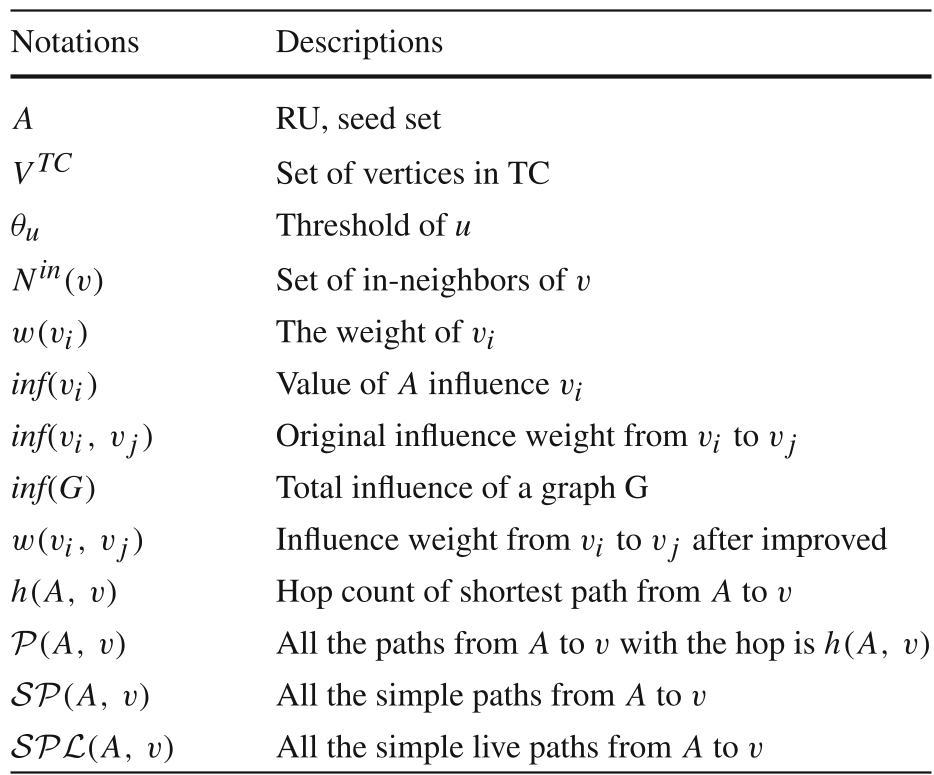 Table 1: Key notations defining the relationship between investment (x) and the resulting influence weight (w).
The mathematical intuition behind their ABIC and ABLT algorithms is to look not just at how much a node can be influenced, but how much that node amplifies the influence to its out-neighbors once its own loyalty is boosted.
Experiments & Results
The researchers tested their approach on the NetHEPT (arXiv co-authorship) and Enron Email datasets. They compared their algorithms against:
- Max Degree: Investing in high-connectivity "hubs."
- Node Weight Centrality: Investing in the "cheapest" nodes to maximize the number of people reached.
- Random: Baseline allocation.
Key Findings
- Efficiency: The proposed algorithms reached the saturation point of influence much faster than baselines.
- Budget Sensitivity: As the budget increases, the marginal gain of "Loyalty Improvement" follows a submodular-like curve (though submodularity itself is difficult to prove for this specific model).
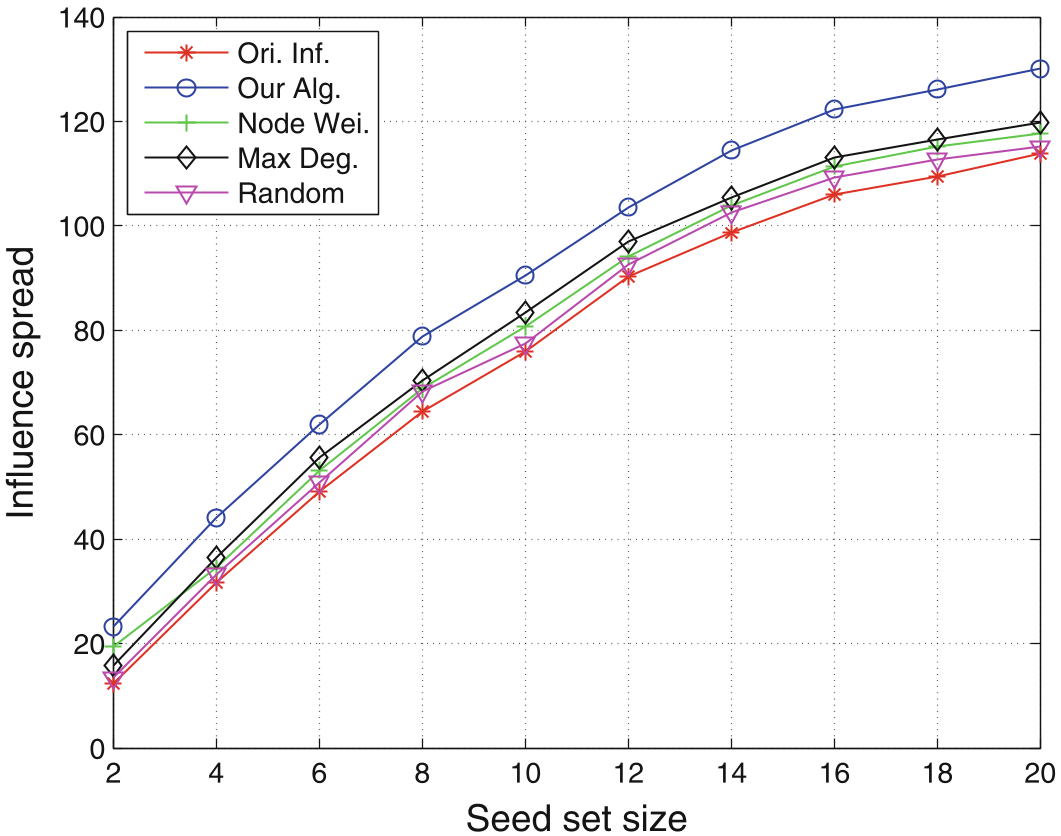 Figure 1: Influence spread as a function of Seed Set Size (left) and Budget (right) on the NetHEPT dataset.
The results clearly show that in both the IC and LT models, the "Our Alg" (EAIL) line stays consistently above the competition, proving that a specific greedy focus on the cost-effectiveness of weight improvement is superior to general network topology heuristics.
Critical Analysis & Conclusion
Takeaway
The shift from "targeting nodes" to "improving connections" is a powerful conceptual leap. It mirrors how modern digital marketing works—not just finding "influencers," but using ad spend to boost the "loyalty" (engagement rate) of existing followers.
Limitations
- Submodularity: The authors note that while their function behaves like a submodular function (diminishing returns), they haven't yet proven it. This means the current greedy algorithm lacks the 1-1/e approximation guarantee common in traditional Influence Maximization.
- Static Topography: The community structure is assumed to be stable, but in reality, social networks are highly dynamic.
Future Outlook
This work opens the door for Resource Allocation in Viral Marketing. Future research could integrate this with reinforcement learning to dynamically allocate budget in real-time as a social campaign unfolds across different network modules.